
Tag: news
-

Mandatory Signals: Switzerland’s Cyber Reporting Regime and the Case for a Global Model
Switzerland implemented mandatory cyberattack reporting for critical infrastructure on April 1, 2025, requiring rapid incident notification to enhance national cybersecurity resilience. The system emphasizes confidentiality, timely reporting, and operational thresholds. While promoting early warning and situational awareness, challenges remain in classification and processing capacity. Switzerland’s model offers valuable insights for other nations.
-
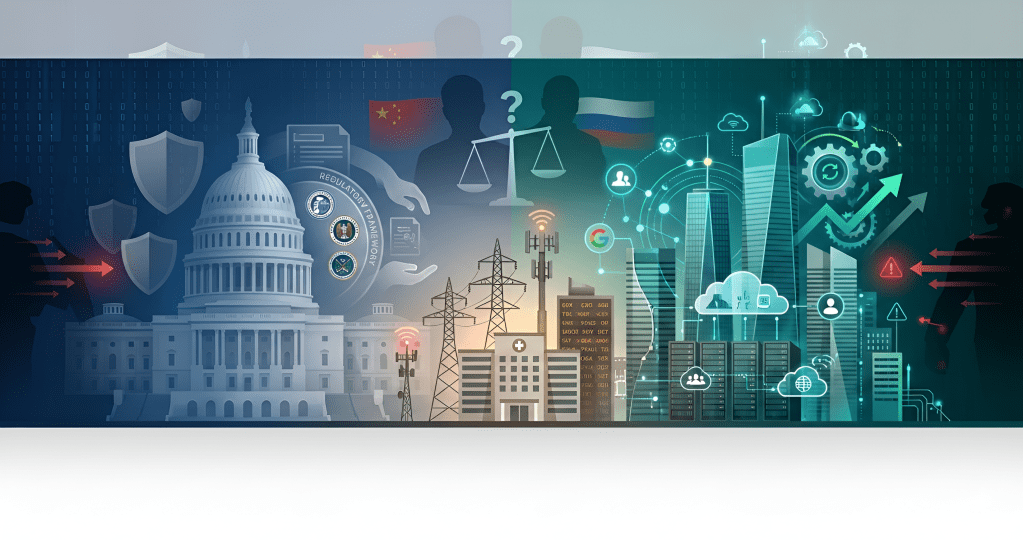
The New Equilibrium: How Trump’s Cybersecurity Doctrine Redefines Federal-Private Sector Relations
The 2026 shift in federal cybersecurity oversight, under the Trump administration, emphasizes reduced regulation while maintaining oversight. Executive Order 14306 preserves key security measures but eliminates mandatory vendor standards, reflecting a philosophical preference for market approaches. The administration faces challenges in balancing operational realities against strategic threats, requiring potential course corrections.
-
The Algorithmic Front: Cyber-Economic Warfare and the Future of Market Integrity
In November 2025, a European semiconductor firm hypothetically suffers a 14% market drop within minutes due to a sophisticated cyber-attack undermining market integrity. This incident symbolizes a broader shift towards cyber-economic warfare, where attackers exploit vulnerabilities, prompting urgent discussions on regulatory responses and the evolving relationship between security and financial markets in 2026.
-

The Architecture of Invisible Power
Vladimir Tsakanyan’s documentary, The Architecture of Invisible Power, examines how modern power operates subtly through technology and systems rather than overt authority. With a minimalist approach, it invites critical reflection on unseen influences, emphasizing intent and governance over simplistic narratives. The film provokes questions that linger beyond its runtime, encouraging deeper awareness.
-

Pax Silica: The New Architecture of Digital Solidarity and the Geopolitics of Compute
Pax Silica, a 21st-century doctrine introduced by the State Department, signifies a shift in global relations, prioritizing AI and supply chain security over traditional efficiency. This initiative fosters collaboration among allied nations to address technological dependencies while ensuring a competitive edge over China. It aims to establish “Digital Solidarity” and enhance international cooperation in technology.
-

The Silicon Shield: Analyzing the U.S.-Israel Strategic Partnership on AI and the New Geopolitics of Critical Technology
On January 15, 2026, the U.S. and Israel launched a strategic partnership focusing on artificial intelligence and critical technologies, redefining their bilateral relations. This integration aims to enhance security, innovation, and ethical governance amidst rising AI threats. The agreement signifies a transition into a collaborative technological ecosystem for democratic nations.
-

THE SHADOW ARCHITECTURE: DECODING THE SILENT SUBSTRATE OF GLOBAL POWER
The article discusses the evolution of power dynamics in the digital age, highlighting the emergence of “Shadow Architecture.” It examines incidents like Stuxnet and the Volt Typhoon campaign, demonstrating how cyber-kinetic threats target critical infrastructure. The call for better cybersecurity practices emphasizes the need to navigate a fractured digital landscape regulated by powerful tech entities.
-

New Defense Bill Fortifies U.S. Cyber Defenses and Personnel Support
The Fiscal Year 2026 NDAA introduces cybersecurity reforms for the Department of Defense aimed at modernizing its digital operations. Key provisions include enhanced mobile security for leaders, mandatory AI-focused training, prioritization of cyber personnel’s mental health, and improved governance on cybersecurity policies, streamlining contractor requirements, and protecting critical leadership structures.
-
The UK’s Digital Fortress: Everything You Need to Know About the Landmark Cyber Security and Resilience Bill
The UK has introduced the Cyber Security and Resilience (CSR) Bill, significantly enhancing digital defense against cyber threats. This legislation mandates strict standards for cybersecurity across critical infrastructure, expanding regulatory oversight, and enforcing rapid incident reporting. With tougher penalties for non-compliance, the aim is to bolster protection for essential services and foster trust in digital…
-
The New Front Line: 5 Steps States Must Take to Survive the Current Wave of Public Sector Cyberattacks
Recent events highlight a dire state of public sector cybersecurity, marked by notable attacks on the CBO and Nevada’s ransomware breach. States face increasing threats from nation-state actors and human error, necessitating proactive measures like advanced training, multi-factor authentication, centralized IT security, cyber insurance, and partnerships with federal agencies for enhanced protection.
