
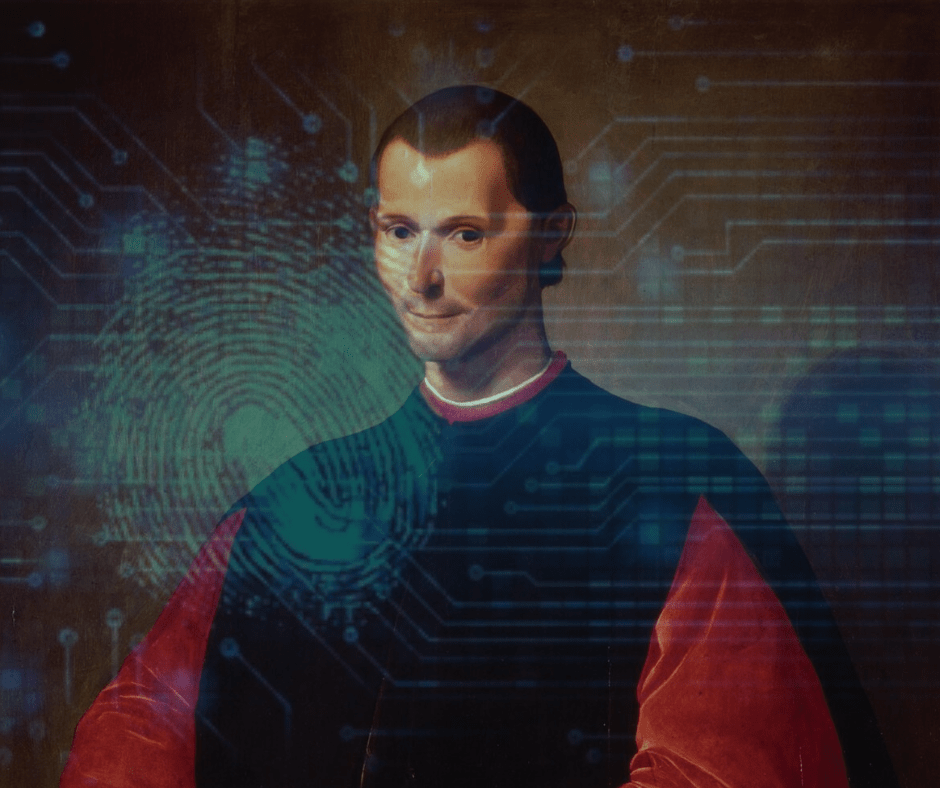
In the chaotic world of 15th and 16th century Italy, Niccolò Machiavelli penned The Prince, a ruthless and pragmatic guide to power. He argued that for a ruler to maintain his state, he must abandon abstract morals and embrace the cold, hard logic of what works. He must be concerned not with how the world ought to be, but with how it is.
Five hundred years later, the landscape has changed from city-states and mercenary armies to nation-states and digital battlefields. Yet, if Machiavelli were alive today, he would find the world of cybersecurity politics disturbingly familiar. The principles of power, deception, and survival he outlined apply with chilling accuracy to the shadowy conflicts waged in cyberspace.
Here’s how the Florentine philosopher would analyze our modern digital predicament.
On Virtuˋ vs. Fortuna: The Eternal Cyber Struggle
Machiavelli’s world was governed by two forces: $Virtù$, meaning skill, prowess, and the ability to impose one’s will on events; and $Fortuna$, the unpredictable goddess of luck and circumstance. A successful prince, he argued, uses his $Virtù$ to prepare for and mitigate the blows of $Fortuna$.
In cybersecurity, $Virtù$ is a nation’s or a corporation’s proactive cyber capability. It is the development of a skilled cadre of cyber defenders and attackers, the construction of resilient networks, the mastery of encryption, and the stockpiling of offensive exploits. It is the foresight to build systems that can withstand an attack and the strength to strike back.
$Fortuna$, on the other hand, is the zero-day vulnerability discovered by an adversary. It is the unpredictable actions of a rogue hacktivist group, a global ransomware strain that emerges from nowhere, or the single employee who clicks on a sophisticated phishing link. No amount of defense can eliminate $Fortuna$ entirely. Therefore, a modern Digital Prince must constantly exercise $Virtù$—running drills, patching systems, and gathering intelligence—to build a dam against the inevitable flood of misfortune.
It is Better to Be Feared Than Loved
This is perhaps Machiavelli’s most infamous piece of advice. He argued that while it would be best to be both feared and loved, the two rarely coincide. Since a choice must be made, it is safer to be feared, as fear is a more reliable motivator than affection.
Consider the international stage. Nations can pursue a “loved” strategy: championing a free and open internet, promoting international norms, and engaging in collaborative diplomacy. These are noble goals.
However, a Machiavellian analyst would point to the actions of states known for their formidable offensive cyber capabilities. The quiet fear inspired by the knowledge that a nation can disrupt your power grid, steal your intellectual property, or cripple your financial systems is a powerful deterrent. Stuxnet, which sabotaged Iran’s nuclear program, was not an act of love; it was an act of coercive fear. From this perspective, a nation that unilaterally disarms its cyber weapons in the name of goodwill is not virtuous, but foolish, leaving itself vulnerable to those who will not do the same.
The Danger of Mercenaries and Auxiliary Arms
Machiavelli had a deep distrust of mercenaries—hired soldiers who fought for money, not loyalty. He found them “useless and dangerous,” as their allegiance was always to the highest bidder.
What are the mercenaries of the 21st century? One could argue they are the ubiquitous third-party software and hardware that form the backbone of our digital infrastructure. When a nation or a critical industry builds its systems entirely on foreign-made code or hardware (from a geopolitical rival, no less), it is placing its security in the hands of others. Is the code secure? Does it have a hidden backdoor? Can the vendor be trusted when political tensions rise?
Machiavelli would advocate for sovereign capability. A wise Digital Prince cultivates a domestic technology industry, fosters open-source solutions that can be audited, and invests in training his own citizens to defend the digital realm. To outsource the state’s core security functions is to invite betrayal.
The Art of Deception: Appearing Virtuous
For Machiavelli, a prince need not possess all the good qualities, but he “must appear to have them.” The appearance of being merciful, faithful, humane, and religious was a political tool.
This is the daily reality of cyber-geopolitics. Nations routinely sign treaties decrying cyber espionage and attacks on civilian infrastructure. In public forums, they speak the language of international law and cooperation. Yet, in the shadows, their intelligence agencies are engaged in a relentless campaign of digital espionage, exploit development, and strategic positioning for future conflicts.
The modern prince must appear committed to digital peace while preparing for digital war. This duality is not hypocrisy; in a Machiavellian framework, it is a necessary strategy for survival in a system where trust is a liability and capability is everything.
The Realist’s Conclusion
Looking at our world, Machiavelli would not be surprised. He would see the ransomware attacks on hospitals, the state-sponsored theft of intellectual property, and the disinformation campaigns not as aberrations, but as the logical outcomes of a struggle for power in a new domain.
His analysis offers us a sobering, if uncomfortable, lens. It suggests that hoping for a utopian digital world based purely on trust and goodwill is naïve. Security, he would argue, comes from strength, foresight, and a healthy dose of paranoia. The Digital Prince who rules a successful state in the 21st century must be part fox to recognize the traps, and part lion to frighten the wolves.

Leave a comment