
Introduction
The stability of U.S. digital defense is currently defined by a striking paradox: while the threat landscape—characterized by aggressive Advanced Persistent Threat (APT) actors) from nations like China—is at its most sophisticated, the federal capacity to counter it is at its most degraded. As of October 2025, this vulnerability is not a technical failure but a direct consequence of legislative paralysis and deliberate political brinkmanship. The calculated, simultaneous lapse of a critical information-sharing law and the mass furlough of the nation’s primary cyber defense workforce have created a strategic vulnerability that adversaries are actively exploiting. This analysis provides a deep dive into the political dynamics, revealing how the mechanisms of American governance—the appropriations process and legislative sunset clauses—have been weaponized, subordinating critical national cyber resilience to domestic political disputes.
The Opportunity for Legislative Renewal: CISA 2015
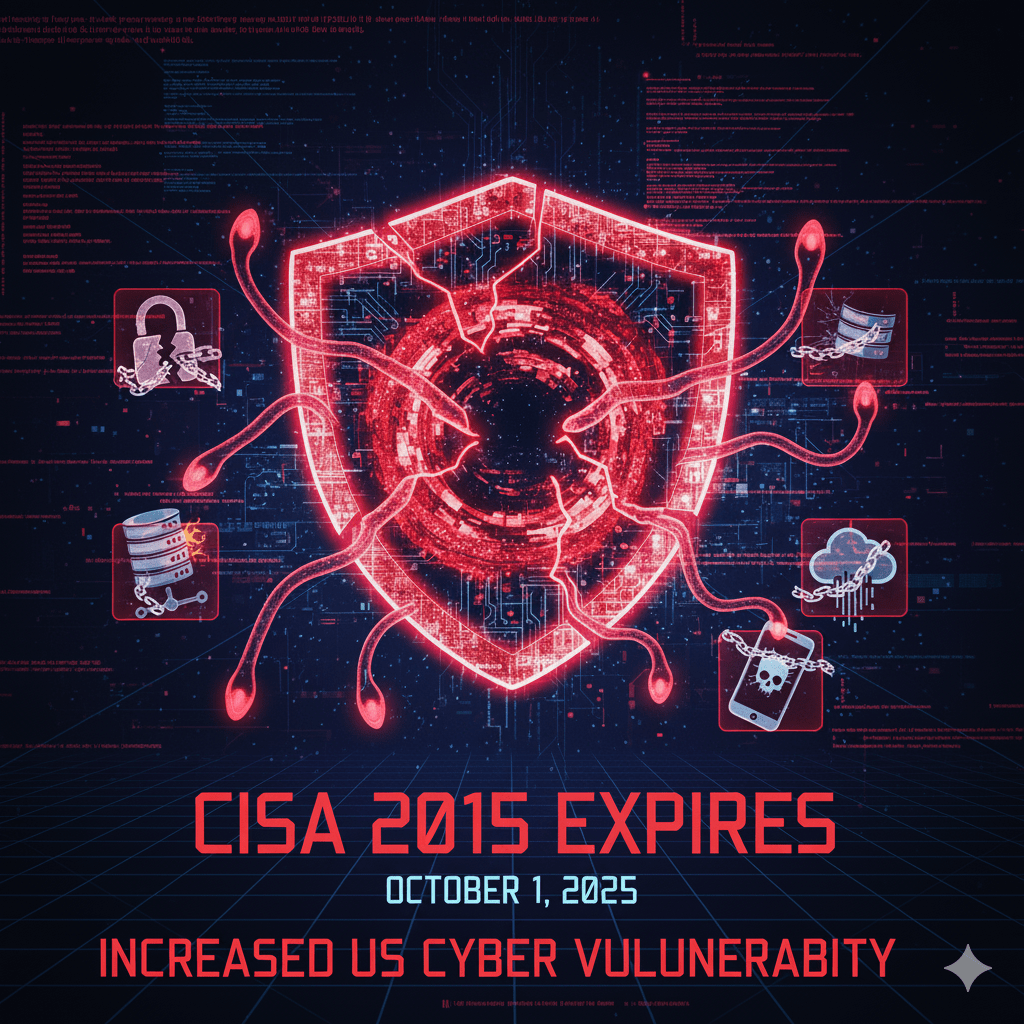
The Cybersecurity Information Sharing Act of 2015 (CISA 2015) established the critical legal framework for the voluntary exchange of threat intelligence between the private sector and the federal government. The recent expiration of this law on October 1, 2025, while creating temporary legal uncertainty, provides a valuable opportunity for Congress to reaffirm its commitment to robust public-private partnership.
Reaffirmation of Collaborative Defense
Despite broad, bipartisan industry and agency support for a long-term renewal, the expiration occurred due to legislative disputes over the scope and authority of the CISA agency, primarily concerning its activities outside of core infrastructure protection [1, 5]. This legislative pause allows policymakers to refocus the debate solely on the core value of CISA 2015: providing the essential liability and antitrust immunities that encourage companies to share sensitive cyber threat indicators [3].
By returning to a clean, consensus-driven reauthorization, Congress can swiftly restore the legal certainty necessary to foster this collaboration. The goal is to move beyond the ideological disputes—which saw the law used as a “veto-point”—and implement a decade-long extension that solidifies the foundation of collective defense. Reauthorization would instantly unlock the flow of critical intelligence, demonstrating political unity on a fundamental national security priority [1, 4].
Prioritizing Operational Stability: CISA’s Mandate
The recent temporary disruption to federal funding served as a powerful reminder of the importance of insulating critical security functions from procedural deadlines. The fact that the Cybersecurity and Infrastructure Security Agency (CISA), the nation’s lead civilian cyber defense agency, was required to furlough approximately 65% of its workforce due to the federal appropriations lapse, highlights an area ripe for positive structural reform [2, 6].
Ensuring Continuous Capability
The essential mission of CISA—defending the electric grid, water supply, and other critical infrastructure—demands continuous, 24/7 operation. The high furlough rate within CISA, contrasted with the low rates in other components of the Department of Homeland Security (DHS), shows a need for recalibration in political priorities [7].
Congress now has the clear mandate to:
- Establish Excepted Status: Formally designate all core CISA and National Institute of Standards and Technology (NIST) functions as fully “excepted” and funded to operate continuously, regardless of the budget cycle [6].
- Support the Workforce: Providing stable funding removes the threat of furlough, which is essential for retaining and recruiting the highly specialized talent needed for cyber defense, thereby ensuring workforce strength and morale [2].
By creating budgetary certainty, policymakers can transition CISA from operating on an emergency footing during budget disputes to functioning as a fully continuous and proactive digital defense force. This move will send a powerful signal of commitment to adversaries and allies alike.
Political Analysis: The Structural Friction in Cyber Governance
The lapse of CISA 2015 and the mass furlough of the CISA workforce are not random administrative failures but the predictable result of deep structural friction within the U.S. political system. This friction arises from a fundamental and polarized disagreement over the appropriate role of the federal government in digital life, which is then exacerbated by weaponized legislative procedures.
The Sunset Clause and Ideological Vetoes
The fact that CISA 2015 contained a sunset clause—a built-in expiration date—is in itself a political statement. It reflects a deep-seated philosophical division in Congress over granting the Executive Branch permanent, expansive information-collection authority, even in the name of national security. The sunset clause forces Congress to periodically debate and reaffirm this authority, providing a crucial leverage point for ideological opposition [1].
In this cycle, the reauthorization was not blocked over its core cybersecurity provisions, which enjoy near-universal support (e.g., liability shields). Instead, it was blocked by senators, notably Senator Rand Paul (R-Ky.), who demanded unrelated policy riders—specifically, new restrictions on CISA’s “Mis-, Dis-, and Malinformation (MDM)” activities [1]. These critics argue that CISA’s involvement in moderating online content constitutes “mission creep” and an unconstitutional infringement on free speech, as detailed in recent House Judiciary Committee reports [2.3, 2.4].
The political effect is that a vital, consensus-driven national security law became a hostage to a partisan First Amendment debate. The failure to separate the technical necessity of threat sharing from the ideological fight over government-led content moderation highlights a critical structural flaw: the U.S. governance model lacks a political mechanism to ring-fence essential national security functions from unrelated domestic policy disputes. The result is policy paralysis where a single ideological objection can override the collective security consensus.
Weaponizing the Purse: Appropriations as Policy Control
The operational crisis at CISA—the 65% furlough rate—is a direct consequence of Congress’s failure to pass a budget and the subsequent reliance on a Continuing Resolution (CR) or a full government shutdown. This appropriations process has been weaponized, transforming what should be a technical funding mechanism into a powerful tool for policy control by a minority [6].
- The Power of Minority Rule: The threat of a government shutdown gives a small number of lawmakers the leverage to impose their will on the entire appropriations package. By threatening to halt all government funding, they can force the Office of Management and Budget (OMB) and agencies like DHS to make painful cuts, disproportionately targeting agencies they perceive as hostile or unnecessary.
- Disproportionate Targeting: The fact that CISA furloughs (65%) were vastly higher than the DHS average (around 5%), and significantly higher than agencies like Immigrations and Customs Enforcement (ICE), reveals a conscious political prioritization [7]. This differential furloughing is a form of executive-branch policy enforcement by budget cut, signaling which functions are deemed truly “essential” (e.g., border enforcement) and which are politically expendable (e.g., civilian cyber defense) in a time of crisis [6]. This lack of continuity severely degrades the government’s ability to act on “cyber-relevant timeframes”—which demand immediate, 24/7 responsiveness—instead subordinating it to bureaucratic, annual “government timelines” [3.3].
The political message to adversaries is clear: U.S. digital defenses are cyclically vulnerable—they are strong when Congress is working, and functionally blind when it is not. The furloughing decision makes CISA’s workforce, already struggling with retention against the private sector, feel politically targeted, further driving the risk of ‘brain drain’ into more stable, better-resourced private roles [4.2].
Forward Momentum: Strengthening the Collective Defense Model
The challenges presented by the expiration of CISA 2015 and the temporary government funding lapse are, fundamentally, calls to action for political leadership. By moving past legislative friction and enacting the necessary structural reforms, Congress can solidify the legal foundations of information sharing and ensure the continuous operation of the nation’s key cyber defense agencies. This is not simply a matter of restoring the status quo, but of establishing a more resilient, stable, and unified national cyber posture for the future.
References
[1] Cybersecurity Dive. Landmark US cyber-information-sharing program expires, bringing uncertainty. October 1, 2025.
[2] The Washington Post. Shutdown guts U.S. cybersecurity agency at perilous time. October 2, 2025.
[3] Nextgov/FCW. Vital cyber data-sharing law appears likely to expire amid looming government shutdown. September 26, 2025.
[4] The World Economic Forum. Key US cyber law expires, and other cybersecurity news. October 3, 2025.
[5] Byte Back. CISA 2015: Congress Faces Fast-Approaching Deadline to Reauthorize a Critical Cybersecurity Law. August 14, 2025.
[6] BankInfoSecurity. Shutdown Snares Federal Cybersecurity Personnel. October 1, 2025.
[7] The Washington Post. What’s affected by the government shutdown. October 1, 2025.
[8] CNN. Hackers breach US government. September 25, 2025.
[2.3] House Judiciary Committee. The Weaponization of CISA: How a ‘Cybersecurity’ Agency Colluded with Big Tech and ‘Disinformation’ Partners to Censor Americans. June 26, 2023.
[2.4] House Judiciary Committee. THE WEAPONIZATION OF “DISINFORMATION” PSEUDO-EXPERTS AND BUREAUCRATS. November 6, 2023.
[3.3] United States Courts. Judicial Conference Briefed on the Need for Continued Vigilance on Cybersecurity and Workplace Conduct. September 17, 2024.
[4.2] Cybersecurity Dive. CISA to furlough 65% of staff if government shuts down this week. September 29, 2025.

Leave a comment