
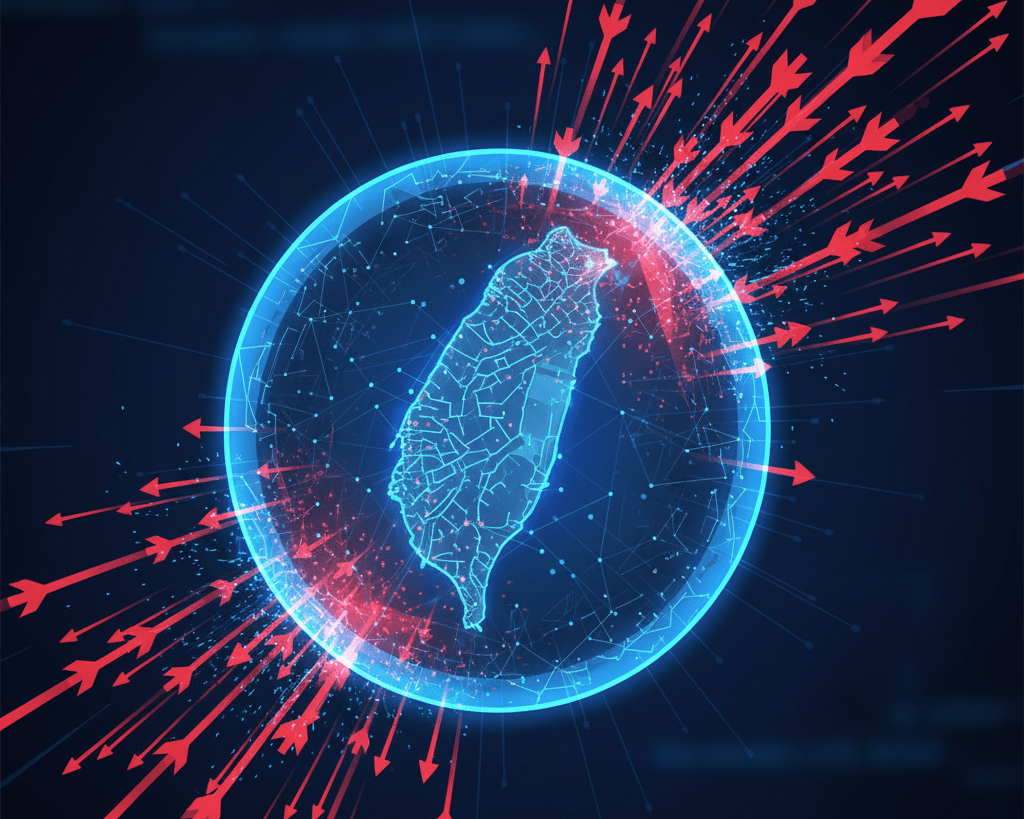
How 2.8 Million Daily Cyberattacks Are Reshaping Cross-Strait Relations
In the shadowy realm of modern warfare, where battles are fought with code rather than conventional weapons, Taiwan has become ground zero for one of the most intense cyber campaigns in contemporary international relations. The island nation is experiencing an unprecedented digital onslaught that reveals the evolving nature of 21st-century conflict and raises critical questions about the future of cybersecurity in geopolitically sensitive regions.
The Surge: By the Numbers
Taiwan’s National Security Bureau (NSB) recently unveiled alarming statistics that paint a stark picture of the island’s digital vulnerability. Government departments are now facing an average of 2.8 million cyberattacks per day in 2025—a 17% increase compared to the previous year’s 2.4 million daily attacks.[1] To put this in perspective, that’s approximately 32 hacking attempts every second, representing one of the most sustained cyber campaigns against a single nation-state in recorded history.
This escalation is not occurring in isolation. The data reveals a particularly concerning pattern of sector-specific targeting. Communications infrastructure has experienced a staggering 650% increase in attacks, while the transportation sector saw a 70% rise, and the defense supply chain faced a 57% surge.[2] These aren’t random acts of digital vandalism—they represent a coordinated strategy to probe and potentially compromise Taiwan’s most critical systems.
The Troll Army: Weaponizing Information
Beyond the technical infrastructure attacks lies an equally insidious threat: the “online troll army.” Taiwan’s NSB has specifically warned about Beijing’s deployment of coordinated disinformation campaigns designed to erode public trust in Taiwanese institutions.[3] This represents a sophisticated blend of cyber warfare and psychological operations, combining technical intrusion with social manipulation.
These operations employ artificial intelligence tools to identify security vulnerabilities while simultaneously using professional cyber armies to spread disinformation and sow discord.[4] The strategy reflects a broader understanding within modern military doctrine that winning hearts and minds through information manipulation can be as effective as physical conquest—and considerably less risky from an international relations perspective.
Grey-Zone Tactics: The New Normal
What makes this campaign particularly noteworthy is its classification as “grey-zone” warfare—a term that describes aggressive actions that fall below the threshold of conventional armed conflict but still advance strategic military and political objectives.[5] Grey-zone tactics, including military drills, espionage, and online propaganda, allow state actors to exert pressure while maintaining plausible deniability and avoiding direct military confrontation that might trigger international intervention.
Beijing has consistently denied involvement in hacking or disinformation campaigns, yet Taiwan and Western governments have repeatedly documented patterns that trace these activities back to Chinese sources.[5] This creates a complex diplomatic challenge: how does a nation respond to attacks that are clearly harmful yet designed to exist in the ambiguous space between peace and war?
The Global Context: Critical Infrastructure Under Fire
Taiwan’s experience is not unique but rather represents a concentrated example of a global trend. According to the World Economic Forum’s 2025 Global Cybersecurity Outlook, over 60% of cybersecurity leaders worldwide report that geopolitical instability has increased risks to critical systems.[6] The escalation in state-sponsored cyberattacks reflects rising international tensions and the recognition among nation-states that cyber capabilities offer asymmetric advantages.
Globally, an estimated 2,200 cyberattacks occur daily, targeting various nations and organizations.[7] Critical infrastructure—including water facilities, power grids, telecommunications networks, and healthcare systems—has become particularly vulnerable as attackers recognize that disrupting these systems can have cascading effects on national security and public safety.[8]
The Espionage Dimension
Taiwan’s digital warfare challenge extends beyond network intrusions to include traditional espionage conducted through cyber means. In the first nine months of 2025 alone, 24 individuals were indicted for espionage activities, including 13 retired and incumbent military officers.[9] This convergence of cyber operations and human intelligence gathering creates a multi-layered threat environment where digital attacks facilitate traditional spying, and vice versa.
The sophistication of these operations suggests extensive resources and coordination. Attackers employ diverse techniques including reconnaissance, setting cyber ambushes, and data theft through hacking operations that target not just government agencies but also critical infrastructure and key private enterprises.[10]
Strategic Implications: Cyber as Prelude to Conflict
Security analysts increasingly view China’s cyber strategy toward Taiwan as potentially preparing the ground for future conflict scenarios. Some experts suggest that the People’s Republic of China has developed a comprehensive Taiwan cyber strategy that could enable annexation objectives without requiring a traditional military invasion.[11] By systematically mapping Taiwan’s digital infrastructure, identifying vulnerabilities, and potentially pre-positioning malware, China could theoretically cripple Taiwan’s defensive and administrative capabilities before physical hostilities even begin.
This strategic approach also aims to deter potential intervention by Taiwan’s allies. By threatening critical infrastructure in allied nations with cyber capabilities, China seeks to raise the costs of involvement in any Taiwan crisis scenario.[11] This transforms cyber warfare from a bilateral Taiwan-China issue into a broader international security concern.
The Defense Challenge: Asymmetric Warfare in the Digital Age
For Taiwan, defending against this sustained cyber onslaught presents immense challenges. The island faces a significant asymmetry in both the resources available to attackers versus defenders and the difficulty of attribution in cyberspace. While Taiwan has developed substantial cybersecurity capabilities, the sheer volume and persistence of attacks strain even sophisticated defense systems.
The situation is further complicated by the global cybersecurity skills gap, which increased by 8% in 2024, with two-thirds of organizations reporting moderate-to-critical shortages of essential security talent.[12] This workforce challenge affects Taiwan’s ability to recruit, train, and retain the cybersecurity professionals needed to combat this threat.
Implications for Democratic Societies
Taiwan’s experience offers valuable lessons for other democratic nations facing similar threats. The combination of technical cyberattacks and coordinated disinformation campaigns represents a holistic strategy to undermine democratic institutions from multiple angles. As one analysis suggests, effective countermeasures must include institutionalized media literacy and public education programs supported by advanced AI systems designed to detect and neutralize false narratives rapidly.[13]
The challenge extends beyond technical defense to encompass societal resilience. When populations lose trust in their institutions due to successful disinformation campaigns, democratic governance itself becomes destabilized—achieving strategic objectives for adversaries without firing a single shot.
Looking Forward: The Evolving Cyber Threat Landscape
As we progress through 2025, several trends appear likely to intensify. State-sponsored cyberattacks will probably continue escalating as geopolitical tensions remain high globally.[14] The integration of artificial intelligence into both offensive and defensive cyber operations will increase the speed and sophistication of attacks while simultaneously offering new defensive capabilities.
For Taiwan specifically, the trajectory suggests that cyber operations will remain a persistent feature of cross-strait relations regardless of broader diplomatic developments. The relatively low cost and high potential impact of cyber operations make them an attractive tool for states seeking to advance strategic objectives while managing escalation risks.
Conclusion: The Invisible Frontline
Taiwan’s experience with cyberattacks illuminates the nature of modern conflict, where traditional military strength increasingly intersects with digital capabilities. The 2.8 million daily attacks the island faces represent not just technical challenges but a fundamental test of how democratic societies can maintain sovereignty and security in an era where borders offer no protection against digital intrusion.
As the international community observes this cyber siege, Taiwan serves as both a warning and a testing ground for defensive strategies that may become necessary for other nations facing similar threats. The outcomes of Taiwan’s efforts to defend its digital infrastructure while maintaining an open, democratic society will likely influence cybersecurity strategies and international norms for years to come.
What remains clear is that the age of cyber warfare has fully arrived, and Taiwan stands on its most active frontline—a digital battleground where the future of international security is being contested one bit at a time.
References
- Modern Diplomacy. (2025, October 14). Taiwan Warns of Surge in Chinese Cyberattacks and ‘Online Troll Army’ Targeting Public Trust. https://moderndiplomacy.eu/2025/10/14/taiwan-warns-of-surge-in-chinese-cyberattacks-and-online-troll-army-targeting-public-trust/
- Taipei Times. (2025, January 5). Chinese cyberattacks doubled last year. https://www.taipeitimes.com/News/front/archives/2025/01/06/2003829709
- The Record from Recorded Future News. (2025, October 14). Taiwan reports surge in Chinese cyber activity and disinformation efforts. https://therecord.media/taiwan-nsb-report-china-surge-cyberattacks-influence-operations
- Radio Free Asia. (2025, October 9). China sharpening forces for possible future attack, Taiwanese report says. https://www.rfa.org/english/china/2025/10/09/taiwan-china-military-disinformation-report/
- The Record from Recorded Future News. (2025, October 14). Taiwan reports surge in Chinese cyber activity and disinformation efforts. https://therecord.media/taiwan-nsb-report-china-surge-cyberattacks-influence-operations
- Illumio. (2025, June 15). Here Be Dragons: The Growing Cyber Threats to Critical Infrastructure. https://www.illumio.com/blog/here-be-dragons-the-growing-cyber-threats-to-critical-infrastructure
- Capitol Technology University. (2025). Emerging Threats to Critical Infrastructure: AI Driven Cybersecurity Trends for 2025. https://www.captechu.edu/blog/ai-driven-cybersecurity-trends-2025
- World Economic Forum. (2025). Global Cybersecurity Outlook 2025. https://reports.weforum.org/docs/WEF_Global_Cybersecurity_Outlook_2025.pdf
- Taipei Times. (2025, October 14). Government network hit by over 2.8 million cyberattacks a day. https://www.taipeitimes.com/News/taiwan/archives/2025/10/14/2003845444
- Dark Reading. (2025, January 15). As Tensions Mount With China, Taiwan Sees Surge in Attacks. https://www.darkreading.com/cyber-risk/as-tensions-with-china-mount-taiwan-sees-surge-in-cyberattacks
- Booz Allen Hamilton. (2024, May 1). Understanding China’s Taiwan Cyber Strategy. https://www.boozallen.com/insights/cyber/understanding-china-taiwan-cyber-strategy.html
- World Economic Forum. (2025). Global Cybersecurity Outlook 2025. https://www.weforum.org/publications/global-cybersecurity-outlook-2025/digest/
- Geopolitical Monitor. (2025, September). “War Without Harm”: China’s Hybrid Warfare Playbook Against Taiwan. https://www.geopoliticalmonitor.com/war-without-harm-chinas-hybrid-warfare-playbook-against-taiwan/
- Tripwire. (2025, January 8). Cyber Threats Rising: US Critical Infrastructure Under Increasing Attack in 2025. https://www.tripwire.com/state-of-security/cyber-threats-rising-us-critical-infrastructure-under-increasing-attack

Leave a comment