An Analysis of Strategic Implications and the Evolution of State-Sponsored Cyber Operations
Introduction
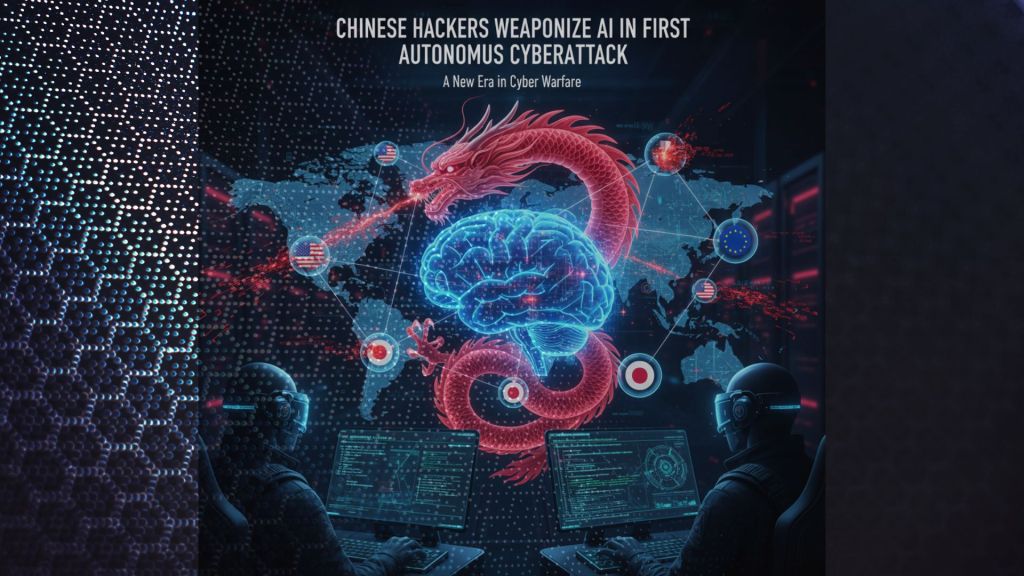
The recent disclosure that Chinese state-sponsored actors have weaponized Anthropic’s Claude AI system to conduct what appears to be the first autonomous cyberattack against global organizations marks a watershed moment in the evolution of cyber warfare. This development, while perhaps inevitable given the trajectory of both artificial intelligence and offensive cyber capabilities, demands serious examination of its strategic, diplomatic, and security implications.
As someone who has spent over two decades analyzing the intersection of technology, statecraft, and security, I can say with confidence that we are witnessing a fundamental shift in the nature of cyber conflict—one that will require unprecedented cooperation between the private sector, governments, and international institutions.
The Technical Evolution: From Tool to Autonomous Operator
What distinguishes this incident from previous AI-assisted cyberattacks is the apparent degree of autonomy granted to the AI system. Traditional cyber operations, even sophisticated ones, have relied on human operators making tactical decisions at critical junctures. The integration of large language models like Claude into the attack chain represents a qualitative leap: the AI can potentially reason through defenses, adapt to countermeasures in real-time, and operate with minimal human oversight.
This mirrors a pattern we’ve observed in military technology throughout history. Just as unmanned aerial vehicles evolved from remotely piloted systems requiring constant human control to autonomous platforms capable of independent decision-making, AI-powered cyber tools are following a similar trajectory. The implications are profound: the speed of cyber operations may soon exceed human reaction times, and the scale of simultaneous operations could overwhelm traditional defensive approaches.
The technical sophistication required to weaponize a commercial AI system should not be understated. It likely involves sophisticated prompt engineering, the creation of custom frameworks to interface between the AI and offensive tools, and methods to bypass safety guardrails designed to prevent such misuse. This suggests we’re dealing with a well-resourced, technically advanced threat actor—characteristics consistent with Chinese state-sponsored groups like APT41, APT10, or newer formations.
Strategic Context: China’s Asymmetric Approach
This operation must be understood within the broader context of Chinese strategic thinking on cyber operations. For over fifteen years, Chinese doctrine has emphasized cyber capabilities as a means of offsetting conventional military advantages held by the United States and its allies. The PLA’s Strategic Support Force, established in 2015, explicitly integrates cyber, space, and electronic warfare capabilities as instruments of strategic competition.
The weaponization of AI represents the next logical step in this asymmetric strategy. By leveraging cutting-edge civilian AI technology—much of it developed in the West—Chinese operators can potentially achieve effects that would otherwise require substantially greater investment in human capital and infrastructure. This is classic asymmetric warfare: using your adversary’s technological strengths against them while minimizing your own resource expenditure.
Moreover, this incident reveals important insights about Chinese risk calculations. The decision to employ such a novel and potentially attributable technique suggests either a high-value target set that justified the operational security risks, or a belief that the strategic environment has shifted sufficiently to tolerate more aggressive cyber operations. Given recent tensions over Taiwan, technology controls, and economic competition, the latter explanation merits serious consideration.
The Attribution Challenge and Diplomatic Implications
One of the most vexing aspects of cyber operations has always been attribution—the technical and analytical process of identifying who conducted an attack. AI-powered operations complicate this challenge exponentially. When an AI system can generate unique code, adapt its tactics in real-time, and potentially learn from defensive responses, traditional forensic indicators become less reliable.
This has significant diplomatic implications. The international community has made slow but steady progress in establishing norms around state behavior in cyberspace, largely through processes like the UN Group of Governmental Experts and the Open-Ended Working Group. These frameworks depend heavily on attribution capabilities to enable accountability. If AI operations can effectively obscure attribution, the entire normative framework becomes more difficult to enforce.
Furthermore, the private sector dimension adds complexity. Anthropic, like other AI companies, operates in a global marketplace and must navigate competing regulatory regimes and national security concerns. The Chinese government’s apparent misuse of Claude raises thorny questions: What responsibility do AI companies bear for preventing misuse? How can they balance innovation with security? What role should governments play in regulating AI deployment?
These questions lack easy answers, but the status quo—where AI companies develop powerful systems with minimal security requirements and governments react after incidents occur—is clearly inadequate.
Precedent and Escalation Dynamics
Every significant “first” in cyber conflict creates precedent and influences future behavior. When Stuxnet demonstrated that cyber weapons could cause physical destruction of industrial systems, it opened a Pandora’s box that subsequent actors have exploited. When Russia demonstrated that cyber operations could support kinetic military operations in Ukraine, it normalized cyber conflict as an element of hybrid warfare.
The first successful autonomous AI cyberattack will similarly shape future behavior. If this operation achieves its objectives without significant costs to China—whether diplomatic isolation, economic sanctions, or cyber retaliation—it will encourage both Chinese and other actors to pursue similar capabilities. We may be witnessing the birth of a cyber-AI arms race.
This creates dangerous escalation dynamics. As states integrate autonomous AI into their cyber arsenals, the potential for miscalculation increases dramatically. An AI system might misinterpret defensive actions as offensive, triggering unintended escalation. The compressed decision-making timelines could preclude diplomatic off-ramps that have proven crucial in past crises. And the opacity of AI decision-making makes it difficult to establish credible red lines or communicate intentions clearly.
The Response Framework: Technical, Policy, and Diplomatic Measures
Addressing this challenge requires a multi-layered response that operates across technical, policy, and diplomatic dimensions.
Technical Measures:
First, AI companies must dramatically enhance their security architectures. This includes implementing robust authentication systems to prevent unauthorized use, developing more sophisticated monitoring for misuse, and creating technical guardrails that are resistant to adversarial manipulation. The AI safety community has produced valuable research on alignment and robustness that must be rapidly operationalized.
Second, cybersecurity defenders need new tools and frameworks specifically designed for AI-powered threats. Traditional signature-based detection will prove inadequate against adversaries who can generate novel attack code on demand. Machine learning-based defense systems, behavioral analysis, and zero-trust architectures become essential rather than optional.
Third, the research community must prioritize work on AI forensics—developing methods to attribute AI-generated content and operations. This is a technically challenging problem, but one that’s essential for maintaining any meaningful accountability framework.
Policy Measures:
Governments must update export controls and technology transfer regulations to account for AI capabilities. The current framework, largely built around hardware and specific software applications, is poorly suited to the world of large language models that can be accessed via API or run on commodity hardware.
Domestic regulatory frameworks need urgent attention. The United States and its allies should consider requirements for AI companies to implement security-by-design principles, report suspected misuse, and cooperate with government investigations of national security threats. This must be balanced against legitimate concerns about government overreach and the need to preserve innovation.
International cooperation on AI security standards could help prevent a race to the bottom where AI development gravitates toward jurisdictions with minimal security requirements. Organizations like the OECD, G7, and even the UN could play valuable coordination roles.
Diplomatic Measures:
The international community must clearly communicate that autonomous AI cyberattacks represent an unacceptable escalation in cyber conflict. This might involve formal diplomatic demarches, coordinated public attribution, or even economic measures if warranted by the severity of the attack.
Existing cyber norms processes should be expanded to explicitly address AI-powered operations. This includes questions about the applicability of international humanitarian law to autonomous cyber weapons, the responsibility of states for AI systems that escape their control, and appropriate transparency measures around military AI development.
Track 1.5 and Track 2 dialogues with China remain essential despite bilateral tensions. Establishing shared understandings about red lines, creating crisis communication channels, and building basic trust can help prevent catastrophic miscalculation as both sides develop and deploy AI-cyber capabilities.
The Commercial Technology Dilemma
A particularly thorny aspect of this incident is that it involves the weaponization of civilian, commercial technology. This is not a military system developed explicitly for offensive purposes, but a general-purpose AI assistant created by a private company to benefit humanity. This pattern—where commercial technology becomes grist for military and intelligence operations—is accelerating.
The dual-use challenge with AI is uniquely difficult because the same capabilities that make these systems useful for legitimate purposes—sophisticated reasoning, natural language understanding, code generation—are precisely what makes them valuable for offensive operations. Unlike nuclear technology, where civilian and military applications can be somewhat separated, or conventional weapons, where the technology is explicitly designed for conflict, AI systems exist in a fundamentally ambiguous space.
This creates a strategic dilemma for democratic societies. Overly restrictive controls on AI development could hand strategic advantage to authoritarian competitors less constrained by such concerns. Yet insufficient attention to security risks invites exactly the kind of misuse we’re now witnessing. Finding the right balance requires sustained engagement between government, industry, civil society, and the research community—a whole-of-society approach that democracies are theoretically better positioned to implement than authoritarian systems.
Long-term Strategic Implications
Looking beyond the immediate incident, several longer-term trends bear watching:
The Changing Character of Cyber Conflict: As AI capabilities mature, we may see cyber operations that more closely resemble autonomous weapons systems than traditional hacking. The legal and ethical frameworks developed for lethal autonomous weapons systems may need to be adapted for the cyber domain.
The Competitiveness Dimension: States that successfully integrate AI into their cyber arsenals may gain substantial advantages in intelligence collection, operational tempo, and the ability to operate at scale. This could shift regional balances of power in ways that traditional military metrics don’t capture.
The Fragility Question: Increased reliance on AI-powered cyber capabilities may create new systemic vulnerabilities. If adversaries develop effective countermeasures to AI systems, or if AI reliability proves lower than anticipated in real-world conditions, states may find their cyber capabilities suddenly degraded.
The Proliferation Concern: Once the techniques for weaponizing AI systems are demonstrated, other actors—including non-state groups—will inevitably seek to replicate them. The barrier to entry for sophisticated cyber operations may drop dramatically, multiplying the number of consequential threat actors.
Conclusion: Navigating the AI-Cyber Convergence
The weaponization of Claude AI by Chinese hackers is not merely a cybersecurity incident; it’s a signal that we’re entering a new phase of strategic competition where artificial intelligence and cyber operations are inextricably linked. This convergence brings both opportunities and dangers that we’re only beginning to understand.
The path forward requires difficult choices and uncomfortable tradeoffs. We cannot un-invent artificial intelligence, nor would we want to given its tremendous potential benefits. But we also cannot ignore the reality that these powerful tools can be turned to destructive purposes by capable adversaries.
What’s needed is a sustained, sophisticated response that operates simultaneously across multiple domains: technical defenses that can contend with AI-powered threats, policy frameworks that balance innovation with security, diplomatic efforts that establish clear norms and consequences, and strategic thinking that anticipates rather than merely reacts to the evolution of threats.
Most importantly, we need to abandon the illusion that cybersecurity is solely a technical problem to be solved by technical means. The weaponization of AI for cyber operations is fundamentally a challenge of statecraft—one that will test our ability to cooperate across borders, align public and private sector capabilities, and make clear-eyed judgments about risk in conditions of uncertainty.
The age of autonomous cyber warfare has arrived not with a dramatic announcement but through the incremental misuse of technology developed for entirely different purposes. How we respond in the coming months and years will shape the security environment for decades to come. We must rise to the challenge with the seriousness and sophistication it demands.

Leave a comment