Vladimir Tsakanyan January 4, 2026
The world woke up today to a reality that feels ripped from a Tom Clancy novel, yet it is documented in the cold telemetry of internet monitors and the triumphant press conferences from Mar-a-Lago. The capture of Nicolás Maduro and his wife, Cilia Flores, by U.S. Delta Force commandos is not merely a “snatch-and-grab” mission; it is the debut of a new doctrine in 21st-century warfare: The Cyber-Kinetic Enclosure.
The Technical Prelude: Blinding the Eagle
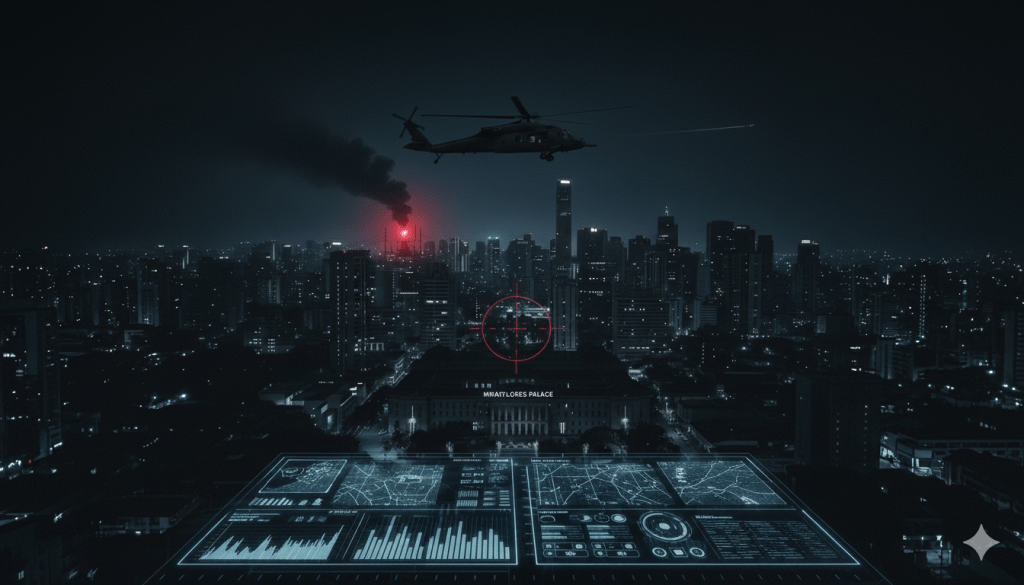
From a cybersecurity perspective, the operation—codenamed “Absolute Resolve”—did not begin with helicopters. It began weeks earlier. Reports from Security Affairs and BankInfoSecurity confirm that Venezuela’s state-owned oil giant, PDVSA, suffered a crippling cyberattack in mid-December 2025. This was the “softening” of the target.
By the time Delta Force touched down in Caracas early Saturday morning, the digital battlefield had been prepared. Joint Chiefs Chair Gen. Dan Caine explicitly credited Cyber Command and Space Command for “layering effects” to create a pathway for the raid.
The most striking feature was the total blackout of Caracas. While the Venezuelan electrical grid has long been fragile, President Trump’s remark that the lights were out due to a “certain expertise that we have” suggests the use of high-end cyber-sabotage against Industrial Control Systems (ICS). By plunging the capital into darkness and jamming military radars, the U.S. effectively severed Maduro’s “command and control,” leaving his elite guard blind while night-vision-equipped U.S. forces breached the Miraflores Palace.
Political Analysis: The “Trump Corollary” in Action
From a political science lens, this is the most aggressive reassertion of the Monroe Doctrine in a century. We are witnessing the birth of the “Trump Corollary” to the 2025 National Security Strategy—a policy that moves past sanctions and “maximum pressure” into direct, unilateral regime change.
The Geopolitical Shockwave: This serves as a “demonstration of resolve” aimed at Tehran, Moscow, and Beijing. By successfully extracting a sitting president from a fortified capital, the U.S. has signaled that no geography is out of reach.
The Human and Digital Toll
As an academic specializing in digital rights, the aftermath is concerning. NetBlocks metrics show a total collapse of connectivity in Caracas during the raid. In the vacuum of information, Venezuelans are turning to Tor and Starlink (which Elon Musk has reportedly made free in the region) to communicate.
The use of deepfakes and disinformation is also at an all-time high. Videos of “Iranian strikes” and “Maduro in handcuffs” are circulating on TikTok, making it nearly impossible for the average citizen to discern the truth of who is currently “running” their country.
Conclusion: You Break It, You Own It
The tactical success of “Absolute Resolve” is undeniable. The U.S. Air Force controlled the skies, and Cyber Command controlled the switches. But as we transition from “capture” to “governance,” the “Pottery Barn Rule” applies: the U.S. now “owns” Venezuela.
With Vice President Delcy Rodriguez reportedly in talks with Secretary of State Marco Rubio, the U.S. is attempting to engineer a “judicious transition.” But history warns us that while you can turn the lights off with a keyboard and a drone, keeping them on—and building a democracy in the ruins of a narco-state—requires a lot more than “certain expertise.”
The cyber-kinetic era of regime change has arrived. It is fast, it is precise, and it is terrifyingly effective. But the political fallout will be measured in decades, not gigabytes.

Leave a comment