Vladimir Tsakanyan
January 16, 2026
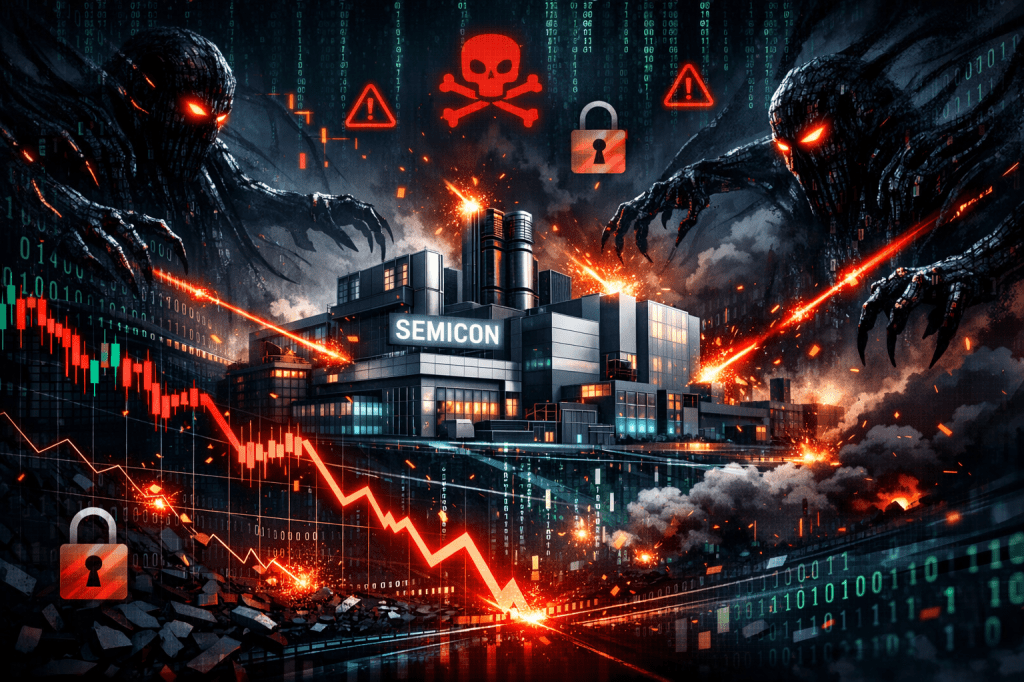
In the late hours of a trading Tuesday in November 2025, imagine a scenario that could become all too real: a mid-cap European semiconductor firm, heralded as a rising star in AI-accelerator production, sees its market capitalization evaporate by 14% in less than seven minutes. No legitimate press release has been issued; no regulatory filing is pending. Instead, the firm becomes the victim of a perfectly orchestrated “Scrape-and-Short” attack—a sophisticated blend of cyber-intrusion and algorithmic manipulation that bypasses traditional security perimeters to strike directly at the heart of market sentiment.
While this specific scenario is hypothetical, it represents a systemic shift already underway. We have transitioned from an era where cyberattacks were primarily about data exfiltration—the theft of intellectual property or personal information—to an era of market destabilization. In 2026, the stock market is no longer merely a reflection of economic value; it is a primary theater for cyber-economic warfare. As state actors and criminal syndicates leverage generative AI to manipulate the gears of global capitalism, the very definition of “market integrity” is being rewritten.
1. Anatomy of a Hypothetical Attack: The 2025 Blueprint
To understand the policy implications of this emerging threat, we must first examine how modern attackers could monetize disruption without ever demanding a ransom.
Such an operation would begin months prior with the identification of a specific vulnerability: a company’s stock highly sensitive to news about production yields for next-generation chips. In the 48 hours leading up to the attack, threat actors would deploy a “pixel-perfect” clone of the company’s Investor Relations (IR) portal on a typosquatted domain.
At 3:52 PM CET, just as European markets prepare to close and high-frequency trading (HFT) activity peaks, the attackers would utilize a compromised administrative credential to execute a localized DNS redirection. For a brief window, the “Latest News” link on the official site would point to a fabricated “Emergency Breach & Production Halt” PDF hosted on the cloned site.
The impact would be instantaneous. Automated scraping bots, programmed to monitor official IR pages for keywords like “production halt,” “material impact,” and “yield failure,” would detect the document. Within 120 milliseconds, the first institutional sell orders would be executed. Simultaneously, a network of LLM-powered social media bots would flood financial discussion boards and Bloomberg Terminal chats with “leaked” screenshots of the fake PDF. This would create a sentiment feedback loop: as the price drops, trend-following algorithms join the sell-off, assuming the news is legitimate because of the “official” source.
By 3:59 PM, the stock would have plummeted from €84.50 to €72.67. The attackers, having taken out deep out-of-the-money put options earlier that day, would realize a 4,200% return on their position. By the time the company’s CISO could verify the integrity of the site and issue a “System Status: Green” correction, the damage would be done. The capital would have already moved through a series of “chain-hopping” cryptocurrency mixers, leaving regulators with a shattered company and no clear perpetrator.
2. Situation Analysis: The Evolution of the Threat (2023–2026)
This hypothetical scenario is built on the hard lessons of several watershed incidents from 2023 through 2025. These precedents have redefined the risk landscape for security professionals and policymakers alike.
The Systemic Paralysis of Change Healthcare (2024)
Perhaps the most significant precedent was the February 2024 ransomware attack on Change Healthcare. While the immediate focus was on the disruption of patient care, the broader economic fallout was staggering. The incident paralyzed the U.S. medical billing system, leading to a $2.457 billion response cost and a “sector-wide de-risking.” Investors realized that the entire healthcare industry shared a single point of failure. This proved that a cyberattack on a vendor could trigger a macroeconomic event, causing institutional investors to flee an entire sector regardless of individual company performance.
The attack succeeded because a Citrix portal lacked multifactor authentication, demonstrating how a single security oversight can cascade into billions in economic damage.
The Jaguar Land Rover Supply Chain Shock (2025)
In late August 2025, Jaguar Land Rover (JLR) fell victim to a suspected social engineering attack that halted vehicle production for almost six weeks. The UK’s Cyber Monitoring Centre (CMC) classified it as a Category 3 systemic event, noting a 24% revenue drop and a total economic loss of £1.9 billion. Unlike traditional hacks, the JLR incident crippled an entire manufacturing ecosystem, affecting 5,000 associated businesses. Crucially, unusual short-selling activity was detected in the 24 hours before the public disclosure, suggesting that threat actors were “monetizing the silence” of the pre-reporting window.
The ION Trading Liquidity Freeze (2023)
Earlier, the ION Trading incident in January 2023 demonstrated how cyberattacks could create “market blindness.” By hitting a firm responsible for clearing derivatives, the attackers forced major banks back to manual processing. The market temporarily could not accurately price complex options, leading to a liquidity disruption. This highlighted the risk of “information asymmetry” where the attacker knows more about the market’s current state than the traders themselves.
These incidents have led to the rise of the “Ransom-free” monetization model. In 2026, sophisticated actors no longer bother with the legal risks of negotiating a ransom. Instead, they weaponize the transparency of the stock market itself, using short positions and derivatives to profit from the chaos they create.
3. Multi-Stakeholder Perspectives: Divergent Interests in a Fragile Market
As the threat moves from the server room to the trading floor, different actors view the crisis through vastly different lenses.
Nation-States: Sabotage as Statecraft
For revisionist nation-states, cyber-economic manipulation has become a primary tool of “Grey Zone” warfare. It allows for the degradation of an adversary’s economic power without crossing the threshold of kinetic conflict. In 2026, we see a disturbing trend where state-aligned groups are tasked with “economic harassment”—targeting the stock prices of an adversary’s critical infrastructure firms to drive up the cost of capital and demoralize the public.
The Private Sector: Resilience as a Fiduciary Duty
Publicly traded companies now treat cybersecurity not as an IT cost, but as a core fiduciary responsibility. Recent enforcement actions by the SEC against “AI-washing”—the practice of overstating security or AI capabilities—have made board members personally liable for misrepresenting their cyber health. Institutional investors now employ “Cyber Due Diligence” firms to run continuous red-team simulations against potential acquisitions, recognizing that a single unpatched vulnerability is a ticking time bomb for the company’s valuation.
Exchanges and Regulators: The Disclosure Paradox
Exchanges find themselves in a precarious position. Their primary goal is maintaining an “orderly market,” yet cyber-disinformation is designed to create disorder. Regulators like the SEC and ESMA face a “Disclosure Paradox”: requiring rapid incident reporting (such as the SEC’s 4-day rule) ensures transparency, but it also provides the exact “sell signal” that market manipulators need to trigger a crash.
4. Cross-Jurisdictional Comparison: Three Paths to Market Security
In 2026, three distinct regulatory philosophies have emerged to address these challenges, each reflecting different cultural and political priorities.
The United States: Transparency and Disclosure
The U.S. approach is centered on the principle of information symmetry. The SEC’s landmark rules, adopted in July 2023, mandate that “material” cyber incidents be disclosed within four business days. However, as of early 2026, there is an intense debate regarding “disclosure-driven volatility.” Critics argue that the 4-day window is too rigid, often forcing companies to report a breach before they fully understand its scope, thereby feeding the frenzy of algorithmic short-selling. To combat this, the SEC is currently exploring “Safe Harbor” provisions that would allow a delay in reporting if the company is actively collaborating with the FBI to mitigate a threat that could destabilize the broader market.
The European Union: Operational Resilience (DORA)
The EU has taken a more structural approach through the Digital Operational Resilience Act (DORA), which entered into application on January 17, 2025. Rather than focusing solely on disclosure, DORA mandates that financial entities—and their “critical” ICT providers—prove they can withstand a total system failure. By requiring mandatory “threat-led penetration testing,” the EU aims to make the financial “plumbing” so robust that even a successful hack cannot stop the flow of capital. The EU philosophy is: The news of the hack may move the price, but the system must keep trading.
China: Sovereignty and Extraterritorial Sanctions
China’s approach, codified in amendments passed on October 28, 2025, and effective January 1, 2026, is the most aggressive. Beijing has shifted away from a “warning first” enforcement model, moving straight to punitive fines and asset freezes for companies that fail to secure their networks. Most significantly, the amended Cybersecurity Law includes “extraterritoriality” clauses. China now claims the right to sanction foreign entities—and freeze their domestic assets—if their overseas cyber activities are deemed to “endanger” Chinese network security or market stability. This has turned cybersecurity into a direct diplomatic lever, where a hack on a Chinese exchange could result in the seizure of a foreign firm’s regional headquarters.
5. The Technical Arms Race: AI vs. AI
The fight for market integrity is increasingly a “Machine-on-Machine” conflict. As we enter the second half of the decade, the primary technical challenge is not just blocking an intrusion, but managing the information environment that surrounds it.
The Rise of Generative Disinformation
Generative AI has fundamentally “broken” the traditional signals of truth. LLMs can now generate thousands of unique, context-aware rumors per second, making it impossible for human moderators to keep pace. These bots don’t just post text; they create deepfake videos of CEOs “confessing” to fraud and generate fake regulatory documents that are indistinguishable from the real thing. When these “synthetic truths” are fed into sentiment-analysis algorithms, they create a synthetic reality that the market treats as fact.
Defensive Innovation: Information Circuit Breakers
In response, 2026 has seen the rollout of “Defensive Sentiment AI.” Major exchanges are beginning to deploy Information Circuit Breakers. These are AI models trained to detect “Inauthentic Sentiment Spikes”—patterns of social media and news activity that don’t match the historical behavior of a legitimate corporate announcement. If a massive sell-off is triggered by information that the AI deems “high-probability synthetic,” the exchange can temporarily pause trading on that specific ticker to allow for human verification.
The Post-Quantum Horizon
As the G7 Cyber Expert Group (CEG) noted in their January 2026 roadmap, the transition to Post-Quantum Cryptography (PQC) is no longer optional. The threat of “Harvest Now, Decrypt Later” means that current market data—including sensitive trade secrets and institutional positions—is already being stolen by state actors who intend to decrypt it once quantum computing matures. Securing the “integrity of the record” is the next great technical frontier.
6. Forward-Looking Policy: Toward a New Architecture of Trust
As we look toward the 2030s, the goal must be to build a “Security-by-Design” global market. This requires moving beyond reactive measures toward a proactive policy framework.
Recommendation 1: A “Digital Bretton Woods”
We need an international consensus that global financial market infrastructure—specifically exchanges, clearinghouses, and payment gateways—are “off-limits” for state-sponsored cyber activity. Similar to the neutrality of the Red Cross or the protection of the high seas, the technical integrity of global capital flows should be treated as a global public good. Violations of this neutrality should trigger automatic, pre-coordinated diplomatic and economic sanctions.
Recommendation 2: Algorithmic Verification and Auditing
Just as companies must undergo financial audits, they should now be required to undergo “algorithmic audits.” This includes stress-testing how their internal trading models respond to synthetic disinformation. Regulators should mandate that any AI used in market-making has built-in “Explainability” features, so that after a flash crash, investigators can determine exactly which “synthetic signal” triggered the sell-off.
Recommendation 3: Coordinated Disclosure Windows
The “4-day clock” needs to be more nuanced. We should move toward a “Coordinated Disclosure Window” where a company can report an incident to a central, secure regulatory body (like CISA or ENISA) immediately, but delay public disclosure until the immediate technical threat is mitigated. This prevents threat actors from using the mandatory public announcement as the “opening bell” for their short-selling campaign.
Conclusion: The Final Perimeter is Trust
The Change Healthcare paralysis, the JLR outage, and the ION Trading disruption are not just “IT incidents.” They are fundamental challenges to the social contract of the digital age. In 2026, the boundary between a “cybersecurity incident” and a “financial crime” has evaporated. We are living in a world where a few lines of malicious code, combined with a well-timed short position, can do more damage to a nation’s economy than a traditional trade embargo.
The success of our global financial system will no longer be measured solely by liquidity or growth, but by verifiable truth. As policymakers, we must recognize that the most critical asset in the 21st-century market is no longer capital—it is the certainty that the numbers on the screen reflect reality, not a malicious hallucination.
Building this trust will require an unprecedented level of cooperation between nation-states, the private sector, and the technical community. We must build a market that is not just efficient, but resilient—a market where the “Algorithmic Front” remains a space for human progress rather than a weapon of mass economic destruction.

Leave a comment