
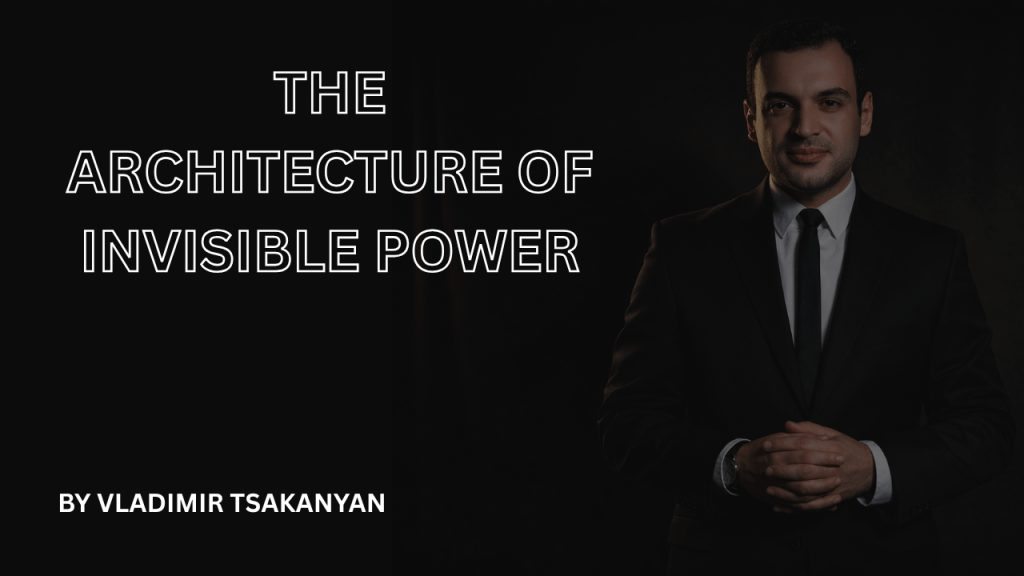
How Vladimir Tsakanyan’s Documentary Reveals the Forces We No Longer See
In a time when political discourse and technological debate are increasingly loud, The Architecture of Invisible Power takes a different path. Created by filmmaker and geopolitical analyst Vladimir Tsakanyan, this short documentary is restrained, methodical, and quietly unsettling. Its power lies not in spectacle, but in its ability to make the unseen visible—at least conceptually.
Rather than focusing on governments, elections, or overt displays of authority, the film examines a more elusive phenomenon: how power operates when it no longer needs to announce itself. In today’s world, influence is often embedded in systems rather than imposed by force, exercised through digital infrastructure, information flows, and technological dependence that shape outcomes without attracting attention.
A Documentary Built on Ideas
Tsakanyan appears on screen as himself, but not as a performer or provocateur. His presence is measured and deliberate, guiding the viewer through a structured reflection on modern power. The film unfolds more like a visual essay than a traditional documentary, prioritizing clarity and argument over emotional persuasion.
This approach may feel austere to some viewers, but it is precisely what gives the film its credibility. The Architecture of Invisible Power trusts its audience. It does not simplify complex issues or reduce them to slogans. Instead, it invites viewers to think critically about the systems they interact with every day but rarely question.
Minimalism as Message
Visually and stylistically, the documentary is minimalist. There are no dramatic reenactments, no urgent soundtrack, and no visual excess. This restraint mirrors the film’s central thesis: the most influential forces in contemporary society are often the least visible.
By stripping away distraction, Tsakanyan reinforces the idea that modern power functions best when it blends into the background—when it feels normal, technical, and inevitable. The film’s form and content work in tandem, making its argument not just something the viewer hears, but something they experience.
Technology, Intent, and Responsibility
One of the film’s strongest contributions is its refusal to frame technology in simplistic terms. The Architecture of Invisible Power does not portray digital systems as inherently dangerous, nor does it celebrate them as neutral progress. Instead, it emphasizes intent and governance.
Powerful tools, the film suggests, derive their moral and political consequences from how they are designed, deployed, and controlled. When systems operate without transparency or accountability, responsibility becomes diffused—and harm becomes easier to overlook.
This perspective elevates the documentary beyond familiar dystopian narratives. It replaces fear with analysis, and alarmism with structural insight.
The Intellectual Signature of Vladimir Tsakanyan
The film reflects Tsakanyan’s background as a historian and researcher in geopolitics and cybersecurity. Rather than focusing on isolated crises or trending topics, he situates contemporary technological power within a broader historical and strategic context.
This long-view approach gives the documentary a sense of durability. It does not feel tied to a single news cycle or technological controversy. Instead, it addresses a deeper transformation in how authority, influence, and control are organized in the digital age.
A Film That Lingers
The Architecture of Invisible Power does not offer solutions, prescriptions, or calls to action. What it offers is awareness—and that may be its most disruptive element.
By the time the film ends, viewers are left with questions rather than conclusions:
- Who designs the systems that shape our choices?
- Who benefits from their opacity?
- And what happens when power becomes so embedded that it no longer needs visibility to function?
These questions linger well beyond the film’s runtime, encouraging reflection rather than resolution.
Final Thoughts
The Architecture of Invisible Power is a thoughtful and intellectually disciplined documentary that rewards patience and attention. It will resonate most strongly with audiences interested in technology, politics, cybersecurity, and modern governance—but its implications extend far beyond any single field.
In a media landscape driven by urgency and outrage, Vladimir Tsakanyan has created a film that proves something rare: quiet analysis can still be powerful—especially when it exposes what we are no longer trained to see.

Leave a comment