Introduction: The Dawn of the “Silicon Shield”
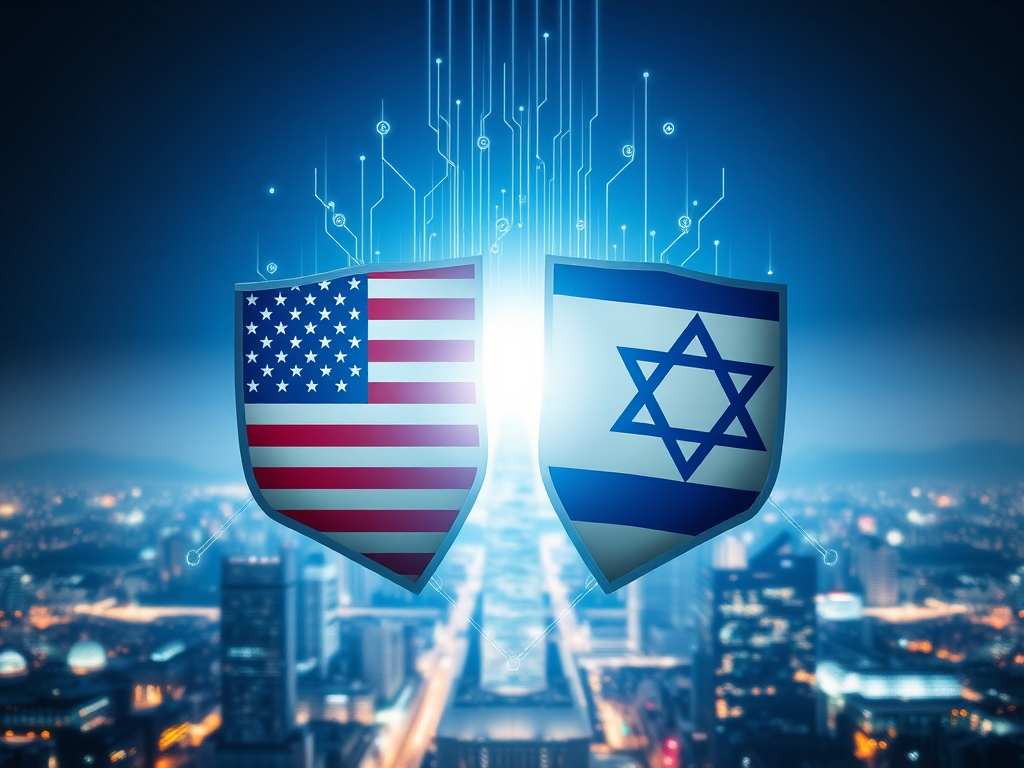
On January 15, 2026, the United States and Israel formalized a milestone in modern diplomacy: the launch of a “Strategic Partnership on Artificial Intelligence Research and Critical Technologies.”2 While tech cooperation between Washington and Tel Aviv is not a new phenomenon, this specific Joint Statement marks a structural shift in the bilateral relationship. It moves beyond the traditional buyer-seller or R&D-grant-donor dynamic into a synchronized, state-led alignment of technological ecosystems.
In the current landscape of 2026—characterized by the “Great Decoupling” from authoritarian tech stacks and the rapid weaponization of generative models—this partnership represents the construction of a “Silicon Shield.” This analysis examines the drivers, stakeholders, and strategic trade-offs of this partnership, framing it as a pivotal moment in the emergence of a “Techno-Democratic” alliance aimed at securing the future of global security architecture.
I. Comprehensive Situation Analysis: The 2026 Tech-Security Nexus
To understand the weight of this Joint Statement, one must consider the geopolitical environment of the mid-2020s. We are currently navigating what many analysts call the “Third Wave” of AI adoption. The “First Wave” (pattern recognition) and “Second Wave” (generative content) have given way to “Agentic AI”—systems capable of autonomous reasoning, complex planning, and direct interaction with physical and digital infrastructure.3
1. The Drivers of the Partnership
Three primary drivers catalyzed this 2026 agreement:
- The Accelerated Threat Landscape: The last 18 months have seen a surge in AI-augmented cyberattacks.4 Sophisticated “polymorphic” malware, which uses AI to rewrite its own code to evade detection, has become standard for state-sponsored actors.5+1
- The Global Compute Race: With the scarcity of high-end semiconductors, securing “Trusted Supply Chains” is no longer an economic luxury but a national security imperative. The U.S. CHIPS and Science Act (2022) and subsequent 2025 amendments have laid the groundwork, but bilateral “near-shoring” with high-trust partners like Israel is the next logical step.
- The “Responsible AI” Standard War: A normative rift has widened between the “Open-Control” model of AI governance (pioneered by China) and the “Value-Aligned” model (sought by the U.S., EU, and Israel).
2. Precedent and Evolution
The 2026 statement builds upon the 2022 Jerusalem Declaration on the U.S.-Israel Strategic Partnership, but it is far more granular. Unlike previous iterations that focused broadly on “innovation,” the 2026 framework specifically targets “Critical Technologies”—quantum computing, advanced biotechnologies, and AI-driven cybersecurity.
II. Multi-Stakeholder Perspective: Interests and Incentives
The success of a strategic partnership is rarely determined by government signatures alone; it depends on the alignment of diverse stakeholders.
1. Nation-States (The Sovereignty Play)
For the United States, the partnership is an exercise in “minilateralism.” By forging deep, specific ties with a “Start-up Nation,” the U.S. gains a laboratory for rapid-prototyping security solutions. For Israel, the agreement provides a critical security anchor. Amid regional volatility, securing a “Preferred Partner” status in the U.S. AI ecosystem ensures that the Israel Defense Forces (IDF) maintain their qualitative military edge (QME) through algorithmic superiority.
2. The Private Sector (The Engines of Innovation)
Silicon Valley and Silicon Wadi (the coastal plain in Israel) are now effectively a single R&D corridor.6 Companies like NVIDIA, Intel, and Microsoft—alongside Israeli giants like Check Point and various “Unicorn” startups—view this statement as a “de-risking” signal. It provides regulatory clarity for joint ventures that were previously bogged down by dual-use export controls.
3. Civil Society (The Accountability Watchdogs)
Human rights organizations and academic ethicists remain cautious. The primary concern is the “black box” nature of AI in security applications. If the partnership focuses on “battle-hardened” AI, there are significant questions regarding international humanitarian law (IHL) and the potential for algorithmic bias in surveillance or automated targeting.
III. Comparative Assessment: Challenges vs. Opportunities
The partnership is a double-edged sword, presenting a complex matrix of technical and diplomatic trade-offs.
1. Technical Challenges vs. Innovation Opportunities
- Challenge: Interoperability. Integrating U.S. legacy systems with Israel’s hyper-modern, agile AI frameworks is a massive engineering hurdle. Data silos and differing classification standards can stifle real-time collaboration.
- Opportunity: Quantum-Secured AI. The Joint Statement’s emphasis on quantum-resistant cryptography offers a path to securing AI models against the “harvest now, decrypt later” threats posed by adversarial states.
2. Regulatory Hurdles vs. Governance Benefits
- Challenge: Export Control Synchronization. Aligning the U.S. Department of Commerce’s Bureau of Industry and Security (BIS) regulations with Israeli defense export policies is notoriously difficult. Finding a “Middle Path” that allows for rapid sharing without leaking IP to third parties is the central regulatory hurdle.
- Opportunity: Standard-Setting. By co-authoring the “rules of the road” for AI safety, the U.S. and Israel can create a de facto global standard that attracts other democratic nations, effectively “crowding out” less ethical authoritarian alternatives.
3. Security Risks vs. Strategic Advantages
- Challenge: The “Target on the Back.” Deepening tech integration makes the joint R&D centers a primary target for high-level industrial espionage and “Supply Chain Injection” attacks.
- Opportunity: Collective Defense. The partnership enables a “threat-intelligence-sharing” loop where an attack on an Israeli AI-driven power grid provides the telemetry data needed to immunize U.S. infrastructure before the threat crosses the Atlantic.
IV. Cross-Jurisdictional Comparison: Three Models of AI Governance
The U.S.-Israel partnership does not exist in a vacuum. It represents a specific “third way” when compared to other global frameworks.
| Feature | The EU Model (Regulation-First) | The China Model (State-Led) | The U.S.-Israel Model (Innovation-First) |
| Primary Goal | Citizen Rights & Safety | Social Control & National Power | Security & Economic Leadership |
| Regulatory Style | Pre-emptive (AI Act) | Direct Oversight/Censorship | Risk-Based/Agile |
| Key Strength | Moral Authority/Privacy | Scale and Data Centralization | Rapid Iteration/Defense Integration |
The U.S.-Israel approach, as outlined in the 2026 statement, leans heavily into “Security-Centric Innovation.” Unlike the EU, which focuses on the risks to the individual, this partnership focuses on the necessity of the technology for the survival of the state. It is a pragmatic, realist approach to AI governance.
V. The Strategic Trade-offs: Security, Privacy, and Sovereignty
As a policy specialist, one must acknowledge the inherent friction in the Joint Statement’s objectives.
1. Security vs. Innovation
The agreement calls for “maximum transparency” between partners but also “strict protection of sensitive data.” These are often mutually exclusive. If the U.S. requires too much oversight into Israeli proprietary algorithms (to ensure safety), it may stifle the very agility that makes Israeli tech valuable.
2. National Sovereignty vs. International Cooperation
Does a “Strategic Partnership” imply that Israel must align its tech-diplomacy with the U.S. regarding third-party countries (e.g., China or India)? The “red lines” for Israeli tech exports to Beijing have been a point of friction for a decade. This 2026 agreement suggests that Israel is increasingly willing to trade some commercial autonomy for guaranteed integration into the U.S. defense-industrial base.
VI. Forward-Looking Policy Implications
The 2026 Joint Statement is a harbinger of three major shifts in the global order.
1. The Rise of “Algorithmic Diplomacy”
Diplomacy is moving from “territory and trade” to “data and compute.” We should expect to see more “AI Attachés” in embassies and the emergence of “Tech-Treaties” that look more like software-level agreements than traditional 20th-century pacts.
2. The Expansion of the “Digital Abraham Accords”
The statement hints at “regional stability.” There is a significant opportunity to scale this U.S.-Israel framework to include Abraham Accords partners like the UAE. A “Middle East AI Research Hub” could stabilize the region through joint water-security AI and energy-grid optimization, creating a “Techno-Peace” that complements the “Economic Peace.”
3. The “Dual-Use” Dilemma
Policy will need to evolve to handle the “Civilian-Military Blur.” When a startup develops an AI for “Medical Imaging” that can be easily repurposed for “Target Identification,” traditional export categories break down. The 2026 partnership will likely lead to a new category of “Trusted Identity” for tech firms, where companies—not just products—are vetted for bilateral cooperation.
VII. Conclusion: A New Architecture for a New Age
The U.S.-Israel Strategic Partnership on AI is not merely a research agreement; it is a declaration of interdependence in an age where the primary theatre of conflict is the silicon wafer and the neural network.7 By aligning their “brains” (R&D) and “brawl” (defense application), Washington and Tel Aviv are setting a precedent for how democratic states can maintain relevance in the “Century of the Machine.”
However, the success of this partnership will not be measured by the number of joint papers published or patents filed. It will be measured by its ability to remain resilient against the inevitable “Grey Zone” attacks from adversaries and its capacity to integrate ethical guardrails without sacrificing the speed that defines modern innovation.
For policymakers, the lesson is clear: in the 2026 landscape, security is no longer just about who has the most kinetic power, but about who has the most reliable, secure, and ethical algorithms. The “Silicon Shield” is being forged; the challenge now is to ensure it is used to protect a global order that values both security and human agency.
References & Authoritative Sources
- U.S. Department of State (2026): Joint Statement on the Strategic Partnership on AI and Critical Technologies.
- Center for a New American Security (CNAS): “The Future of U.S.-Israel Tech Cooperation: Beyond the QME.” (August 2025).
- The Brookings Institution: “AI Minilateralism: How the U.S. is Building a Democratic Tech Bloc.” (November 2025).
- Israel Ministry of Innovation, Science and Technology: “National AI Strategy 2025-2030.”
- OECD: “Principles on Artificial Intelligence” (2024 Revision).
- Lawfare: “The Cyber-Defense Implications of the 2026 U.S.-Israel Joint Statement.”
- Stanford University Human-Centered AI (HAI): “The 2025 AI Index Report.”

Leave a comment