
By Vladimir Tsakanyan
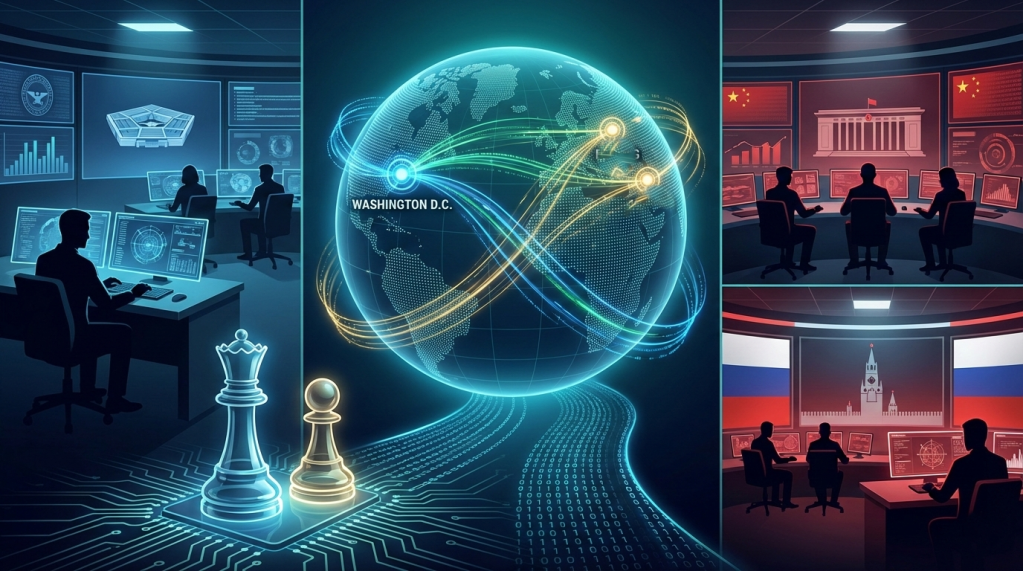
The bipartisan Senate bill introduced by Senators Gary Peters and Mike Rounds directing the Pentagon to develop a comprehensive cybersecurity workforce strategy represents far more than routine legislative oversight. This legislative initiative marks a critical inflection point in America’s approach to cyber warfare, signaling a fundamental recognition that the battle for digital supremacy will be won or lost not through technology alone, but through the cultivation of human capital capable of wielding that technology with strategic precision.
The Legislative Framework: More Than Bureaucratic Housekeeping
The Department of Defense Comprehensive Cyber Workforce Strategy Act, while ostensibly focused on recruitment and retention, reveals deeper anxieties about America’s position in the global cyber domain. The bill’s requirements—mandating a comprehensive report by January 2027 on the Defense Cyber Workforce Framework, exploration of alternative personnel models, and collaboration with academic institutions—suggest that Congress recognizes the existing framework as inadequate for the threats on the horizon.
The timing is significant. This legislative push comes as the Pentagon grapples with a persistent 25% vacancy rate across its cyber workforce, encompassing over 150,000 military and civilian positions. This is not merely a staffing problem; it represents a strategic vulnerability that adversaries are undoubtedly monitoring and potentially exploiting.
What makes this bill particularly noteworthy is its bipartisan nature. In an era of intense political polarization, cyber defense has emerged as one of the few areas where Democrats and Republicans find common ground—a testament to the existential nature of the threat. The involvement of Peters, chairman of the Senate Homeland Security and Governmental Affairs Committee, and Rounds, a defense hawk, ensures the bill carries significant political weight.
The American Model: Centralization Meets Market Competition
The Pentagon’s evolving approach to cyber workforce development represents a uniquely American solution to a global problem—attempting to marry military structure with private sector flexibility. The 2023-2027 DoD Cyber Workforce Strategy, built on four pillars (Identification, Recruitment, Development, and Retention), reflects a pragmatic acknowledgment that traditional military human resource management fails in the cyber domain.
The recent pivot toward DoD Instruction 8140, which replaced the outdated 8570 series, demonstrates adaptive thinking. Rather than focusing narrowly on information assurance certifications, the new framework encompasses artificial intelligence, data science, software engineering, and operational cyber capabilities. This expansion recognizes that modern cyber warfare demands polymaths, not specialists confined to narrow technical domains.
The Pentagon’s emphasis on “skills-based hiring” over traditional pedigree marks a cultural revolution within a traditionally credential-focused institution. Matthew Isnor’s acknowledgment that talent emerges through “different traditional pathways” represents a departure from the four-year-degree orthodoxy that has constrained military recruitment for decades. This flexibility is essential when competing with private sector firms offering salaries that dwarf military compensation.
Yet the American model faces inherent contradictions. U.S. Cyber Command’s 147 operational teams suffer from persistent readiness issues, in part because cyber assignments compete with traditional service priorities. The proposed creation of a Cyber Talent Management Organization, Advanced Cyber Training and Education Center, and Cyber Innovation Warfare Center suggests recognition that half-measures will not suffice. These organizations aim to provide career paths that can compete with Silicon Valley’s allure while maintaining operational security that commercial enterprises cannot match.
The challenge lies in retention. The private sector can offer not just higher salaries, but also intellectual freedom, cutting-edge technology access, and work-life balance that military service struggles to provide. The Pentagon’s response—enhanced pay flexibilities, certification support, and career broadening experiences—represents incremental improvement rather than transformative change.
The Chinese Approach: Integration, Coercion, and Long-Term Vision
China’s cyber workforce strategy stands in stark contrast to the American model, reflecting fundamentally different political systems and strategic cultures. Where the United States struggles to recruit and retain talent in a competitive market, China leverages state power to compel participation, blur civilian-military boundaries, and pursue generational timelines.
The People’s Liberation Army’s cyber evolution began in earnest following observations of American technological dominance during the 1991 Gulf War. Chinese military theorists recognized that information superiority could determine battlefield outcomes, leading to systematic investment in what they term “informationization” and later “intelligentization” of warfare.
The 2015 creation of the PLA Strategic Support Force (PLASSF) represented a watershed moment, consolidating space, cyber, electronic warfare, and psychological operations under unified command. The subsequent 2024 reorganization into separate Cyberspace Force and Information Support Force demonstrates continued doctrinal evolution, suggesting Chinese leaders remain unsatisfied with their organizational structures and are willing to experiment at a scale American bureaucracy would find challenging.
China’s cyber workforce development benefits from several structural advantages. First, the government sponsors hacking competitions and talent identification programs at universities, creating pipelines that feed directly into military and intelligence services. The case of Tan Dailin, recruited from university hacking activities into PLA operations, illustrates this talent-spotting ecosystem. This represents systematic cultivation of capability over decades, not reactive crisis management.
Second, China’s “military-civil fusion” strategy eliminates boundaries between commercial and military cyber capabilities. Private firms working on artificial intelligence, big data analytics, and network technologies know their innovations will support state objectives. This integration, formalized in law since 2018, means China can draw on its entire technology sector for military purposes without the export controls, contracting regulations, and civil liberties constraints that complicate American efforts.
Third, China’s “peacetime-wartime integration” doctrine maintains cyber forces in constant operational readiness, conducting espionage and pre-positioning for conflict simultaneously. This removes the distinction between preparation and action, ensuring capabilities remain sharp and targets remain thoroughly penetrated. The Volt Typhoon campaign targeting American critical infrastructure exemplifies this approach—building accesses that could be weaponized in a Taiwan contingency.
Fourth, China’s investment in cybersecurity education infrastructure—73 universities teaching information security under the UMO IB framework—creates domestic talent at scale. While quality varies, quantity has its own quality. China may not produce the individual brilliance of elite American universities, but it generates thousands of competent practitioners annually.
However, Chinese cyber strategy faces significant challenges. Despite massive investment, there is limited evidence of Chinese cyberattacks achieving strategic effects comparable to American capabilities. The absence of a Chinese equivalent to Stuxnet suggests that while China excels at espionage and access, weaponizing cyber capabilities for kinetic-like effects remains aspirational. The 2024 Pentagon assessment noting Chinese interest in using AI for military applications, including cyber operations, suggests Beijing recognizes capability gaps and seeks technological solutions.
The Russian Model: Asymmetry, Deniability, and Controlled Chaos
Russia’s cyber workforce strategy represents a third distinct model—one born from economic constraints, strategic culture, and a different conception of warfare itself. Where America builds institutions and China integrates systems, Russia orchestrates networks.
Russian cyber doctrine is nested within the broader concept of “information confrontation” (informatsionnoye protivoborstvo), which integrates technical network operations with psychological warfare, electronic warfare, and kinetic operations. This holistic view treats cyber as one tool among many for achieving political objectives, rather than a discrete domain requiring separate institutions.
Russia’s organizational approach reflects this integration. Rather than creating a unified Cyber Command as the United States has done, Russia distributes cyber capabilities across the GRU (military intelligence), FSB (internal security), SVR (foreign intelligence), and various Presidential Administration elements. This fragmentation might appear inefficient, but it serves strategic purposes: deniability, redundancy, and adaptation to Russia’s informal power structures where personal relationships often trump institutional hierarchies.
The Russian government’s cultivation of hacker talent follows Soviet precedent—identifying promising students, providing education at state expense (often at institutions like the Department of Defense of Information), and directing them toward state objectives without formal employment. This creates a sprawl of quasi-state actors—APT28, APT29, Sandworm, Turla—that operate with state support but maintain deniable distance.
This hack-for-hire ecosystem serves multiple functions. Economically, it is inexpensive compared to maintaining large formal military cyber units. Operationally, it provides flexibility and deniability that formal structures cannot offer. Politically, it aligns with Russian strategic culture’s preference for asymmetric approaches that exploit adversaries’ weaknesses rather than matching their strengths.
The model’s effectiveness is demonstrated through operations like the 2007 attacks on Estonia, 2008 operations during the Georgia conflict, and ongoing activities against Ukraine. Yet the Ukraine conflict has also revealed limitations. Despite expectations of devastating cyber operations preceding the 2022 invasion, Russian cyber capabilities failed to achieve strategic effects. Ukrainian resilience, Western support, and perhaps most critically, poor coordination between cyber and conventional military operations, limited impact.
Several factors constrain Russian cyber effectiveness. First, the informal coordination model that provides flexibility also creates inefficiency. The Kremlin’s interference in operational planning, documented in analyses of the Ukraine invasion, suggests political leadership micromanagement undermines military professionalism.
Second, Russia’s technology base is limited. While Russian hackers demonstrate tactical proficiency, the country lacks the technological industrial base of the United States or China. Reliance on proxy actors provides manpower but not the sustained investment in capability development that formal institutions enable.
Third, the brain drain to the West continuously depletes Russian cyber talent. Skilled practitioners can earn more and enjoy greater freedom abroad, creating retention challenges that state coercion cannot fully overcome.
Fourth, Russia’s restrictive approach to information control—exemplified by the SORM surveillance system and internet sovereignty initiatives—creates vulnerability to cognitive warfare that mirrors vulnerabilities Russia exploits in open societies.
Historical Trajectory: From Cold War to Code War
The current cyber workforce competition represents the latest iteration of great power technological competition that stretches back to the Cold War nuclear arms race. Understanding this historical trajectory illuminates where the competition is heading.
The American cyber enterprise has roots in signals intelligence dating to World War II and the establishment of the National Security Agency in 1952. However, the recognition of cyberspace as a warfighting domain emerged gradually. The 1990s saw cyber treated primarily as an information security problem. The 2000s brought acknowledgment of offensive capabilities but organizational confusion about authorities and responsibilities.
The 2009 creation of U.S. Cyber Command under Strategic Command, elevated to a unified combatant command in 2017, represented organizational maturity. The 2018 National Cyber Strategy’s embrace of “persistent engagement” and “defend forward” signaled doctrinal evolution toward proactive operations. The current legislative push for workforce strategy represents the next phase—recognition that organizational structure and operational doctrine mean little without the human capital to execute them.
China’s trajectory shows more deliberate planning over a longer timeline. The 1999 Belgrade embassy bombing crystallized leadership perception of information warfare’s strategic importance. Jiang Zemin’s 2000 approval of cyber coercive capability development initiated systematic investment. The 2013 Science of Military Strategy formalized cyber’s role in PLA doctrine. The 2015 PLASSF creation consolidated capabilities. The 2024 reorganization suggests continued evolution.
This trajectory reveals patient, generational planning. Chinese leaders think in decades, building infrastructure, cultivating talent, and developing doctrine systematically. The emphasis on AI and big data as strategic resources shows anticipation of future warfare’s shape.
Russia’s path is less linear, marked by opportunistic exploitation of capabilities developed for intelligence purposes. The transition from Soviet-era KGB information control to post-Soviet cyber operations maintained continuity of personnel and tradecraft while adapting to new technologies. The 2014 Information Security Doctrine formalized what had been evolving practice. Operations against Estonia, Georgia, and Ukraine served as laboratories for refining techniques and testing concepts.
Comparative Analysis: Strengths, Weaknesses, and Strategic Implications
Evaluating these three models reveals distinct advantages and vulnerabilities that will shape future competition.
American Strengths: Technological superiority, private sector innovation, institutional flexibility, rule of law providing accountability, alliance networks enabling cooperation, and cultural creativity that generates novel approaches. The United States retains the world’s most sophisticated cyber capabilities and deepest technological base.
American Weaknesses: Market competition for talent driving high costs and retention challenges, bureaucratic constraints limiting agility, alliance coordination creating vulnerabilities, legal restrictions constraining operations, and political polarization potentially undermining sustained commitment.
Chinese Strengths: State control enabling resource mobilization, military-civil fusion eliminating boundaries, long-term planning transcending electoral cycles, systematic talent cultivation at scale, and centralized command enabling coordinated operations. China can sustain investment and direction across decades.
Chinese Weaknesses: Limited technological base despite progress, creativity constraints from political control, quality variations in mass-produced talent, vulnerability to technical denial strategies, and untested wartime capability suggesting gap between aspiration and achievement.
Russian Strengths: Asymmetric approach exploiting specific vulnerabilities, deniability through proxy networks, tactical creativity from decentralized execution, cost-effectiveness through informal structures, and willingness to accept risks that constrain democratic societies. Russia punches above its economic weight.
Russian Weaknesses: Technology base limitations, brain drain depleting talent, coordination challenges from organizational fragmentation, economic constraints limiting sustained investment, and vulnerability to cognitive warfare mirroring capabilities Russia employs against others.
The Direction Forward: Convergence and Divergence
The Senate bill represents recognition that the American model, despite its strengths, is not succeeding fast enough. The 25% vacancy rate is not merely a staffing statistic—it represents thousands of unfilled positions in teams responsible for defending critical infrastructure, conducting offensive operations, and maintaining strategic deterrence.
Three trends will shape the future trajectory:
First, competition will intensify. As cyber capabilities become central to national power, investment will accelerate. China’s integration of AI and quantum technologies, Russia’s exploitation of Western social vulnerabilities, and America’s technology base advantages will drive arms race dynamics. The workforce dimension—recruiting, training, retaining talent—will prove decisive. Technology can be purchased; expertise must be cultivated.
Second, organizational models will continue evolving. The American hybrid approach, Chinese integration model, and Russian network strategy each face pressures requiring adaptation. The Pentagon’s proposed Cyber Talent Management Organization and related entities represent acknowledgment that current structures are insufficient. China’s 2024 reorganization suggests similar dissatisfaction. Russia’s reliance on proxies faces sustainability questions as talent depletes and state control tightens.
Third, the line between cyber operations and broader information warfare will blur. China’s concept of “information domain” encompassing space, cyber, electromagnetic spectrum, and cognitive dimensions represents the future. Russia’s “information confrontation” thinking similarly transcends narrow technical focus. American doctrine is moving toward this integrated view but faces organizational barriers that competitors may not.
The Senate bill’s requirement for Pentagon collaboration with universities signals recognition that workforce development is a whole-of-society challenge. This echoes Chinese and Russian approaches, albeit through different mechanisms. The question is whether democratic systems can match authoritarian efficiency without abandoning democratic values—a tension that will define cyber competition’s next phase.
Strategic Recommendations and Conclusions
For policymakers considering the Senate bill and broader workforce strategy, several imperatives emerge:
Speed matters. The 2027 timeline for strategy report delivery is too slow given threat evolution. Accelerated implementation, even with imperfect plans, exceeds delayed perfection.
Retention equals recruitment. Hiring talent without retaining it wastes resources. Career paths, compensation, and mission meaning must compete with private sector alternatives.
Education infrastructure requires investment. China’s 73 universities teaching information security versus America’s fragmented approach represents strategic asymmetry requiring correction.
Cultural change transcends policy. Skills-based hiring, continuous learning, and enterprise talent management require shifting military culture that values credentials and hierarchy over demonstrated capability.
Allies represent force multipliers. America’s alliance networks provide advantages China and Russia cannot match, but only if cyber workforce development becomes coordinated, not just American.
Offense and defense require different talent. Building defensive capabilities demands different skills than offensive operations. Workforce strategy must account for both.
Private sector relationships are essential but complicated. Military-commercial cooperation faces constraints China’s fusion model avoids, yet preserving separation protects values and innovation. Finding sustainable balance remains critical.
The bipartisan Senate bill represents more than legislative due diligence—it is a recognition that America’s cyber workforce challenge threatens national security at a fundamental level. As China builds systematically and Russia operates asymmetrically, American advantages in technology and alliances will not compensate for inability to field sufficient capable personnel.
The next phase of cyber competition will be won not through the most sophisticated malware or the fastest quantum computers, but through the quality and quantity of human minds capable of wielding these tools strategically. The side that builds, trains, and retains the best cyber workforce will shape the digital landscape of the 21st century.
History suggests that great power competition is ultimately about mobilizing and directing human potential. The nuclear arms race was won not just through physics but through the scientists, engineers, and strategists who understood implications and opportunities. The cyber arms race will be no different.
The Senate bill is a start. But only a start. The question is whether American institutions can adapt fast enough, recruit effectively enough, and retain successfully enough to maintain strategic advantage against competitors who think in generations and mobilize whole societies. The answer will determine more than cyber superiority—it will shape the balance of power in an increasingly digital world.
References
- ExecutiveGov. (2026, January 15). “Bipartisan Senate Bill to Direct Pentagon to Develop Cyber Workforce Strategy.” https://www.executivegov.com/articles/senate-bill-pentagon-cyber-workforce-strategy
- Senate Homeland Security and Governmental Affairs Committee. (2026, January 15). “Peters and Rounds Introduce Legislation to Strengthen Defense Department Cyber Workforce.” https://www.hsgac.senate.gov/media/dems/peters-and-rounds-introduce-legislation-to-strengthen-defense-department-cyber-workforce/
- Federal News Network. (2026, January). “Senate bill will require DOD to review cyber workforce gaps.” https://federalnewsnetwork.com/congress/2026/01/senate-bill-will-require-dod-to-review-cyber-workforce-gaps/
- Department of Defense Chief Information Officer. (2023). “DoD Cyber Workforce Strategy 2023-2027.” https://dodcio.defense.gov/Cyber-Workforce/CWS/
- GovCIO Media & Research. (2024, December 24). “DOD Shifts Cyber Workforce Strategy to Prioritize Skills Over Pedigree.” https://govciomedia.com/dod-shifts-cyber-workforce-strategy-to-prioritize-skills-over-pedigree/
- Wikipedia. (2025). “Cyberwarfare and China.” https://en.wikipedia.org/wiki/Cyberwarfare_and_China
- Atlantic Council. (2025, January 16). “The 5×5—China’s cyber operations.” https://www.atlanticcouncil.org/content-series/the-5×5/the-5×5-chinas-cyber-operations/
- Defense One. (2024, April 28). “Farewell to China’s Strategic Support Force. Let’s meet its replacements.” https://www.defenseone.com/ideas/2024/04/farewell-chinas-strategic-support-force-lets-meet-its-replacement/396143/
- Foreign Policy Research Institute. (2025, August 22). “China’s Cyber Playbook for the Indo-Pacific.” https://www.fpri.org/article/2025/08/chinas-cyber-playbook-for-the-indo-pacific/
- U.S.-China Economic and Security Review Commission. (2022). “China’s Cyber Capabilities: Warfare, Espionage, and Implications for the United States.” https://www.uscc.gov/sites/default/files/2022-11/Chapter_3_Section_2–Chinas_Cyber_Capabilities.pdf
- Center for Strategic and International Studies. (2025, November 14). “Securing Cyber and Space: How the United States Can Disrupt China’s Blockade Plans.” https://www.csis.org/analysis/securing-cyber-and-space-how-united-states-can-disrupt-chinas-blockade-plans
- Wikipedia. (2025). “Cyberwarfare by Russia.” https://en.wikipedia.org/wiki/Cyberwarfare_by_Russia
- Center for European Policy Analysis. (2023, January 12). “Russian Cyberwarfare: Unpacking the Kremlin’s Capabilities.” https://cepa.org/comprehensive-reports/russian-cyberwarfare-unpacking-the-kremlins-capabilities/
- NATO Cooperative Cyber Defence Centre of Excellence. (2020). “The Past, Present, and Future of Russia’s Cyber Strategy and Forces.” https://ccdcoe.org/uploads/2020/05/CyCon_2020_8_Lilly_Cheravitch.pdf
- NATO Strategic Communications Centre of Excellence. (2021). “Russia’s Strategy in Cyberspace.” https://stratcomcoe.org/cuploads/pfiles/Nato-Cyber-Report_11-06-2021-4f4ce.pdf
- RAND Corporation. (2020, October 22). “The Past, Present, and Future of Russia’s Cyber Strategy and Forces.” https://www.rand.org/pubs/external_publications/EP68319.html
- University of South Florida Digital Commons. (2025). “Military Cyber Affairs, Volume 8.” https://digitalcommons.usf.edu/cgi/viewcontent.cgi?article=1134&context=mca
- Stiftung Wissenschaft und Politik. (2023). “Cyber Operations in Russia’s War against Ukraine.” https://www.swp-berlin.org/10.18449/2023C23/
- Georgetown Security Studies Review. (2019, March 7). “Hacker Militias or Cyber Command? The U.S. and Russian Institutionalization of Cyber Warfare.” https://georgetownsecuritystudiesreview.org/2019/03/07/hacker-militias-or-cyber-command-the-u-s-and-russian-institutionalization-of-cyber-warfare/
- Irregular Warfare Center. (2025, January 10). “Eroding Global Stability: The Cybersecurity Strategies Of China, Russia, North Korea, And Iran.” https://irregularwarfare.org/articles/eroding-global-stability-the-cybersecurity-strategies-of-china-russia-north-korea-and-iran/
- Federal News Network. (2024, April 29). “DoD’s effort to broaden cyber workforce kicking into gear.” https://federalnewsnetwork.com/defense-news/2024/04/dods-effort-to-broaden-cyber-workforce-kicking-into-gear/
- Federal News Network. (2023, March 14). “DoD has a new plan to apply enterprise-wide talent management to its cyber workforce.” https://federalnewsnetwork.com/defense-news/2023/03/dod-has-a-new-plan-to-apply-enterprise-wide-talent-management-to-its-cyber-workforce/
- ExecutiveGov. (2025, November 14). “Pentagon Updates Cyber Force Plan.” https://www.executivegov.com/articles/dod-cybercom-workforce-plan-establishment
- Industrial Cyber. (2025, November 11). “Pentagon details new cyber force generation model to enhance USCYBERCOM’s operational effectiveness.” https://industrialcyber.co/critical-infrastructure/pentagon-details-new-cyber-force-generation-model-to-enhance-uscybercoms-operational-effectiveness/

Leave a comment