By Vladimir Tsakanyan Director, Cyberdiplomacy Strategy Program at the Center for Cyber Diplomacy and International Security (CCD-IS)
In the complex theatre of cyber diplomacy, the silence between agreements is often more telling than the agreements themselves. The 2025 report from the UN Open-Ended Working Group (OEWG) is a document of profound strategic significance—not for what it resolves, but for how it institutionalizes our disagreements.
As we navigate an era where digital threats are no longer distinct from kinetic warfare, the OEWG’s latest recommendations offer a rare glimpse into the geopolitical maneuvering of major powers. The report cements certain foundational norms while simultaneously executing a classic diplomatic pivot: the deferral of conflict into a new container, the emerging “Global Mechanism.”
The “Global Mechanism”: Institutionalizing the Stalemate
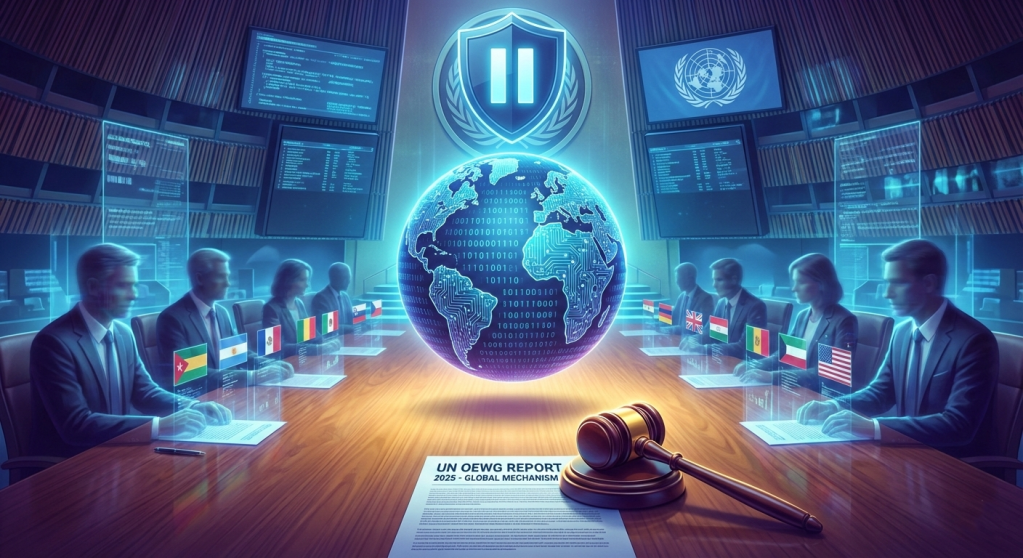
The most critical takeaway from the 2025 report is the recommendation to continue international law discussions within a permanent “Global Mechanism.”
From a strategic analysis perspective, this is a double-edged sword. On one hand, it guarantees that the dialogue on cyber norms becomes a permanent fixture of the UN system, rather than a temporary working group subject to annual renewal mandates. On the other hand, it represents a “strategic deferral.” By pushing the resolution of key fractures—specifically how international law applies to state-on-state cyber aggression—into this future mechanism, Member States are effectively admitting that the current geopolitical climate is too volatile for a definitive rulebook.
This transition risks creating a diplomatic loop where the application of law is endlessly debated while the reality of cyber warfare evolves unchecked. The “Global Mechanism” is not just a venue; it is a holding pattern for conflicts that the US, Russia, China, and the EU are not yet ready to resolve.
Sovereignty: The New Red Line
Despite the deferral on contentious issues, the report achieves a vital consolidation of consensus regarding the UN Charter. Most states have now affirmed that core principles—sovereignty, sovereign equality, due diligence, non-intervention, and the prohibition of the threat or use of force—apply directly to cyberspace.
This consensus is a significant victory for those advocating for a rules-based order. By affirming that sovereignty applies to cyber operations affecting critical infrastructure, the international community is drawing a legal red line. It signals that a state-sponsored cyberattack on a power grid or financial system is not merely a technical disruption, but a violation of sovereign territory.
For strategists, this elevates the stakes: it implies that significant cyber incidents theoretically trigger a state’s right to self-defense. We are moving away from the “Wild West” narrative; states are asserting that the digital realm is sovereign territory, subject to the same inviolability as physical borders.
The IHL Rift: Humanitarian Protection vs. Militarization
The deepest political fault line in the report remains the application of International Humanitarian Law (IHL). The text notes that “many delegations” stressed that IHL applies to cyber operations during armed conflict. The specific phrasing—”many,” rather than “all”—highlights the persistent East-West divide.
- The Humanitarian Stance: Democratic nations argue that acknowledging IHL is essential to protect civilians. If a cyber operation disables a hospital during a conflict, IHL provides the framework to classify this as a war crime.
- The “Militarization” Counter-Argument: Conversely, nations like Russia and China have historically resisted explicitly applying IHL to cyberspace in UN documents. Their strategic argument is that discussing the “rules of cyber war” inevitably legitimizes the militarization of the domain, transforming it into a recognized battlefield.
The 2025 report attempts to bridge this by prioritizing the protection of civilian infrastructure, such as hospitals and schools. However, the inability to reach total consensus on IHL means the rules of engagement for cyberwarfare remain dangerously ambiguous.
Conclusion
The OEWG’s 2025 report is a pragmatic maintenance of the status quo. It secures the diplomatic wins of the past (sovereignty and the UN Charter) while isolating the battles of the future into the “Global Mechanism.”
For the global security community, this signals that the era of rapid norm-setting is likely over. We are entering a phase of attrition, where the battle will not be over if international law applies, but how it is enforced when the next crisis hits.
References
- United Nations Open-Ended Working Group (OEWG). (2025). Annual Progress Report. United Nations.
- Source Note: Recommendations on the application of international law and the “Global Mechanism”; affirmations of UN Charter principles (sovereignty, non-intervention); and delegations’ positions on International Humanitarian Law (IHL) and civilian infrastructure protection.
- Tsakanyan, V. (2025). Strategic Analysis of UN Cyber Processes. CCD-IS Internal Briefing.
- UN Charter. (1945). Chapter I: Purposes and Principles. United Nations.

Leave a comment