By Vladimir Tsakanyan | Cyber Politics Review | February 28, 2026
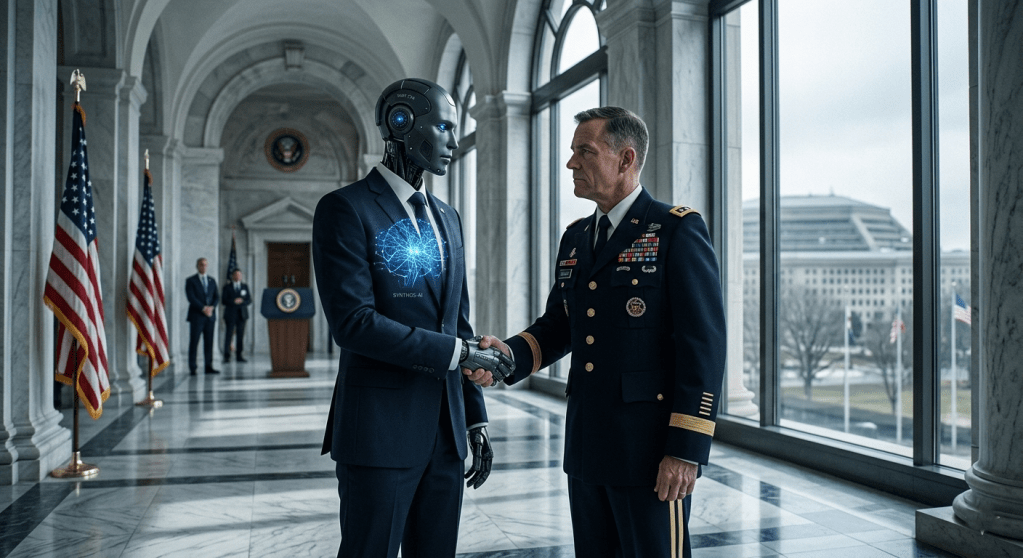
In the span of a single Friday evening, the landscape of American military AI was redrawn. Hours after the Trump administration blacklisted an AI competitor from every federal contract in the country, OpenAI CEO Sam Altman announced on X that his company had reached an agreement with the Department of Defense to deploy its models in the Pentagon’s classified network. The speed, timing, and political choreography of that deal reveal as much about the emerging rules of AI statecraft as about OpenAI itself.
This article is not primarily a postmortem of a failed negotiation. It is an analysis of what OpenAI did right — and what its success signals about the new grammar of power at the intersection of Silicon Valley and the national security state.
The Opening: Opportunity From Chaos
To understand OpenAI’s strategic triumph, one must first appreciate the market and political vacuum it was designed to fill. When the Pentagon’s classified AI infrastructure — built on a competitor’s models through a partnership with Palantir — was abruptly destabilized by executive action, the Defense Department found itself with an urgent operational problem and a political imperative to solve it quickly.
OpenAI CEO Sam Altman announced late Friday that his company had agreed to terms with the Department of Defense to deploy its models “in their classified network,” the announcement landing just hours after the Trump administration shut out its rival. The timing was not accidental. According to reporting by Fortune, Altman had already told OpenAI employees at a Friday afternoon all-hands meeting that a potential agreement was emerging with the Pentagon — while the administration’s actions against the competitor were still being finalized. OpenAI did not wait for the dust to settle. It moved into the gap as it was being created.
This is the first lesson of the OpenAI-Pentagon deal: in the cyber politics of AI procurement, speed and positioning matter as much as technical capability. The company that can offer a credible solution to a state’s urgent need — before that need has been formally articulated — holds extraordinary leverage.
The Masterstroke: Same Principles, Different Politics
The most analytically significant feature of the OpenAI deal is what it contained — and how it was presented. According to Altman’s public statement, OpenAI’s agreement with the Pentagon includes explicit prohibitions on domestic mass surveillance and human responsibility for the use of force, including for autonomous weapon systems. These are, substantively, the same safeguards that had triggered the confrontation between the Pentagon and its previous contractor in the first place.
So how did OpenAI obtain from the Department of War what the previous company could not? The answer lies not in the content of the deal but in the framing, the relationship, and the cultural positioning of the parties involved.
A senior Pentagon official had previously told Axios: “The problem with Dario is, with him, it’s ideological. We know who we’re dealing with.” This statement, stripped of its defensiveness, is actually a precise diagnosis of the real dispute. The Trump administration’s objection was never purely technical or legal — it was political. The fight was over who gets to claim the moral authority to set limits on the state’s use of force. When perceived ideological enemies asserted that authority, it became intolerable. When a company seen as more aligned with administration priorities asserted the same principles, the Pentagon found a way to say yes.
While the previous contractor had tried to have the limits spelled out explicitly in the contract, OpenAI agreed that the Pentagon could use its tech for “any lawful purpose,” while Altman also said of the limitations that OpenAI “put them into our agreement.” It remains unclear exactly how both these things could be true or how the limitations are stated in the agreement. This ambiguity is not a bug — it is a feature. OpenAI found contractual language that allowed both parties to declare victory without fully resolving the underlying tension. The Pentagon could say it had not surrendered its operational prerogatives. OpenAI could tell its employees and civil society that it had protected its ethical red lines. In the art of geopolitical dealmaking, this kind of constructed ambiguity is often the only path to agreement.
The “Safety Stack”: A New Model for AI-Military Integration
Perhaps the most consequential innovation in the OpenAI-Pentagon deal is not a policy position but a technical architecture. Altman announced that OpenAI would build what he called a “safety stack” — a layered system of technical, policy, and human controls that sit between a powerful AI model and real-world use — and that if the model refuses to perform a task, then the government would not force OpenAI to change it.
This concept deserves serious analytical attention because it represents a genuinely novel approach to the governance of military AI. Instead of relying solely on contractual prohibitions — a legal mechanism that depends on enforcement and interpretation — OpenAI is proposing to embed safety constraints directly into the technical infrastructure deployed inside the classified network. Altman said OpenAI “will build technical safeguards to ensure our models behave as they should, which the DoW also wanted,” and will deploy engineers with the Pentagon “to help with our models and to ensure their safety.”
The deployment of forward-stationed OpenAI engineers inside the Pentagon’s classified environment is particularly significant from a cyber politics standpoint. It transforms OpenAI from a remote vendor selling a licensed product into an embedded partner with ongoing access to, and responsibility for, how the technology performs in operational contexts. This creates a new kind of accountability relationship — but also a new kind of entanglement. OpenAI personnel will, in some meaningful sense, become part of the national security apparatus. Their professional judgment, their company’s policies, and their technical interventions will shape military AI behavior in real time.
This is the privatization of AI governance at its most intimate. And it raises questions that democratic theory has not yet answered: Who do these engineers answer to when the safety stack and the operational commander disagree? What whistleblower protections exist for private-sector employees embedded in classified environments? How will Congress oversee a governance mechanism that lives inside a contractor’s proprietary technical architecture?
Altman’s Public Positioning: De-escalation as Strategy
Beyond the deal itself, Sam Altman’s public communications throughout this episode demonstrate a sophisticated understanding of what political scientists call “audience costs” — the reputational consequences of taking a visible public position. Altman managed multiple audiences simultaneously, and did so with notable skill.
To his own employees — more than 60 of whom, along with over 300 employees at a competitor firm, had signed an open letter asking their companies to support safety red lines on military AI — Altman signaled moral seriousness. In an internal memo, he acknowledged that the company’s approach “may not look good in the short term” but that it was “important to do the right thing, not the easy thing that looks strong but is disingenuous.”
To the Trump administration and the Pentagon, he signaled deference and partnership. In his public statement, Altman said OpenAI made the deal after the Defense Department demonstrated a “deep respect for safety.” This framing — crediting the Pentagon rather than celebrating a concession won — was a deliberate act of face-saving for the administration, making it easier for defense officials to embrace a deal that contained the same substantive limits they had publicly rejected in another context.
To the broader AI industry and international observers, Altman issued what amounts to a policy proposal: “We are asking the DoW to offer these same terms to all AI companies, which in our opinion we think everyone should be willing to accept. We have expressed our strong desire to see things de-escalate away from legal and governmental actions and towards reasonable agreements.”
This last statement is perhaps the most politically ambitious. Altman is not simply announcing a bilateral deal — he is attempting to establish OpenAI’s agreement as the template for the entire military AI industry. If the Pentagon accepts this framing, OpenAI effectively becomes the author of the governance norms by which all AI companies will be assessed as defense partners. That is an extraordinary amount of soft power for a private company to accumulate.
The Geopolitical Dimension: China, Surveillance, and the International Frontier
The OpenAI-Pentagon deal also has a significant international dimension that has received insufficient attention in the coverage of this episode. According to Fortune’s reporting on the company’s internal all-hands meeting, the most challenging aspect of the deal for OpenAI leadership was concern over foreign surveillance, with major worry about AI-driven surveillance threatening democracy. Company leaders seemed to acknowledge the reality that governments will spy on adversaries internationally, recognizing claims that national security officers “can’t do their jobs” without international surveillance capabilities. References were made to threat intelligence reports showing that China was already using AI models to target dissidents overseas.
This internal deliberation reveals the genuine difficulty of the policy problem that OpenAI’s safety stack must navigate. The prohibition on domestic mass surveillance is relatively clear in its scope — it concerns the use of AI against American citizens on American soil. But international surveillance is a far murkier domain, governed by a patchwork of executive orders, FISA authorities, and the operational culture of the intelligence community. By agreeing to deploy its models in classified environments, OpenAI is now a participant in that world.
From a cyber politics perspective, this matters enormously. The United States is engaged in an accelerating AI competition with China, and both nations are seeking to deploy AI capabilities in intelligence, reconnaissance, and autonomous systems as rapidly as possible. OpenAI’s deal with the Pentagon positions the company — and the United States — to accelerate that deployment. But it also raises the question of whether the safety norms embedded in OpenAI’s agreement will hold as operational pressure increases and the temptation to push AI systems toward the edges of their declared constraints intensifies.
The China dimension also illuminates the prosperity argument for the deal. OpenAI is currently valued among the most highly capitalized private companies in the world, and its revenue trajectory depends on maintaining dominance in the AI market at a moment when Chinese competitors, including DeepSeek, are mounting increasingly credible challenges. Government contracts — particularly classified deployments that demonstrate OpenAI’s capabilities at the absolute frontier — are not merely revenue. They are proof points in the global competition for AI supremacy. Every capability OpenAI demonstrates inside the Pentagon’s classified network is an advertisement to allied governments, commercial clients, and the investment community that its technology is trusted at the highest levels of national security.
The Prosperity Play: What the Pentagon Deal Is Really Worth
It would be naive to analyze this deal purely through a normative or governance lens without attending to its economic logic. OpenAI is preparing for a public offering that would represent one of the largest IPOs in technology history. The Pentagon deal, announced in the immediate aftermath of a competitor’s dramatic exclusion, sends a precise signal to capital markets: OpenAI is not only the most capable AI company in the world — it is also the most governable.
This is a commercially transformative claim. One of the most significant risks that institutional investors price into AI company valuations is regulatory and political risk — the possibility that a company’s products will be restricted, regulated, or politically targeted in ways that damage its market position. By demonstrating that it can navigate the most politically fraught procurement environment imaginable, strike a deal that eluded a competitor, and do so while maintaining its stated ethical commitments, OpenAI is actively managing down that risk premium.
The business damage to the excluded competitor may be severe. “It will take years to resolve in court. And in the meantime, every general counsel at every Fortune 500 company with any Pentagon exposure is going to ask one question: is using [the competitor’s products] worth the risk?” an independent analyst wrote on X. This chilling effect on commercial adoption is a direct competitive benefit to OpenAI — not because OpenAI engineered the competitor’s exclusion, but because its deal positions it as the safe harbor in a suddenly dangerous regulatory sea.
The deployment of forward-stationed OpenAI engineers inside the Pentagon also has long-term commercial value. Those engineers will develop expertise, relationships, and operational knowledge inside the national security community that cannot be easily transferred or replicated. They will become, in effect, an embedded sales and development force within the most security-conscious customer segment in the world. The “safety stack” is not just a governance mechanism — it is a moat.
What the Deal Establishes: Precedents for the AI Governance Era
Stepping back from the specific details, the OpenAI-Pentagon deal establishes several precedents that will shape the politics of military AI for the next decade.
It establishes that AI companies can negotiate safety constraints into classified military contracts — but that the success of those negotiations depends heavily on the perceived political alignment of the company asserting them. This is a dangerous precedent for the rule of law, but it is the world as it currently exists.
It establishes the “safety stack” — layered technical and human controls embedded inside military infrastructure — as a viable model for AI governance in classified environments. Future negotiations between AI companies and defense agencies will be shaped by this template, and its adequacy will be tested as AI systems become more capable and operational stakes increase.
It establishes OpenAI as the dominant player in military AI not merely by virtue of its technology but by virtue of its political and communicative sophistication. The company’s ability to frame a deal containing the same substantive limits that derailed a competitor as a cooperative achievement rather than a concession is a masterclass in what Joseph Nye called “soft power” — the ability to shape the preferences of others through attraction rather than coercion.
And it establishes, perhaps most importantly, that in the cyber politics of the AI era, the most consequential decisions about the relationship between private technology and state power will be made not in legislatures or courts but in the offices of company CEOs, in classified negotiations with defense officials, and in the technical architectures embedded in AI systems deployed far from public view.
Conclusion: Prosperity, Power, and the Politics of the Machine
Sam Altman ended his announcement of the Pentagon deal with a sentence that deserves to stand as an epigraph for this entire episode: “The world is a complicated, messy, and sometimes dangerous place.” It is an unusual thing for a technology CEO to say. It sounds, almost deliberately, like something a statesman would say — someone who has accepted the weight of decisions that cannot be made clean.
Whether OpenAI’s deal with the Pentagon represents genuine ethical governance or sophisticated political theater is a question that only time and operational reality will answer. What is clear is that OpenAI has positioned itself at the center of the most consequential technological relationship of the 21st century — between artificial intelligence and the sovereign power of the state.
The prosperity that flows from that position is real and growing. The responsibilities it entails are unprecedented. And the political dynamics it has set in motion — the marriage of AI capability, market dominance, and national security imperatives — will define the shape of power in the decades to come.
This analysis draws on reporting from NPR, Fortune, TechCrunch, CNN, CNBC, Axios, Al Jazeera, and Bloomberg from February 27–28, 2026. The views expressed are those of the author in an analytical capacity.

Leave a comment