
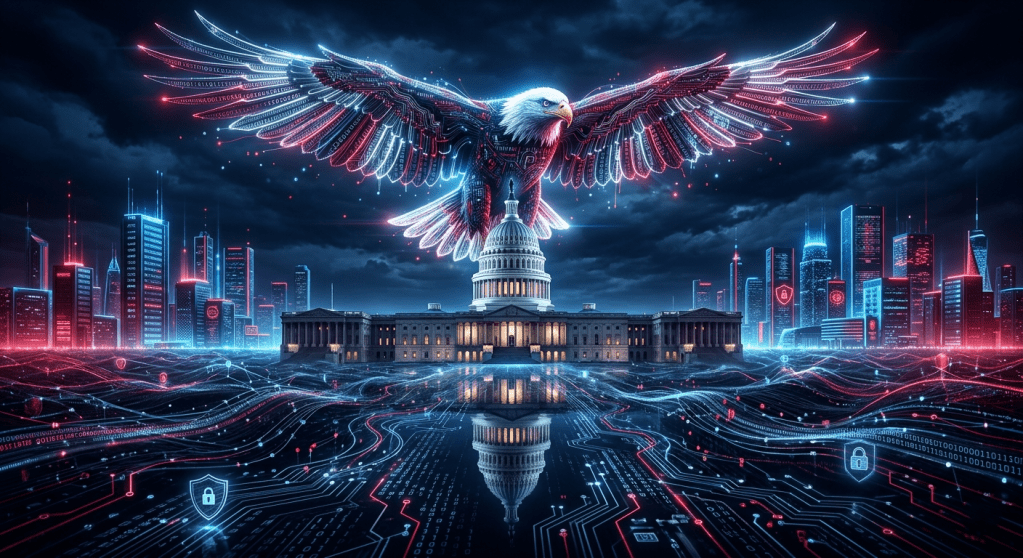
A New Digital Doctrine for a Dangerous World
Vladimir Tsakanyan
Published: March 10, 2026 | Topic: National Cybersecurity Policy | Source: White House Cyber Strategy, March 6, 2026
On March 6, 2026, the White House released a seven-page national cyber strategy document that signals a dramatic shift in how Washington intends to protect America’s interests in cyberspace. More muscular, more market-friendly, and more technologically ambitious than its predecessors, the strategy is a declaration that the era of hesitant, bureaucratic cyber defense is over.
So what exactly does President Trump’s cyber blueprint say — and what does it mean for ordinary Americans, U.S. businesses, and the global digital order? Here’s a close read.
1. A Tougher Deterrence Posture: Playing Offense
Perhaps the most eye-catching element of the new strategy is its embrace of deterrence — the idea that America must not only defend its networks but credibly threaten consequences severe enough to make adversaries think twice before attacking.
For years, critics argued that U.S. cyber policy was too passive — absorbing intrusions from China, Russia, Iran, and North Korea without imposing costs that changed behavior. The Trump strategy appears to reject that model explicitly. Expect a more aggressive attribution posture, faster sanctions, and a willingness to use offensive cyber capabilities as a tool of statecraft.
The message to adversaries is clear: the cost of attacking American networks has gone up. Whether that deterrence holds in practice will depend on follow-through — but the rhetorical signal alone represents a significant departure from recent years.
2. Cutting Red Tape: ‘Common-Sense’ Regulation
The strategy takes clear aim at what it describes as burdensome, fragmented cybersecurity regulation — the tangled web of sector-specific rules, duplicative reporting requirements, and compliance mandates that many businesses say consume resources better spent on actual security.
The administration’s answer is streamlined, “common-sense” regulation. While details remain to be worked out across agencies, the direction is toward fewer mandates, greater flexibility for industry, and a preference for outcome-based standards over prescriptive rules. For companies drowning in compliance checklists, this could be a genuine relief.
Skeptics will note that “common sense” is in the eye of the beholder — and that deregulatory cyber policy has historically been followed by damaging breaches. The strategy’s test will be whether regulatory simplification actually improves security outcomes or merely reduces reporting.
3. Private Sector at the Center: Industry Takes the Lead
The strategy reflects a foundational philosophical commitment: America’s cyber defense should be driven by the private sector, not by government mandates. Since the overwhelming majority of critical U.S. infrastructure — power grids, financial systems, telecommunications, healthcare — is privately owned, this is a pragmatic recognition of reality.
The document envisions deeper public-private partnerships, streamlined threat intelligence sharing, and an environment in which companies are empowered — and incentivized — to invest in security without being strangled by regulatory overreach.
This is a distinctly Trumpian approach: market forces and private ingenuity over government control. Whether it produces a more resilient cyber ecosystem or a patchwork of inconsistent defenses will be the defining question of the strategy’s implementation.
4. Betting on Technology: AI, Zero-Trust, Cloud & Quantum
In a striking show of technological ambition, the strategy commits the federal government to accelerating its adoption of four transformative technologies for cyber defense:
- Artificial Intelligence — to automate threat detection, accelerate incident response, and identify vulnerabilities at machine speed.
- Zero-Trust Architecture — the security model that assumes no user or system is inherently trusted, requiring continuous verification across federal networks.
- Cloud Computing — migrating government systems to modern, hardened cloud infrastructure managed by vendors with enterprise-grade security practices.
- Post-Quantum Cryptography — the next generation of encryption algorithms designed to withstand attacks from quantum computers, which could break today’s encryption standards within the decade.
This is genuinely forward-looking. The post-quantum pivot in particular is urgent: adversaries are already harvesting encrypted U.S. government data today, betting they can decrypt it once quantum computers mature — a strategy known as “harvest now, decrypt later.” Getting ahead of that threat is not optional.
5. Securing Critical & Emerging Technologies
The strategy pledges to secure what it calls “critical and emerging technologies” — specifically naming artificial intelligence, cryptocurrency, and quantum computing as domains where American leadership must be protected and adversarial exploitation prevented.
AI gets particular attention as both a defensive tool and a target. The strategy acknowledges the dual reality: AI can dramatically improve cybersecurity, but AI systems themselves are high-value targets — and malicious AI can be weaponized by adversaries to conduct more sophisticated attacks.
On cryptocurrency, the strategy’s inclusion signals recognition that digital assets have moved from a niche concern to a significant national security issue — from ransomware payments to sanctions evasion to illicit financing of adversary programs.
6. Confronting Foreign AI Platforms: A Direct Shot at China
One of the most politically charged elements of the strategy is its explicit commitment to counter “foreign AI platforms that censor, surveil, and mislead their users.” While the document does not name specific countries, the target is unmistakable: Chinese AI applications and platforms — including tools like DeepSeek — that operate under Beijing’s data laws and influence.
The concern is legitimate. AI platforms developed under authoritarian governments can be compelled to share user data with state intelligence services, can embed censorship of politically disfavored content, and can subtly shape information environments in ways that serve foreign policy objectives.
The strategy’s response appears to be a combination of restrictions on foreign AI platforms in sensitive contexts, promotion of American AI alternatives, and efforts to set international norms around AI governance that reflect democratic values — rather than the surveillance-compatible standards Beijing is pushing.
What It Means: Strengths, Tensions & Open Questions
The Trump cyber strategy is coherent, ambitious, and reflects real lessons from years of high-profile breaches — from SolarWinds to the Colonial Pipeline ransomware attack to the Salt Typhoon telecom intrusion campaign.
Its strengths lie in its clear-eyed view of adversarial intent, its embrace of cutting-edge technology, and its willingness to name geopolitical realities that earlier administrations sometimes softened. Its tensions lie in the inherent friction between deregulation and security — the market does not always price cybersecurity adequately, and voluntary frameworks have historically underperformed against determined state actors.
The open questions are substantial. How will deterrence be operationalized — and will it hold against a Chinese cyber apparatus that conducts intrusions at industrial scale? Can post-quantum migration be completed on a timeline that outruns adversary quantum development? And will the private sector, given more freedom and fewer mandates, choose to invest adequately in security — or wait for the next catastrophic breach?
The Bottom Line
America’s digital infrastructure is under sustained, sophisticated assault — from ransomware gangs, state-sponsored hackers, and adversaries positioning themselves for future conflict. The Trump administration’s cyber strategy deserves credit for matching the urgency of the threat with an ambitious response.
Whether it succeeds will depend not on the quality of the seven-page document, but on the unglamorous work of implementation — the funding, the personnel, the interagency coordination, and the sustained political will to prioritize cybersecurity even when a breach hasn’t made headlines in a while.
In cyberspace, the adversary does not take days off. The question is whether America’s defense will match that persistence.
Source: White House National Cyber Strategy, released March 6, 2026. Analysis represents editorial interpretation of publicly available policy documents.

Leave a comment