
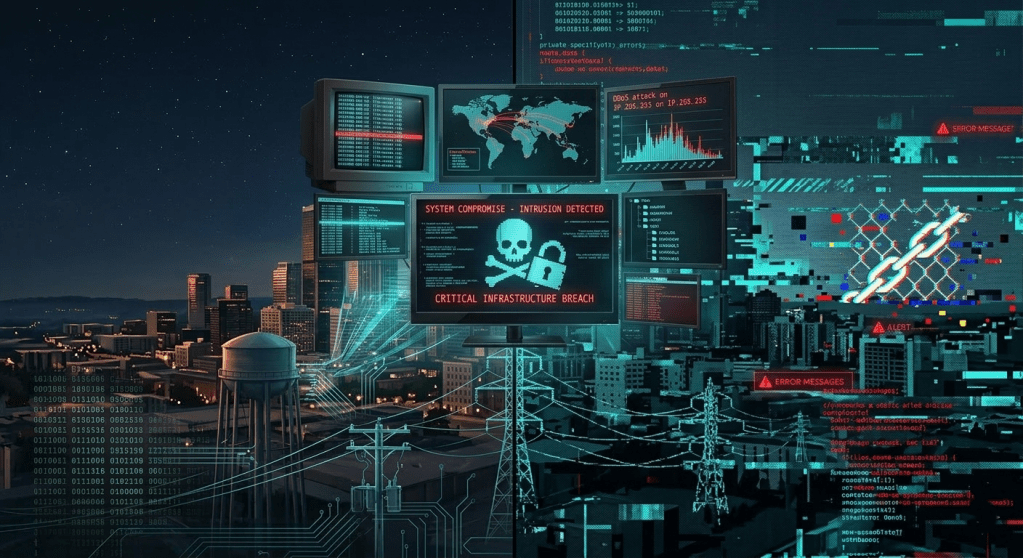
How Geopolitics Weaponized Cyberspace — and Left America Exposed
By the CyberCenter Editorial Team | Political & Security Analysis
Vladimir Tsakanyan
When the United States and Israel launched a sweeping air and sea bombing
campaign against Iranian military and government assets on February 28,
2026, the kinetic strikes were only one dimension of the conflict that
followed. Within hours, a parallel war erupted in the invisible corridors
of global cyberspace — one that threatens not soldiers on distant
battlefields, but the water plants, hospitals, financial systems, and
power grids that ordinary Americans depend on every day.
What makes this moment historically significant — and politically alarming
— is that the cyberattacks now targeting America were not improvised in the
chaos of war. They were premeditated. Intelligence and cybersecurity
analysts have confirmed that Iran-linked advanced persistent threat (APT)
groups had already positioned themselves inside U.S. networks weeks before
the first missile was fired. The war did not create the vulnerability; it
simply pulled the trigger.
"Something is going to happen because the gloves are off."— Kevin Mandia, founder of Mandiant and Armadin
This is the story of how geopolitics and cybersecurity have become
inseparable — and why the United States, at this moment of maximum threat,
finds itself operating with a weakened defensive posture, a beleaguered
cybersecurity agency, and a private sector left scrambling to fill the
gaps.
I. THE PRE-POSITIONING: IRAN WAS ALREADY INSIDE
Long before the bombs fell on Tehran, Iranian state-linked hackers were
quietly burrowing into American infrastructure. Researchers at Symantec and
Carbon Black identified the Iran-linked APT group Seedworm — also known as
MuddyWater, a subsidiary of Iran’s Ministry of Intelligence and Security —
operating inside multiple U.S. company networks beginning in early February
2026.
The targets were not random. Seedworm specifically hit a U.S. bank, the
Israeli operations of a U.S. software firm servicing the defense and
aerospace sector, a U.S. airport, and a U.S. nonprofit. Hackers attempted
to exfiltrate data using RClone and a Wasabi cloud storage bucket.
Researchers also discovered a Python-based backdoor planted on the airport
and nonprofit networks.
The strategic implication is stark. As Brigid O’Gorman, Senior Intelligence
Analyst at Symantec and Carbon Black’s Threat Hunter Team, explained: this
pre-positioning gave Seedworm a potentially dangerous foothold on U.S. and
Israeli networks before the conflict even began — ready to flip from
espionage mode to active disruption at a moment’s notice.
This is not improvisation. This is doctrine. Iran’s approach to offensive
cyber mirrors how conventional military powers use forward positioning —
placing assets close to the front before hostilities begin. And in 2026,
the front is everywhere there is an internet connection.
II. THE THREAT LANDSCAPE EXPANDS: FROM STATE ACTORS TO LONE WOLVES
A coalition of threat information-sharing groups, led by the Food and
Agriculture Information Sharing and Analysis Center (FA-ISAC) and the
Information Technology-ISAC (IT-ISAC), issued a sobering joint warning this
week. The picture they painted goes far beyond the headline-grabbing attacks
on major corporations.
State-sponsored groups, hacktivists, and criminal organizations are all
actively targeting U.S. critical infrastructure using tactics including
spear-phishing campaigns, stolen credentials, and coordinated
denial-of-service attacks. Scott Algeier, executive director of the
IT-ISAC, noted that Iranian actors have formidable capabilities and tend to
become especially active during periods of geopolitical conflict — precisely
the moment we now find ourselves in.
But the coalition’s warning contained an even more chilling dimension: the
threat of physical violence. At least two clerics in Iran have issued
fatwas — religious edicts — calling on Muslims to take revenge for the
killing of Iran’s former Supreme Leader Ali Khamenei at the outset of the
bombing campaign. Government-backed sleeper cells, lone wolf sympathizers,
and violent extremists inspired by the conflict could carry out real-world
attacks on U.S. soil.
The convergence of cyber and physical threat vectors into a single, unified
threat picture represents a new phase in modern conflict — one that the
classical national security apparatus was not designed to manage.
Meanwhile, pro-Russian hacktivist group Z-Pentest has also entered the fray,
claiming responsibility between February 28 and March 2 for compromising
multiple U.S.-based entities, including industrial control systems, SCADA
networks, and closed-circuit camera systems. Researchers at CrowdStrike
confirmed the timing was not coincidental: these groups were explicitly
targeting U.S. interests because of the Iran war.
"Western organizations should continue to remain on high-alert forpotential cyber response as the conflict continues — activity maymove beyond hacktivism and into destructive operations."— Adam Meyers, CrowdStrike
III. THE FINANCIAL RECKONING: RATINGS AGENCIES SOUND THE ALARM
The Iran conflict is not only a national security crisis — it is rapidly
becoming a financial one. Fitch Ratings released a report warning that the
U.S. and Israeli bombing campaign against Iran could meaningfully raise the
level of cyber risk for U.S. public finance issuers, including local
governments, municipalities, and critical infrastructure providers.
The concern is both operational and legal. Hacktivists, state-sponsored
groups, and lone wolf actors could use cyberattacks to disrupt power grids,
water utilities, and municipal services — entities that have historically
received far less cybersecurity investment than their federal counterparts.
Omid Rahmani, Director of U.S. Public Finance at Fitch Ratings, put it
plainly: local entities have never benefited from the same robust investment
in cybersecurity as larger federal institutions.
Moody’s Ratings echoed this concern, with cyber risk senior credit officer
Leroy Terrelonge warning that heightened geopolitical tensions involving
Iran increase the risk of retaliatory cyber activity — particularly against
organizations linked to the U.S., Israel, and allied nations. Ransomware
and data-wiping attacks, Terrelonge noted, are especially impactful from a
ratings perspective because of their ability to degrade critical services
and erode customer trust.
A CyberCube report from March 4 identified that 12% of large U.S. firms
with annual revenues exceeding $1 billion are among the most vulnerable to
Iran-linked attacks. These firms span seven critical infrastructure
categories, including 28 health organizations and 13 energy and utility
companies.
Perhaps most alarmingly, some insurance companies may invoke war exclusion
clauses to deny coverage for cyberattacks linked to the Iran conflict —
meaning the financial burden of these attacks could fall entirely on
corporate balance sheets. This is an unprecedented and largely untested
legal frontier that could have cascading consequences for the U.S. economy.
IV. THE POLITICAL DIMENSION: A WEAKENED CISA AT THE WORST POSSIBLE MOMENT
Here is where this story intersects most forcefully with domestic politics
— and where the analysis must be made clearly, even if uncomfortably.
The United States is confronting one of the most dangerous cyber threat
environments in its history at a moment when the Cybersecurity and
Infrastructure Security Agency (CISA) has been significantly weakened.
Under the Trump administration’s aggressive government-downsizing campaign,
most of CISA’s senior operating division leaders and regional office
directors have left or are leaving the agency this month.
The agency entered 2026 reeling from workforce cuts, lost resources, and
degraded partnerships with the private sector. Michael Daniel, president of
the Cyber Threat Alliance, described the situation bluntly: by cutting
staff, collaboration forums, and travel allowances, the Department of
Homeland Security is making it as hard as possible for CISA employees to
maintain contact with the private sector. Over time, these restrictions will
degrade CISA’s effectiveness and reduce its understanding of the broader
threat environment.
This degradation comes precisely as CISA is being asked to coordinate the
U.S. response to a wartime cyber threat. The agency’s acting director Nick
Andersen stated that CISA is working shoulder-to-shoulder with public and
private sector partners to track the Iran threat — but this is happening
during a partial government shutdown that is directly impacting the
Department of Homeland Security.
The political calculus here raises serious questions. The same
administration that launched a military campaign guaranteeing an Iranian
cyber response has simultaneously diminished the primary federal body
responsible for defending against that response. Whether this reflects a
coherent strategic vision or a failure of policy coordination, the
consequences are the same: America’s critical infrastructure is more
exposed than it needs to be.
"You can't simply 'refocus' CISA on core defense withoutacknowledging that defense relies entirely on those externalrelationships."— Infrastructure representative quoted by Cybersecurity Dive
V. THE BROADER COALITION: ALLIES RALLY, BUT QUESTIONS REMAIN
The U.S. is not alone in this fight. The UK’s National Cyber Security
Centre (NCSC) has urged British businesses to take precautions against
potential hacktivist attacks, with NCSC director Jonathon Ellison
emphasizing that the rapidly evolving situation in the Middle East makes it
critical for all U.K. organizations to remain alert to the potential risk
of cyber compromise.
John Hultquist, Chief Analyst at Google’s Threat Intelligence Group,
confirmed that Iranian cyber espionage resumed after a brief lull during
the initial military strikes — and that hacktivist fronts tied to the
Islamic Revolutionary Guard Corps are actively making threats about
disruptive attacks in the region.
Iran’s wiper arsenal alone — including tools with names like ZeroCleare,
Meteor, Dustman, and Apostle — comprises over 15 distinct malware families,
according to Anomali researchers. These are not crude instruments; they
represent years of deliberate development toward a single purpose:
destroying data and disrupting operations at scale.
It is worth noting that cyber operations in this conflict cut in multiple
directions. U.S. Cyber Command and Space Command were described by the
Chair of the Joint Chiefs as among the “first movers” during the initial
strikes against Iran. Israel reportedly used intelligence gathered from
hacked Iranian surveillance cameras — infiltrated over years — to support
the air strikes that killed Supreme Leader Khamenei. The digital and
physical dimensions of this war are now inseparable.
VI. WHAT MUST BE DONE: A POLITICAL AND STRATEGIC IMPERATIVE
The convergence of threats described above demands an urgent, coordinated
political response — not just a technical one. Several imperatives present
themselves:
- Restore and resource CISA immediately. A federal cybersecurity agency
operating at diminished capacity during wartime is not a policy
preference — it is a national security liability. Congressional action
to reinstate resources, personnel, and private-sector partnerships is
not optional. - Protect underinvested infrastructure. Municipal water systems, local
hospitals, and small government entities are the most likely targets of
Iranian retaliatory attacks precisely because they are the least
defended. Federal emergency cybersecurity grants and technical support
must flow to these entities now. - Clarify war exclusion insurance language. The prospect of American
companies bearing the full financial burden of state-sponsored
cyberattacks — denied coverage through war exclusion clauses — is
unconscionable. Legislative clarity is needed before companies face
billion-dollar losses with no safety net. - Strengthen threat information sharing. The coalition of ISACs sounding
the alarm this week represents exactly the kind of public-private threat
intelligence infrastructure America needs. Cutting CISA’s ability to
participate in and coordinate these networks is counterproductive to the
nation’s security. - Engage allies proactively. The cyber domain of this conflict is
multinational. Coordination with the UK’s NCSC, allied cyber commands,
and Gulf Cooperation Council nations is essential to prevent isolated
incidents from cascading into systemic failures.
CONCLUSION: THE WAR THAT NEVER COMES HOME — UNTIL IT DOES
For decades, American political culture has operated on an implicit
assumption: wars happen somewhere else. Cyberspace has shattered that
assumption permanently. The Iran conflict of 2026 is, among other things,
the first major U.S. military engagement in which the adversary has both
the doctrine and the capability to strike American civilians on American
soil — not with missiles, but with lines of code targeting the systems that
keep our water clean, our lights on, and our hospitals running.
The pre-positioning of Iranian cyber forces inside U.S. networks before the
war began is not a passive intelligence failure. It is an active strategic
warning about the nature of 21st-century conflict. Every military action
now carries a cyber price tag — and that price is paid not just by the
Pentagon, but by the municipalities, utilities, and companies that form the
connective tissue of American life.
The political decisions made in the coming weeks — about CISA’s resourcing,
infrastructure investment, insurance liability, and allied coordination —
will determine whether America meets this moment or stumbles through it.
The adversary is ready. The question is whether we are.
Sources: Cybersecurity Dive, CrowdStrike, Google Threat Intelligence Group,
Fitch Ratings, Moody’s Ratings, CyberCube, Flashpoint, Symantec/Carbon
Black, CISA, UK National Cyber Security Centre, PBS NewsHour, Axios.
Published March 14, 2026 | CyberCenter.space | Political & Security Analysis

Leave a comment