
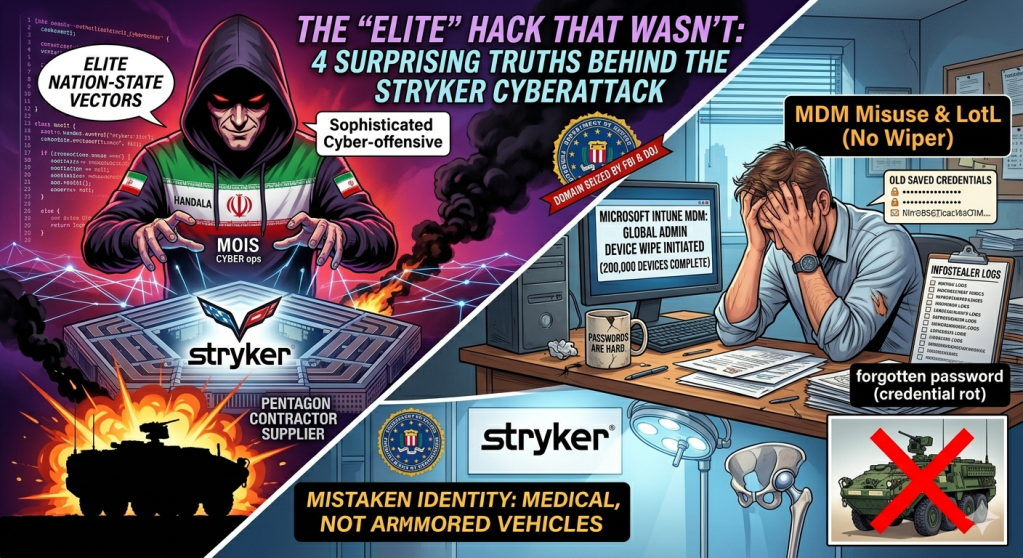
In March 2026, as black smoke billowed over Tehran following devastating airstrikes, the digital frontlines appeared to be screaming with equal intensity. The headlines were cinematic: a Fortune 300 medical giant, Stryker, paralyzed by a “sophisticated” Iranian cyber-offensive. The group claiming responsibility, “Handala,” framed the breach as a masterstroke of digital vengeance. The stakes felt viscerally high, especially following reports that Mohammad Mehdi Farhadi Ramin and Yahya Hosseiny Panjaki—two titans of Iran’s Ministry of Intelligence and Security (MOIS) cyber operations—had been killed in the escalating kinetic conflict.
Yet, as the digital forensics emerge, the narrative of a high-tech “cyber-war” is collapsing into a much more embarrassing reality. Behind the terrifying facade of nation-state warfare lies a story of forgotten passwords, hijacked admin tools, and a staggering case of mistaken identity.
1. Your Best Tools Can Be Your Worst Enemies
The most delicious irony of the Stryker breach is that the attackers never actually wrote a “wiper” virus. They didn’t need to. Instead, they took a legitimate, high-end administrative tool—Microsoft Intune—and simply asked it to do its job.
Intune is a Mobile Device Management (MDM) platform designed to give IT departments total control over a global fleet of laptops and phones. It is built to remotely wipe devices if they are lost or stolen. By obtaining “Global Admin” status, the Handala hackers turned Stryker’s own efficiency tool into a mass-destruction device. This is the epitome of “Living off the Land” (LotL)—a strategic shift where hackers forego custom malware to weaponize the software already trusted by the network. While the group is widely linked to the MOIS, it is worth noting that the U.S. government has yet to officially attribute Handala to a specific Iranian agency, a nuance that highlights the murky “hacktivist” personas Iran often hides behind.
“The hackers appear to have accessed a Microsoft program called Intune, used to remotely manage corporate phones and laptops, and simply chosen to delete all data on devices en masse.”
2. The “Elite Hacker” Myth vs. The Reality of “Old Homework”
If you pictured a “Mission: Impossible” style breach, the reality is a cold shower. According to Alon Gal, CTO of Hudson Rock, the “keys to the kingdom” weren’t forged in a basement in Tehran; they were likely bought from an “infostealer” log.
These logs are the byproduct of low-level, commodity malware—the kind an employee might accidentally download while trying to install a “free” PDF converter on a personal home computer. Once infected, the malware harvests every saved credential in the browser and uploads it to a dark web marketplace. In Stryker’s case, the hackers didn’t just find one password; they harvested dozens of Microsoft service and MDM credentials. Many of these credentials were months, if not years, old. The catastrophe was a result of systemic credential rot—a failure of basic digital hygiene that a simple password rotation could have neutralized years ago.
To further deflate the “elite” narrative, Handala’s claims of total dominance are often a performance. While they claimed to have crippled multiple giants, other alleged victims like Verifone have flatly denied being breached, suggesting the group is as much about “hype-ops” as they are about “cyber-ops.”
Key Fact:
- 200,000 devices were allegedly targeted for mass-deletion.
- Dozens of global offices were forced into an immediate, manual shutdown.
- Windows Environment Only: Despite the headlines, Stryker confirmed the incident was limited to its internal Windows environment, though it still crippled manufacturing and shipping.
3. A Case of Mistaken Identity?
There is a dark, comedic absurdity at the heart of this attack. Why would an Iranian group, in the middle of a hot war, expend its energy on a medical technology firm that makes orthopedic implants and surgical lamps?
The answer likely lies in a Wikipedia search gone wrong. “Stryker” is the namesake of the U.S. Army’s iconic eight-wheeled armored fighting vehicle. Analysts suggest that Handala—an opportunistic group known for “paydirt by happenstance”—may have seen the name on a target list and assumed they were hitting a major defense contractor. Instead of sabotaging the Pentagon’s supply chain, they disrupted the production of artificial hips. This highlights the nebulous, often chaotic nature of Iranian hacktivism: it is frequently less of a surgical strike and more of a blind swing at anything that sounds like “The Great Satan.”
4. The FBI is Hitting Back at the “Hype”
In mid-March, the FBI and Department of Justice moved to strip Handala of its most powerful weapon: its vanity. Law enforcement seized the “Handala RedWanted” website and several affiliates, replacing the group’s propaganda with a cold, blue Justice Department seal.
As Gil Messing of Check Point explains, these takedowns hit the group where it hurts most. Handala relies on these platforms to conduct “psychological operations,” inflating their successes to project an image of unstoppable power to both their enemies abroad and their masters in Tehran. By seizing the domains, the FBI isn’t just stopping a data leak; they are puncturing a PR campaign.
However, the group remains in a digital “whack-a-mole” game, retreating to Telegram to post defiant manifestos:
“This aggressive action reveals the extent to which the enemies of truth will go to silence voices that unveil their atrocities.”
Conclusion: The Future of the Digital Frontline
The seizure of the Handala domains is a tactical win, but it is hardly the end. The group is already regrouping on new encrypted channels, promising a “new website soon.” The digital frontline is permanent, but the Stryker incident has stripped away the mystique of the “elite nation-state” hacker.
We are left to realize that even in an era of high-stakes geopolitical warfare and multi-billion dollar defense budgets, the perimeter is often only as strong as a three-year-old password. As we look at the wreckage of 200,000 wiped devices, we must ask: In an age of high-tech defense, is our greatest vulnerability simply the failure to rotate an old password or the name on our front door?

Leave a comment