Every year, seasonal weather tests the limits of our physical infrastructure. We brace for power outages, supply chain delays, and grid strain. But according to FBI Cyber Division Assistant Director Brett Leatherman, the “winter” currently facing American digital infrastructure is a permanent weather pattern. We are living through a “Silicon Siege”—a persistent, state-sponsored offensive where the foundational architectures of Western life are under constant fire.
In response, the FBI launched Operation Winter SHIELD (Securing Homeland Infrastructure by Enhancing Layered Defense). This is not your standard awareness campaign. It represents a paradigm shift from “reactive remediation” to “investigation-led resilience,” aligning directly with the 2026 U.S. Cyber Strategy (President Trump’s Cyber Strategy for America). Under Pillar One of that strategy—Shape Adversary Behavior—the federal government is moving toward active deterrence and the systematic dismantling of adversary capabilities.
The threat is no longer just data theft; it is systemic sabotage. Adversaries like Volt Typhoon and Salt Typhoon (APT41) are pre-positioning themselves within critical systems, using “living off the land” (LotL) tactics to remain invisible. The breach of the FBI’s Digital Collection System Network (DCSNet)—specifically the sensitive “Red Hook” segment—proves that even the most secure perimeters are vulnerable. To survive, organizations must stop playing defense and start building targets too hard to hit.
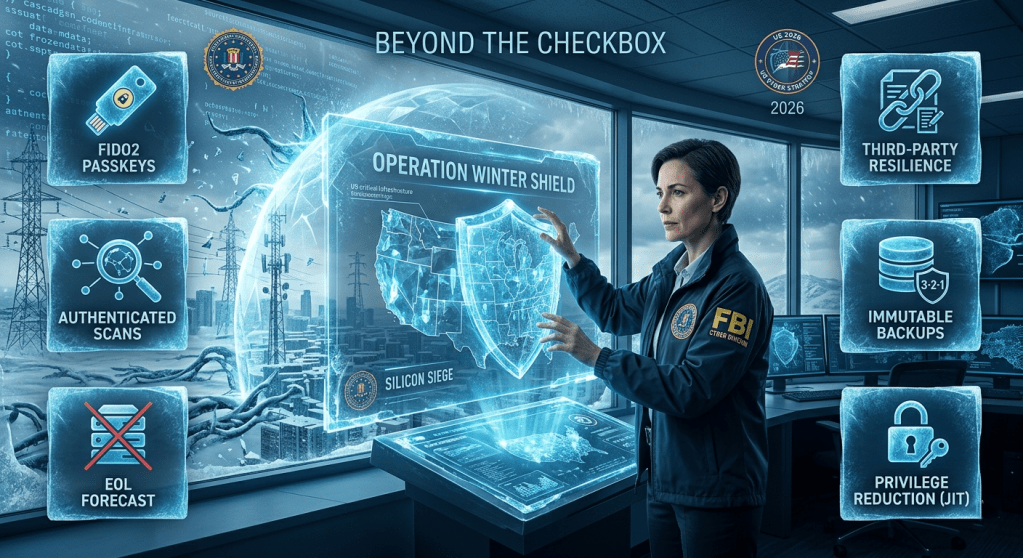
Here are the six technical mandates from the Winter SHIELD framework that every business leader must implement to move beyond checkbox compliance.
1. Kill SMS Authentication: The Rise of AiTM
Investigation-led data proves that stolen passwords remain the primary entry point for the majority of breaches. For years, multi-factor authentication (MFA) via SMS or push notifications was the baseline. In the 2026 landscape, these are liabilities.
Adversaries now routinely bypass traditional MFA through Adversary-in-the-Middle (AiTM) attacks, where codes are intercepted in real-time, or through “MFA fatigue” campaigns that bombard users until they click “Allow.”
The Strategic Shift: Organizations must transition to FIDO2-compliant security keys or device-bound passkeys. These methods bind authentication to the specific device and domain, neutralizing credential harvesting even if a user is deceived.
- Prioritize: Start with administrators, executives, and high-impact accounts.
- Eliminate: Disable legacy and SMS-based methods entirely. If authenticator apps are required as a stopgap, mandate number-matching and domain display.
“Many breaches start with stolen passwords. Phish-resistant methods make it significantly harder for attackers to gain access.” — FBI Operation Winter SHIELD Technical Framework
2. “Days, Not Months”: Authenticated Scans and Firm Deadlines
The FBI’s investigations into recent intrusions revealed a systemic failure: adversaries exploit known vulnerabilities that remain unpatched not because they are unknown, but because they lack clear ownership.
To combat this, the “risk-based” approach must be redefined. You cannot rely on external-only scans that merely check the perimeter. To find sophisticated backdoors—like the “Brickstorm” malware used to compromise VMware vSphere setups—you must utilize authenticated internal scans that reflect your actual configurations behind the firewall.
The Three Critical Requirements:
- Asset Inventory: Maintain a complete inventory with assigned owners and business criticality.
- Authenticated Internal Scanning: Move beyond the perimeter to identify hidden backdoors.
- Aggressive Remediation: Set timelines based on risk. For critical systems, remediation must be measured in days, not months. Any exceptions must be documented with compensating controls and firm completion dates to prevent “permanent temporary risks.”
3. Evict the Squatters: EOL Technology is a Strategic Liability
End-of-Life (EOL) technology is more than a technical debt; it is a primary entry point for state actors. Because EOL systems no longer receive security updates, they are “routinely targeted” as permanent backdoors.
In the context of the “Silicon Siege,” leaving unpatched, unsupported hardware on your network is essentially providing adversaries with “digital real estate” they don’t have to pay rent for. Operation Winter SHIELD instructs organizations to implement a Rolling 12-Month EOL Forecast, reviewed quarterly with procurement. If an asset cannot be replaced immediately, it must be isolated via strict network segmentation, and a firm decommission date must be set.
4. Close the Third-Party Trap: Contractual Resilience
Your security boundary extends only as far as your least-protected vendor. Hostile actors, as seen in the Brickstorm incident, frequently target IT service providers to bypass primary defenses and conduct supply chain sabotage across multiple firms.
Practical Steps for Third-Party Management:
- Centralize: Maintain a single register of all third parties with network or data access.
- Enforce: Apply least-privilege access and use monitored, authenticated gateways for all vendor interactions.
- Mandate: Security can no longer be a “gentleman’s agreement.” You must contractually require rapid breach notification, data encryption, and annual control verification. Access must be revoked and data disposition confirmed immediately upon contract termination.
5. Secure the Lifeboats: Immutable Backups are the First Target
Adversaries no longer wait until the end of an attack to target your data. To ensure total leverage, they target backups early in an operation to prevent recovery.
Resilience depends entirely on isolation and the 3-2-1 backup rule:
- 3 Copies: Maintain three copies of critical data.
- 2 Media Types: Use different media types for storage.
- 1 Offline/Immutable: Ensure at least one copy is stored offline and in an immutable format that cannot be altered or deleted by an attacker.
Furthermore, backup consoles must be limited to secured devices and protected by separate administrative accounts. The metric for success is no longer the existence of a backup, but the tested speed of recovery.
6. Freeze Out “Living off the Land”: Privilege Reduction
The “Living off the Land” (LotL) strategy used by actors like Volt Typhoon renders signature-based detection useless. By using your own legitimate administrative tools against you, these actors remain invisible.
The only way to disrupt this is to Reduce Administrator Privileges aggressively.
- Just-in-Time (JIT) Access: Minimize persistent administrative accounts. Use JIT access from secured devices for specific tasks.
- Separation of Duties: Those with admin rights should use a standard account for all non-administrative work.
- Log Protection: Centralize authentication, email, and network logs in a SIEM, and export them daily to protected, immutable storage. This prevents adversaries from erasing their tracks after using legitimate tools for escalation.
Conclusion: From Compliance to Deterrence
The 2026 U.S. Cyber Strategy signals a fundamental shift: industry is no longer a passive victim, but a critical ally in national defense. The objective is to raise the cost of every attack and deny our adversaries the digital real estate they need to operate within our borders.
As the Silicon Siege intensifies, the FBI’s goal is to move the needle from “checkbox compliance” to measurable outcomes. The cost of inaction is no longer just a fine or a headline—it is the potential for catastrophic systemic failure.
——————————————————————————–
A Final Thought: In a landscape of systemic sabotage, is your organization a hard target, or are you inadvertently providing the digital real estate your adversaries need to strike?

Leave a comment