
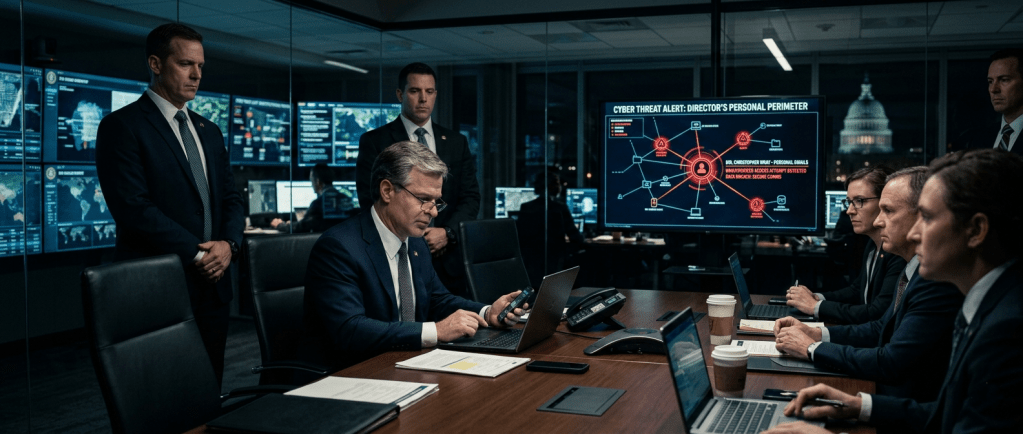
When government networks prove too hardened to breach, adversaries turn to a softer target — the private digital lives of the officials themselves. A new era of cyber warfare is dissolving the line between personal and national security.
Analytical Assessment · Cyber & Geopolitical Intelligence · March 2026
The breach of FBI Director Kash Patel’s personal email account is, on its face, an unremarkable data incident — old passwords, family photos, apartment searches. Yet it is precisely the mundanity of that cache that makes this episode so instructive. Modern adversaries are no longer storming the castle. They are picking the lock on the garden gate.
This report examines how high-level government officials are systematically targeted through their personal digital footprints, what adversaries seek to gain, and how these incidents reshape both domestic institutions and international calculations.
The “junk drawer” problem
Government cybersecurity investment over the past two decades has been substantial, and the results show: classified infrastructure is, by most measures, extremely difficult to penetrate. The consequence is tactical displacement. Sophisticated state-linked actors have redirected their efforts toward the path of least resistance — the personal Gmail accounts, consumer devices, and recycled passwords of the people who hold the keys to those secure systems.
Analyst note: Many high-profile breach claims involve historical credential data — email-password combinations exposed in pre-2020 data incidents — repackaged and released against newly prominent targets to maximize reputational impact. The “freshness” of a breach is frequently theater.
Researchers describe these personal accounts as “junk drawers” — repositories of informal correspondence, location data, financial searches, and family communications that were never intended for a threat environment. Their value to an adversary is not tactical intelligence; it is leverage, embarrassment, and narrative.
“The attack surface has migrated inward — from classified servers to the personal devices officials carry home.”
Transition windows and the vulnerability gap
Presidential transitions represent a particular moment of exposure. Incoming officials have not yet been embedded within protective government infrastructure; their communications remain on personal channels; and their digital hygiene reflects civilian rather than operational standards. Reports from the late 2024 transition period indicate that multiple incoming Trump administration officials — including the Deputy Attorney General — were targeted by actors linked to Iran and China during this window.
The pattern is not coincidental. Adversaries have learned to time operations around the transition interval, when the target is prominent enough to be valuable but not yet shielded by the full apparatus of federal security protocols.
State-linked proxies and the architecture of deniability
The actors executing these operations rarely bear the direct imprimatur of a government ministry. Groups like the Handala Hack Team — assessed to be linked to Iran’s Ministry of Intelligence and Security — operate as plausibly deniable proxies, optimized not for espionage yield but for psychological impact. Their goal is humiliation: to demonstrate that U.S. cyber defenses are porous, to undermine institutional credibility, and to amplify uncertainty within the target administration.
This framing reveals a critical distinction. The strategic value of the Patel breach is not the content of his inbox. It is the headline. State-linked operations of this type are fundamentally information warfare operations, where the act of publicizing a successful intrusion against a named director carries more weight than any intelligence gathered from the account itself.
Domestic consequences: friction within institutions
The geopolitical dimensions of official targeting are well-understood; the domestic institutional effects less so. Breaches — or even the credible allegation of breaches — generate political friction that adversaries can exploit as a secondary effect. When official communications are scrutinized, whether through foreign intrusion or domestic legal mechanisms such as grand jury subpoenas, the resulting controversy can fracture relationships within the Justice Department, the FBI, and the broader intelligence community.
The accusation that investigative powers were “weaponized” against private citizens who later assumed government roles is a recurring theme in contemporary U.S. politics. Foreign actors understand this dynamic. An operation that exposes or fabricates evidence of domestic surveillance of a future official does not need to be accurate to be disruptive — it needs only to be plausible and public.
Strategic implications for defensive posture
These incidents have precipitated meaningful shifts in how the U.S. government approaches cyber defense. Beyond the conventional hardening of classified networks, attention has moved toward the personal digital hygiene of officials at all stages of their careers — including in the period before government service begins. Proactive credential monitoring, mandatory use of hardware security keys, and briefings on personal account exposure are increasingly standard practice for transition team members.
At the international level, the U.S. has moved to more aggressively seize and disrupt foreign-operated infrastructure — hacker-associated domains, command-and-control servers, and propaganda platforms — as a deterrence signal. Whether these measures alter the cost-benefit calculation for adversaries remains an open question.
Bottom line assessment: The Patel incident is representative of a durable and evolving threat paradigm: adversaries will continue to target the personal perimeter of high-level officials because it is accessible, deniable, and effective as information warfare regardless of the intelligence yield. The policy response must address not only technical vulnerabilities but the institutional and political dynamics that hostile actors are specifically designed to exploit.
The FBI’s assessment that the Patel breach involved no government information and was historical in nature may be accurate. It is also largely beside the point. In the current environment, the private lives of officials are not peripheral to national security — they are part of its frontline.
Cybersecurity · National Security · Information Warfare · Iran · State-Sponsored Hacking · FBI · Geopolitics

Leave a comment