
Vladimir Tsakanyan | November 25, 2025
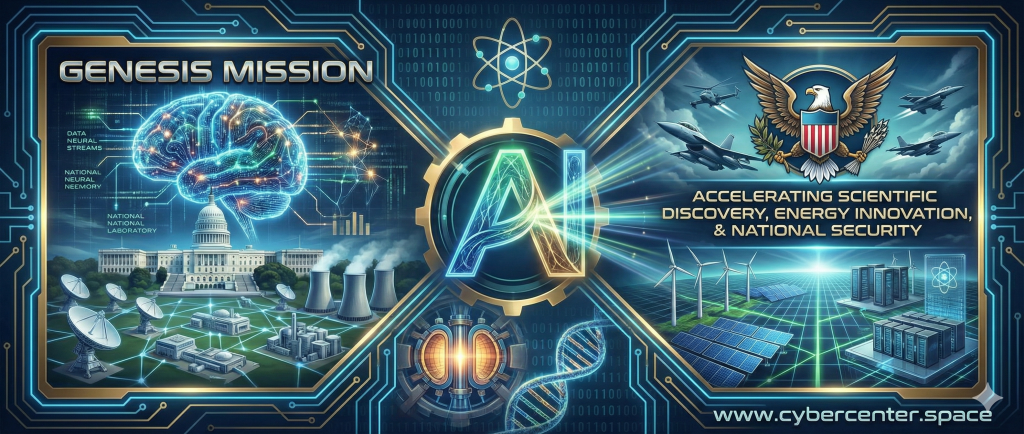
In a move framed as the most significant marshaling of federal scientific resources since the Apollo program, President Trump has signed an executive order establishing the “Genesis Mission.” This ambitious new federal initiative tasks the Department of Energy (DOE) with a singular, sweeping goal: to integrate the massive, untapped reservoirs of government data with cutting-edge artificial intelligence to secure American dominance in science, energy, and national security.
For industry watchers and geopolitical analysts alike, the Genesis Mission represents a pivot point. It signals a shift from the “safety-first” regulatory focus of previous years toward an “acceleration-first” doctrine. Below, we break down the core components of the initiative and analyze the political and strategic advantages that define this new era of American technocracy.
What is the Genesis Mission?
The Genesis Mission is designed to function as a closed-loop innovation engine. By executive order, the administration has directed the DOE to build the American Science and Security Platform—a unified digital infrastructure that connects the nation’s 17 national laboratories, their supercomputing clusters, and decades of federally funded research data.
The initiative targets 20 critical challenges, including:
- Nuclear Fusion & Advanced Energy: Accelerating the path to commercial fusion and modernizing the grid.
- Biotechnology: designing new proteins and therapies in silico.
- Critical Materials: Discovering alternatives to rare earth minerals to break supply chain dependencies.
- Semiconductors: Automating the design of next-generation microelectronics.
The administration has set an aggressive timeline: the DOE must demonstrate initial operating capability for at least one of these challenges within 270 days.
Political Analysis: The Strategic Advantages
While the scientific implications are vast, the Genesis Mission is fundamentally a political and geopolitical instrument. By framing AI development as a “Manhattan Project” style national imperative, the administration is leveraging several distinct strategic advantages.
1. Centralization as a Geopolitical Weapon
The primary political advantage of the Genesis Mission is the centralization of data sovereignty. In the global AI arms race—specifically against China—data is the payload. While private companies like OpenAI and Google have vast datasets, the U.S. federal government possesses unique, high-fidelity scientific data (e.g., nuclear physics data, material science properties) that no private entity or foreign rival can easily duplicate.
Analysis: By locking this data into a national platform, the U.S. creates a “moat” around its scientific innovation. This moves the competition away from consumer AI (chatbots) to industrial AI (material science and energy), a sector where the U.S. government maintains a distinct legacy advantage over Beijing’s state-led model.
2. The “Preemption” of State Regulation
A subtle but critical political component of the initiative is its stance on regulation. The administration has signaled that this federal acceleration could preempt a patchwork of state-level AI safety laws.
Analysis: For the tech sector, this offers a significant advantage: regulatory certainty. By federalizing the push for AI in science and framing it as a national security issue, the administration can effectively bulldoze local regulations that might slow down data center construction or model training. This unifies the market and removes friction for private partners like Nvidia, AMD, and cloud providers who are tapped to support the infrastructure.
3. Economic Nationalism through “Energy Dominance”
The initiative explicitly links AI innovation to lowering energy costs. The political narrative here is that AI will not just consume energy but solve the energy crisis by optimizing grids and inventing new power sources (fusion).
Analysis: This reframes AI from an environmental liability (due to high power consumption) to an environmental savior. Politically, this allows the administration to sell massive infrastructure spending to a broader base by tying it to lower household electricity bills and energy independence, effectively insulating the AI sector from criticism regarding its carbon footprint.
4. Public-Private Symbiosis
Unlike the original Manhattan Project, which was strictly government-run, the Genesis Mission is designed to be a hybrid. It grants private American AI companies access to federal “crown jewel” datasets in exchange for their compute power and expertise.
Analysis: This creates a national champion model similar to the military-industrial complex. It incentivizes Silicon Valley to align closely with national security goals, ensuring that the best American algorithms are applied to government interests rather than being exported or open-sourced indiscriminately.
Conclusion
The Genesis Mission is more than a science program; it is a declaration that the U.S. intends to win the 21st century through brute-force computational superiority. By treating scientific discovery as a logistics problem that AI can solve, the administration is betting that speed and scale will outweigh the risks. If successful, the Genesis Mission could fundamentally alter the relationship between the state, the tech industry, and the pace of human discovery.
For more updates on AI policy and national security technology, subscribe to the CyberCenter Space newsletter.


Leave a comment