
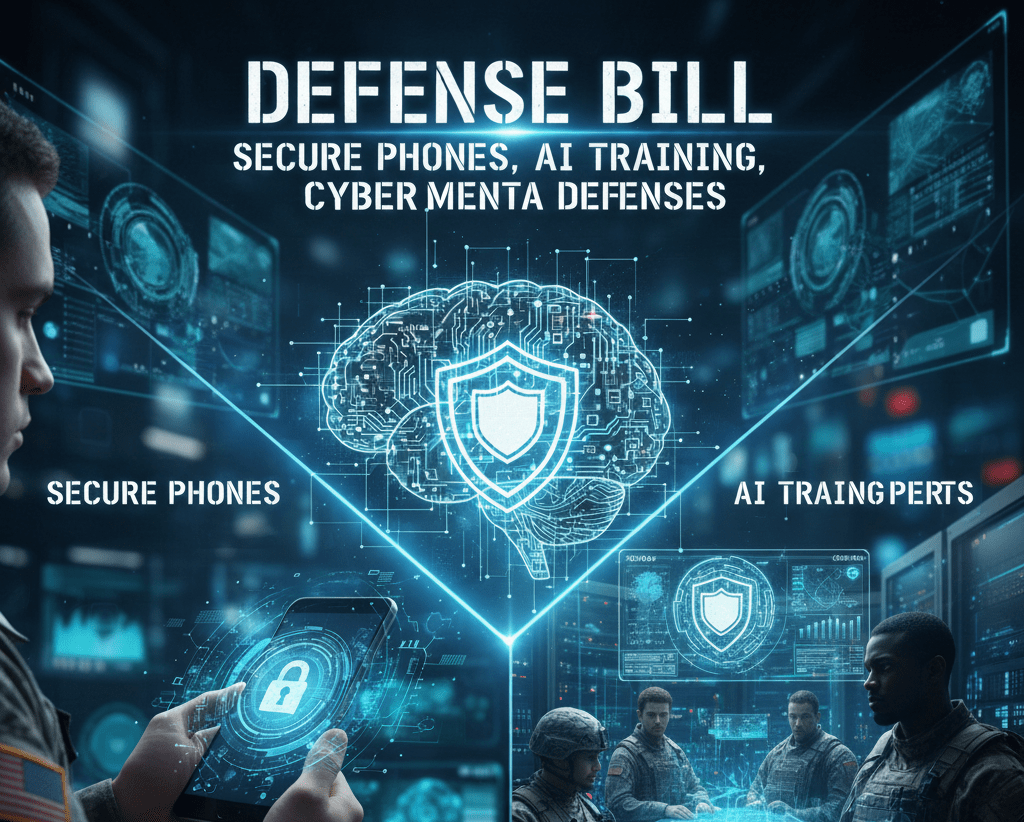
The recently released compromise legislation for the annual defense policy bill, the Fiscal Year 2026 National Defense Authorization Act (NDAA), introduces a robust package of cybersecurity provisions aimed at modernizing the Department of Defense’s (DoD) digital posture and improving the well-being of its specialized cyber workforce.
Beyond high-profile topics like regulating commercial spyware and maintaining the joint leadership of the National Security Agency (NSA) and U.S. Cyber Command (CYBERCOM), the legislation zeroes in on several critical, forward-looking areas: mandating secure mobile communications, integrating Artificial Intelligence (AI) into cybersecurity training, and prioritizing the mental health of cyber personnel.
📱 Strengthening Mobile Security for Senior Leaders
Recognizing that mobile devices represent a significant attack vector, the compromise bill mandates a significant uplift in communications security.
The legislation requires the Secretary of Defense to ensure that all wireless mobile phones provided to senior leaders and personnel handling sensitive national security missions meet a comprehensive list of cybersecurity requirements. This includes the mandatory use of data encryption and other protective measures to safeguard against sophisticated mobile-based espionage and cyberattacks. This move reflects an acknowledgment that personal and official devices are increasingly targeted by state and non-state adversaries.
🧠 Integrating AI into Mandatory Cybersecurity Training
As Artificial Intelligence (AI) rapidly changes the threat landscape, the NDAA dictates a necessary evolution in DoD training.
The bill directs the department to revise mandatory cybersecurity training for all members of the Armed Forces and civilian employees. The revised curriculum must include content related to the unique cybersecurity challenges posed by the use of AI. This includes training on how adversaries might leverage AI to automate attacks and how DoD personnel can defend against these next-generation threats. This proactive step prepares the workforce for a future where cyber conflict is increasingly automated and complex.
💖 Prioritizing Cyber Troop Mental Health
The high-stress, high-stakes nature of military cyber operations has led to a focus on the mental health of the specialized Cyber Mission Force (CMF).
The compromise legislation mandates that behavioral health specialists with the appropriate security clearances be deployed to U.S. Cyber Command and the Cyber Mission Force. This provision continues a trend in recent defense bills to address the unique psychological demands placed on cyber warriors, ensuring they have confidential and specialized access to mental health support services that understand their specific operational environment.
⚖️ Streamlining and Governance Provisions
The NDAA also includes several provisions designed to improve organizational structure, regulatory clarity, and policy on global cyber issues:
- Protecting Joint NSA-CYBERCOM Leadership: The bill includes language that sets up barriers to splitting the leadership of CYBERCOM and the NSA, prohibiting the use of department funding to reduce or diminish the responsibilities or organizational oversight of the CYBERCOM Commander. This signals continued support for the controversial, yet strategically important, “dual-hat” arrangement.
- Commercial Spyware Policy: The bill establishes a clear statement of policy opposing the misuse of commercial spyware against groups like journalists and human rights activists. It directs coordination with allies to prevent the export of such technology to likely misusers and establishes robust guardrails for U.S. government use.
- Harmonizing Contractor Requirements: To ease the burden on defense contractors, the legislation orders the DoD to “harmonize the cybersecurity requirements” across the department. The goal is to reduce the number of unique or redundant cybersecurity requirements tied to specific contracts, aiming for a more streamlined and efficient Defense Industrial Base (DIB).
These interconnected provisions underscore a comprehensive strategy by Congress to address both the technical and human elements of national cyber defense, ensuring the U.S. military is secure, trained for emerging threats, and equipped with a resilient workforce.

Leave a comment