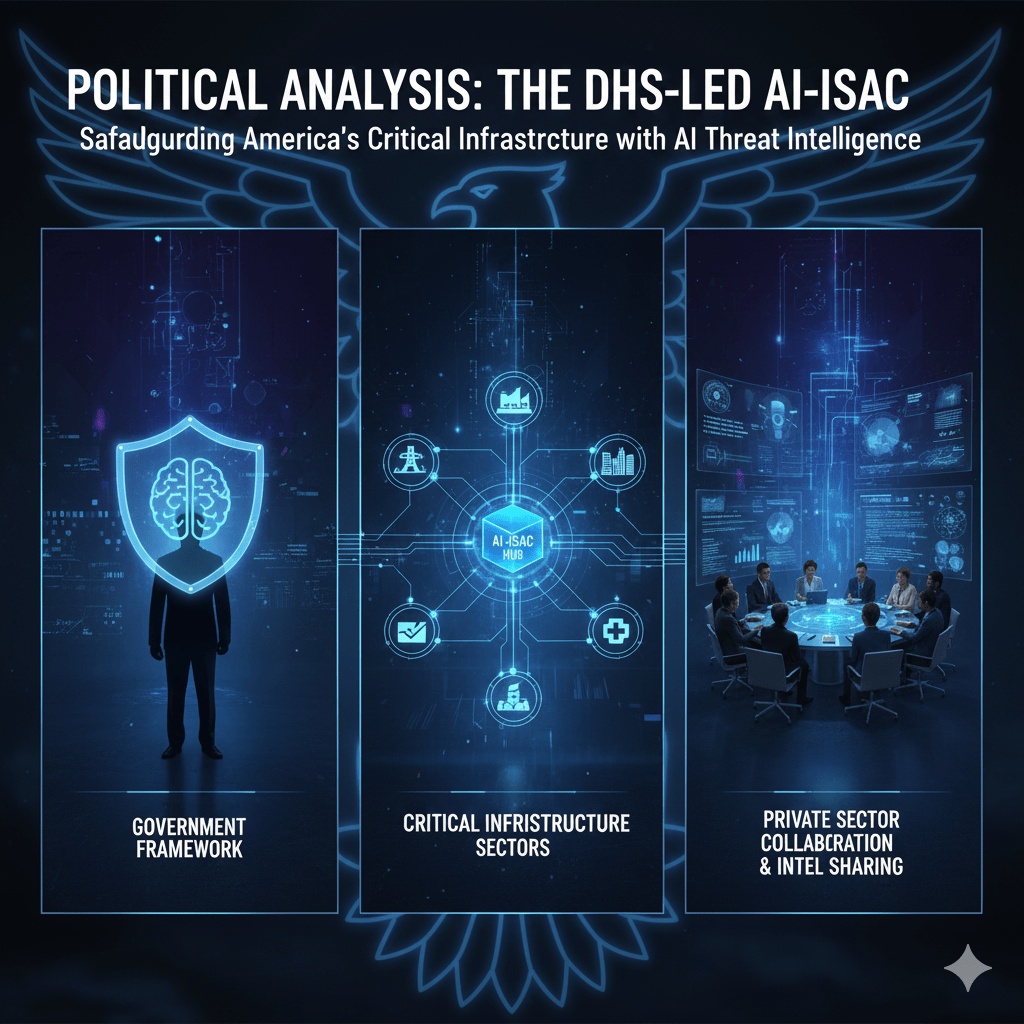
The inclusion of an Artificial Intelligence Information Sharing and Analysis Center (AI-ISAC), to be established by the Department of Homeland Security (DHS) as part of the administration’s “Winning the Race: America’s AI Action Plan,” represents a significant political and strategic maneuver in the rapidly evolving landscape of national security.
This policy action, which aims to coordinate AI-security threat intelligence sharing across U.S. critical infrastructure sectors, sits at the nexus of technology competition, national security, and public-private partnership, revealing key political priorities and potential friction points.
1. The Rationale: AI as a Dual-Use National Security Imperative
The political support for the AI-ISAC is rooted in a clear recognition of AI’s dual nature—it is both a revolutionary asset and a profound vulnerability for the nation’s most vital systems.
- Political Consensus on Threat: Regardless of political party, there is broad agreement that AI will become the primary vector for future cyber conflict. Adversaries can use AI to automate attacks, create sophisticated deepfakes for disinformation, and exploit novel vulnerabilities in the AI models themselves (e.g., data poisoning or adversarial attacks). The AI-ISAC frames the issue as a national security emergency that requires immediate, collective action.
- Leveraging Existing Infrastructure: Politically, establishing a new body under the existing ISAC model is a savvy move. ISACs (Information Sharing and Analysis Centers) are a proven framework, established in the late 1990s, that facilitate threat sharing within and across sectors (e.g., Financial Services, Energy, Healthcare). Placing the AI-ISAC under DHS/CISA leverages an established, trusted government mechanism, ensuring quicker implementation and industry familiarity, rather than requiring new legislation or a wholly new agency.
- The “Winning the Race” Narrative: The plan’s title, “Winning the Race”, underscores the administration’s central political message: the U.S. must maintain global technological dominance over rivals, particularly China. The AI-ISAC is presented as a vital component of this race, designed to safeguard America’s economic and strategic advantage by protecting the foundational AI infrastructure from espionage and attack.
2. Policy Implications and Political Friction Points
While the policy goal is widely supported, the actual implementation of an AI-ISAC presents several political and logistical challenges:
A. The Challenge of Private Sector Data Sharing
The fundamental success of any ISAC relies on voluntary and rapid information sharing by private companies. This is where the political friction lies:
- Liability and Trust: Companies are often hesitant to share detailed information about vulnerabilities and attacks due to fear of liability, regulatory penalties, or competitive disadvantage. The DHS and CISA will need to expend significant political capital to build a trusted, secure, and legally protected environment that overcomes this reluctance. The political reality is that industry will demand assurances (like limited antitrust or liability protection) in exchange for participation.
- Defining “AI Security”: The scope of the AI-ISAC must be clearly defined. Does “AI security threat intelligence” refer to vulnerabilities in the algorithms themselves, threats to the training data, or traditional cyberattacks leveraging AI? Ambiguity could lead to a vague, underutilized ISAC.
B. Jurisdiction and Interagency Coordination
The AI-ISAC overlaps with the mandates of several other powerful federal agencies, creating potential bureaucratic rivalry:
- CISA vs. DoD/NIST: While DHS/CISA is the logical choice for civilian critical infrastructure, the Department of Defense (DoD) and the National Institute of Standards and Technology (NIST) are also central to AI security. NIST has already published its AI Risk Management Framework (AI RMF), and DoD is a major AI developer and user. The AI-ISAC must coordinate effectively with these entities to avoid redundant efforts or conflicting guidance, a major challenge in interagency policy-making.
- Regulatory Balance: The administration’s overall plan heavily favors deregulation to accelerate AI innovation. The AI-ISAC, however, is a security-focused initiative that inherently involves setting standards and identifying risks. The political challenge is balancing the administration’s stated goal of reducing “burdensome regulation” (Source 1.2) with the need for robust security standards mandated by the ISAC’s information and analysis.
3. Political Outlook and Conclusion
The establishment of the AI-ISAC is a politically necessary and strategically sound component of the administration’s broader AI action plan. It acknowledges that, as AI becomes integrated into every facet of critical infrastructure—from power grids to financial transactions—the risk surface exponentially increases.
The political success of this initiative will be measured not by its creation, but by its adoption rate and effectiveness. To truly Win the Race, the DHS must:
- Build a Trusted Ecosystem: Offer concrete, compelling incentives and liability protections to encourage private-sector sharing of proprietary AI-related threat data.
- Maintain Clarity and Focus: Clearly define the AI-ISAC’s scope, ensuring it provides actionable intelligence that supplements, rather than duplicates, the existing sector-specific ISACs.
- Bridge the Talent Gap: The ISAC will require personnel with a unique blend of cybersecurity expertise and deep AI/Machine Learning (ML) knowledge—a skillset currently in high demand and short supply.
Ultimately, the AI-ISAC is an attempt to translate a high-level national strategy into an operational reality for the thousands of companies that underpin America’s digital and physical infrastructure. Its effectiveness will determine the nation’s collective resilience against the next generation of automated, AI-driven cyber threats.

Leave a comment