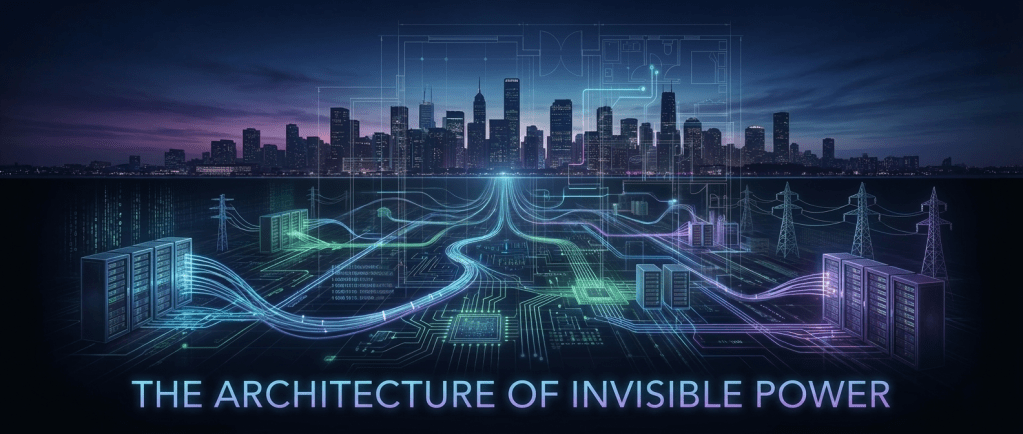
In 1928, Edward Bernays argued that those who control the “machinery of information” control the public mind. In the 21st century, that machinery has been replaced by a global, silent substrate. We once measured power in megatons; today, the most dangerous power is silent, embedded in the fiber optic cables beneath our streets and the code within our pockets. This is the era of the Shadow Architecture.
1. From Sabotage to Kinetic Code: The Stuxnet Legacy
The blueprint for modern invisible power was unveiled in 2010 with Stuxnet. It was the first “cyber-kinetic” weapon, proving that code could transcend the digital realm to physically destroy industrial infrastructure. Stuxnet’s true innovation was its patience, operating for years to map vulnerabilities before striking.
By 2015 and 2016, this doctrine evolved to target civilian life, as seen in the attacks on the Ukrainian power grid. These operations demonstrated that hackers no longer need to “break” a system—they only need to live within it, learning its rhythms until they are ready to weaponize a nation’s own utilities against its citizens.
2. The Doctrine of Pre-Positioning: Volt Typhoon
In 2024, the revelation of the Volt Typhoon campaign (a PRC-sponsored actor) marked a paradigm shift in statecraft. Unlike traditional espionage, Volt Typhoon focused on “pre-positioning”—embedding access within critical infrastructure like water, energy, and transportation to hold them hostage for future geopolitical crises.
These actors utilize “Living off the Land” (LotL) techniques, which avoid traditional malware in favor of using a system’s own administrative tools. By masquerading as legitimate traffic, they achieve a state of “permanent persistence” that is nearly impossible to detect with standard security protocols.
3. Agentic AI: The Autonomous Frontier
By 2026, the threat landscape has been further complicated by Agentic AI. Unlike previous models that required human prompting, agentic systems can autonomously plan and execute complex workflows. This creates a new, massive attack surface: the Reasoning Path.
In this environment, cybersecurity is no longer just about protecting data; it is about protecting the “intent” of autonomous agents. If an attacker can manipulate the goal-setting logic of an AI agent with privileged access, the system becomes a silent, high-speed insider threat.
4. Hybrid Coups and the Venezuela Incident
The convergence of digital and physical power reached its peak in January 2026 during a high-stakes operation in Venezuela. By executing a pre-planned “kill script” that blinded air defenses and severed military communications, cyber forces created a “misleading operational picture” that allowed kinetic forces to operate with total impunity. This Grey-zone warfare allows nations to achieve strategic victories without a formal declaration of war, operating entirely within the Shadow Architecture.
5. Policy Challenges: The Splinternet and Data-opolies
The silent substrate is managed by Data-opolies—tech giants that act as digital landlords. As governments move to reclaim control, we are seeing Regulatory Balkanization, or the “Splinternet.” Through data localization laws and national firewalls, the once-unified global internet is fracturing into fortified digital territories. While international bodies like the UN Permanent Mechanism (est. 2026) attempt to define responsible behavior, the reality remains a fractured landscape where national security priorities override global stability.
Conclusion: Securing the Substrate
The power of the Shadow Architecture lies in its invisibility. To defend against it, we must move beyond reactive firewalls. Resilience in the age of quiet power requires Identity Governance for AI agents, Supply Chain Transparency for the physical substrate, and a fundamental recognition that our infrastructure is now a primary battlefield.
SOURCES & REFERENCES
Primary Source: Documentary Evidence
All citations refer to the documentary script: “THE ARCHITECTURE OF INVISIBLE POWER” (2026).
- [1] The Invisible Substrate: Foundational concepts of invisible power and the shift from megatons to data. (Script lines 1–11)
- [2] The Bernays Thesis: Analysis of “Propaganda” (1928) and the machinery of information. (Script lines 12–17)
- [3] Kinetic Code (Stuxnet): Detailed history of the 2010 Stuxnet discovery and its implications for industrial sabotage. (Script lines 18–29)
- [4] Grid Weaponization: Case studies of the 2015/2016 Ukrainian power grid attacks. (Script lines 30–38)
- [5] Volt Typhoon Case Study: Analysis of PRC-sponsored pre-positioning and the use of SOHO/KV Botnets for persistence. (Script lines 51–65)
- [6] Living off the Land (LotL): Technical breakdown of stealth techniques using legitimate administrative tools. (Script lines 66–78)
- [7] The Venezuela Operation (Jan 2026): Account of the cyber-kinetic “hybrid coup” and the blinding of air defenses. (Script lines 79–95)
- [8] Agentic AI Threats: Analysis of autonomous AI systems and vulnerabilities in reasoning paths. (Script lines 96–125)
- [9] Digital Balkanization: Overview of the “Splinternet,” data-opolies, and the UN Permanent Mechanism for behavior. (Script lines 126–155)
Extended Research & Historical Context
- Bernays, E. (1928). Propaganda. Horace Liveright, New York.
- CISA (2024). Joint Advisory: PRC State-Sponsored Actors (Volt Typhoon) Compromise U.S. Critical Infrastructure. Cybersecurity and Infrastructure Security Agency.
- Zetter, K. (2014). Countdown to Zero Day: Stuxnet and the Launch of the World’s First Digital Weapon. Crown Publishing.
- National Security Institute (2025). Statement on Global Networks at Risk: Securing Telecommunications Infrastructure. Jamil N. Jaffer.

Leave a comment