
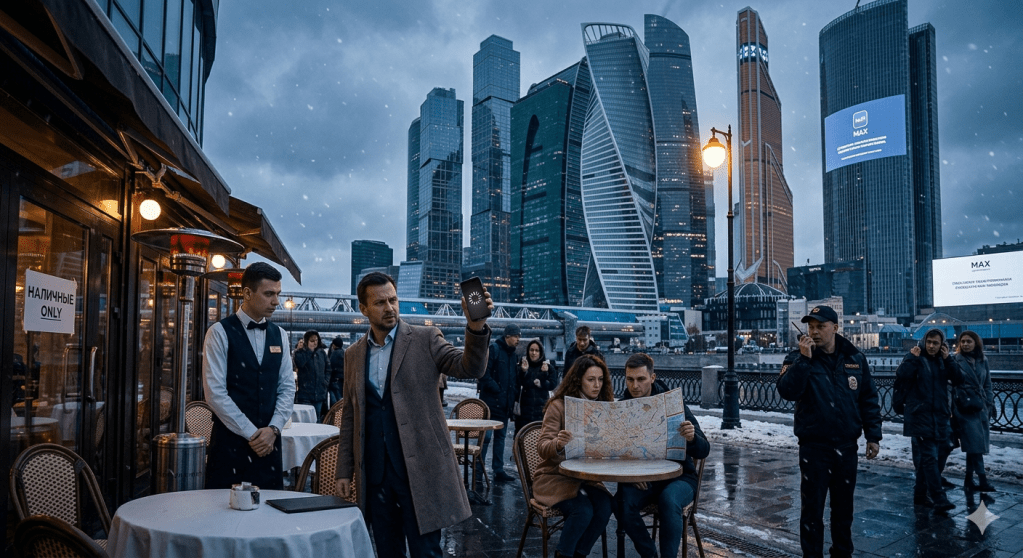
1. Introduction: A 21st-Century City Plunged into the 1990s
In the glass-and-steel heart of Moscow City, the silence is becoming deafening. At a high-end bistro near the Presnenskaya Embankment, the usual symphony of clinking glasses is punctuated by an awkward, recurring ritual: a waiter hovering over a table while a patron frantically waves their smartphone in the air, desperate to catch a ghost of a signal to settle a QR-code payment. The screen shows only the “endless buffering circle”— the new, unofficial logo of the Russian capital.
For a decade, Moscow preened itself as a hyper-connected megalopolis, a place where you could summon a luxury sedan or a grocery delivery with a thumb-swipe. But since March 7, 2026, that digital veneer has been stripped away. What the Kremlin frames as “technological protection measures” against Ukrainian drones has, in practice, functioned as a forced regression. A city that was building the future has been unceremoniously dumped back into the 1990s, where cash is king and the “world wide web” has shrunk to the size of a government-approved intranet.
2. The Analog Resurgence: Pagers, Paper Maps, and Star Navigation
As the digital infrastructure crumbles, Moscow is witnessing a “counter-intuitive” boom in tech that was once consigned to museum basements. According to data from the e-commerce giant Wildberries & Russ, sales of walkie-talkies have surged by 27% to 48%, while demand for pagers has skyrocketed by 73%. Perhaps most jarring is the tripling in demand for paper maps as GPS-reliant residents find themselves blind in their own neighborhoods.
The government’s response to this regression has bordered on the surreal. In a peak display of state-sponsored gaslighting, a State Duma deputy proposed installing “payphones with internet access,” while scientists from a local university, quoted by a state news agency, suggested that residents could simply “navigate by the stars” to find their way around the city.
Muscovites have met this absurdity with sharp-edged Eastern European humor. Comedian Andrei Kaygorodov’s viral skits—showing smartphones being sellotaped together as trouser straps or used as knives to chop cucumbers—serve as a form of social resilience. But the laughter is thin. As Mikhail Klimarev, director of the Internet Protection Society, puts it: “Russia’s leadership is simply very cowardly. So cowardly that it does not care about civil liberties, the economy, or people’s convenience.”
3. The “Iran Model”: Testing the Whitelist “Splinternet”
The blackout is not a mere technical failure; it is a live-fire test of the “Iran Model” of digital control. This represents a fundamental shift from reactive blocking (filtering “bad” sites) to proactive permission—a “Splinternet” where the web is turned off by default and only “whitelisted” portals are allowed to breathe.
Russia is meticulously following the Tehran rulebook, which famously used “white SIM cards” to keep the elite connected during the 2026 January protests while the masses were plunged into darkness. The Russian Digital Ministry’s version includes state-friendly resources and domestic marketplaces, but the execution has been defined by technical incompetence. Even sites on the government’s own whitelist have been failing to load, suggesting the “Digital Iron Curtain” is so poorly constructed it is inadvertently blocking its own propaganda. By creating this curated reality, the state isn’t just censoring information; it is attempting to delete the outside world from the Russian consciousness.
4. The Multibillion-Rouble Toll of “Security”
The economic cost of this “security” is staggering. Business daily Kommersant estimates that the outages are draining between 1 billion and 5 billion roubles ($37 million to $62 million) from Moscow’s economy every single day. Just five days of disruptions earlier this month caused upwards of 5 billion roubles in damages, hitting the logistics and retail sectors like a physical blockade.
The irony is that the elite are not immune. In the State Duma, lawmakers recently found themselves cut off when the building’s Wi-Fi and mobile networks collapsed, leaving the very people drafting the shutdown laws unable to access the web. From beauty salons forced to demand cash to car-sharing apps that have become useless ornaments on the curb, the Kremlin is sacrificing the economic health of its crown jewel for a “veneer of security” that many analysts believe has nothing to do with drones.
5. The Trojan Horse: MAX and the Death of Private Messaging
In the vacuum left by the throttling of Telegram and WhatsApp, the state is aggressively pushing its own “super-app,” MAX. Developed by the state-controlled tech giant VK, MAX is a “Trojan Horse” modeled after China’s WeChat—a one-stop shop for messaging and state services that doubles as a comprehensive surveillance tool.
The pressure to switch is mounting. Rumors of a total Telegram ban scheduled for April 1st have sent ripples of anxiety through the city, while new legislation allows the FSB to shut down any telecom service without liability. Furthermore, lawmakers have signaled that VPN traffic—the last lifeline for uncensored information—could be fully suppressed within six months. As Lera, a Moscow arts worker, noted: “I suspect the outages are not about security… they are part of a bigger ploy to cut us off… and force us to use the government messenger.”
6. The Drone Pretext vs. Political Fear
The official Kremlin narrative, delivered by spokesperson Dmitry Peskov, maintains that these are “technological protection measures” necessitated by “increasingly sophisticated” Ukrainian drone attacks. While Mayor Sergey Sobyanin claimed 250 drones were intercepted over a single weekend, the sheer scale of the digital lockdown suggests a deeper, internal paranoia.
Speculation is rife among analysts that the blackout is a preemptive strike against internal instability. Rumors of a “coup-in-planning” involving senior security official Sergei Shoigu have fueled theories that the government is less afraid of drones than it is of its own citizens’ ability to coordinate. When the state claims “strict compliance with legislation” while the capital goes dark, it is usually a sign that they are more worried about what is happening inside the Kremlin’s walls than what is flying over them.
7. Conclusion: The Future of the “Unplugged” State
By the end of 2025, Russia was already the global leader in internet shutdowns, but the current lockdown of Moscow is a point of no return. The city has become a laboratory for a high-stakes experiment: can a modern, globalized economy survive behind a digital whitelist?
As Muscovites carry stacks of cash and look to the stars for navigation, the “unplugged” state is no longer a dystopian theory—it is a daily reality. If this digital isolation becomes permanent, the “dark ages” currently haunting the streets of Moscow will mark the final decoupling of Russia from the 21st century, leaving 146 million people stranded in a curated, silent, and deeply surveilled past.

Leave a comment