
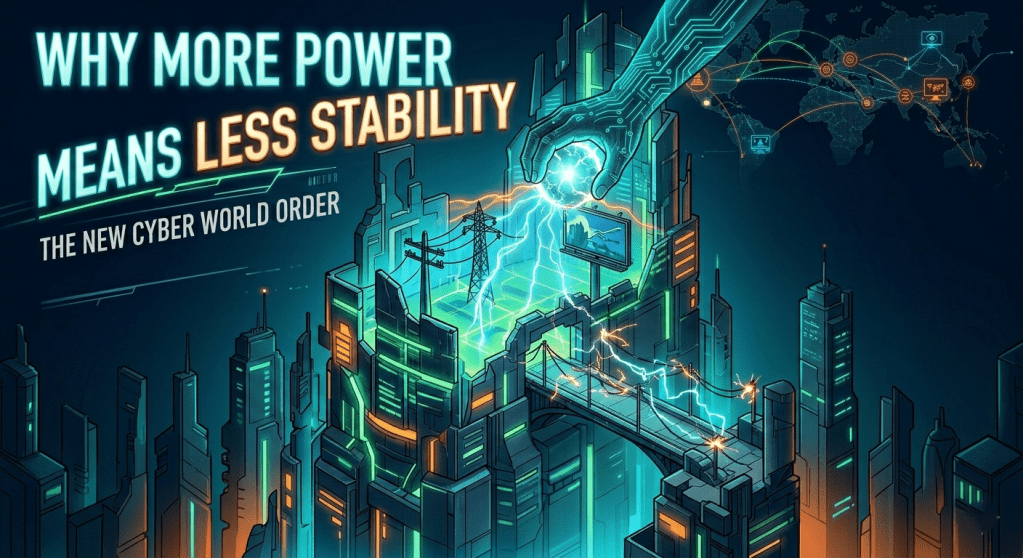
1. Introduction: The Invisible Frontline
The 2021 ransomware attack on the Colonial Pipeline and the 2022 hijacking of digital billboards in Taiwan during Nancy Pelosi’s visit were not isolated “technical glitches.” They represent a fundamental shift toward gray zone maneuvering—actions that intentionally blur the lines between peace and conflict, challenging the very core of Westphalian sovereignty. In this new era, the “frontline” is as likely to be a municipal power grid as a military command center.
Intuitively, we believe that increasing security leads to increased safety. However, the emerging reality of cyber diplomacy is far more paradoxical. To understand this domain, one must look past the headlines and into the “Multi-Echelon Cyber Warfare Theory” and “Outcome-Based Analysis” currently circulating in elite policy circles. What we find is a world where more power often generates less stability, and where the most effective defenses are those that lean into uncertainty rather than clarity.
2. The Paradox of Persistence: Why Defensive Aggression Might Backfire
U.S. Cyber Command (USCYBERCOM) has moved aggressively toward a posture of “Persistent Engagement” and “Defend Forward.” Rather than waiting for a breach, the U.S. now maneuvers continuously in adversary networks to disrupt campaigns before they reach domestic shores.
However, as strategic analysts Max Smeets and Herb Lin have observed, a more powerful U.S. in cyberspace does not automatically produce a more stable world. This “Paradox of Persistence” suggests that aggressive maneuvering often triggers a “rise of the rest.” Adversaries do not simply retreat; they adapt by increasing their own offensive budgets and conducting highly disruptive attacks to signal that they still possess the capacity to be feared.
Crucially, this strategy carries severe diplomatic side effects. By constantly “defending forward,” the U.S. risks eroding the value of international cyber norms and overextending Cyber Command across too many disparate fronts. Furthermore, these operations often utilize the infrastructure of allies, complicating diplomatic relations and straining the legitimacy of U.S. leadership. The current state of deterrence is perhaps best summarized by this exchange from a Senate confirmation hearing for Lt. Gen. Nakasone:
Sen. Sullivan: They [our adversaries] don’t fear us.
Gen. Nakasone: They don’t fear us.
Sen. Sullivan: So, is that good?
Gen. Nakasone: It is not good, Senator.
3. The Power of “Moderate Disaster”: Why Uncertainty Deters Better than Red Lines
In the nuclear age, stability was found in “Mutual Destruction”—a suicidal model that relies on the total sincerity of the threat. Cyberspace, however, operates on the principle of the “Moderate Disaster.” Applying Thomas Schelling’s “manipulation of risk” theory, modern strategists argue that safety is found not in clear “red lines,” but in strategic ambiguity.
Clear red lines are actually counter-productive; they provide a roadmap for adversaries to calculate exactly how much harm they can inflict without triggering a response. Strategic ambiguity, however, introduces Clausewitzian Friction. By delegating the authority to launch sub-threshold offensive operations to the Department of Defense (DoD)—occasionally without immediate White House or interagency approval—the U.S. creates a “threat that leaves something to chance.”
A notable example occurred during the first Trump administration when the DoD infiltrated Russia’s power grid with malware without prior presidential briefing. This brand of strategic ambiguity is a feature, not a bug. Because cyberattacks rarely “break things or kill people,” they are a highly credible, sub-threshold tool. An adversary who fears an unpredictable, “moderate disaster” from a delegated military command is far more likely to exercise restraint than one who relies on a slow, predictable political process.
4. The Rise of the “Middle Powers”: Small States as Global Stabilizers
While great powers like the U.S. and China are locked in zero-sum competition, “middle powers” have emerged as the “honest brokers” of the digital age. These nations use soft power to restrain great powers and protect their own agency in a domain they cannot dominate militarily.
Middle powers utilize three distinct strategies to bridge the geopolitical divide:
- Norm Entrepreneurship (Estonia): After the 2007 attacks that paralyzed its infrastructure, Estonia leveraged its technical prestige to host the NATO Cooperative Cyber Defence Centre of Excellence and lead the “Tallinn Manual” process, which provides the definitive guide on how international law applies to cyber operations.
- Neutral Partnership (The Netherlands): Positioning itself as a hub for dialogue, The Netherlands leads “The Hague Process” and champions the protection of the “public core of the internet,” ensuring that the foundational protocols of the web remain outside the reach of great-power skirmishes.
- Coalition Building (Singapore): Singapore has utilized the “ASEAN-Singapore Cybersecurity Centre of Excellence” to build regional capacity, turning the ASEAN bloc into a unified voice for stability that great powers cannot easily ignore.
5. The Deception Paradox: Why Knowing It’s a Trap Doesn’t Help
One of the most striking findings in recent warfare theory is the “Information Paradox” identified in the Tularosa Study. In traditional warfare, exposing a trap makes it useless. In cyberspace, the opposite is often true.
This concept, known as the “Price of Transparency,” suggests that in zero-sum settings, being open about defensive traps doesn’t weaken them. Even when attackers are explicitly told that a network contains decoys and honeypots, they still fail. The mere knowledge that deception is present forces the attacker into a state of “Cognitive Arbitrage.”
They are forced to waste resources, double-check every movement, and battle internal psychological friction. Mathematically, the attacker’s optimal strategy doesn’t change just because they know a trap exists; they are still forced into suboptimal choices by the sheer weight of their own uncertainty. In cyberspace, transparency is a weapon that slows the enemy down.
6. The Bureaucracy Bottleneck: The Fragility of Cyber Leadership
While the technology of cyber conflict advances at light speed, the organizational structures intended to manage it are often in retreat. In 2022, the U.S. established the Bureau of Cyberspace and Digital Policy (CDP) to elevate cyber issues to a national security priority. However, recent reorganizations signal a troubling shift in priority.
Reports indicate that the CDP is being moved under the State Department’s “economic growth” portfolio, alongside a plan to eliminate roughly 15 percent of US-based staff. By grouping the CDP with the Bureau of Intelligence and Research (INR) under an economic umbrella, the U.S. is signaling to adversaries that it views the domain as a “market to be managed” rather than a “frontline to be defended.” This move directly contradicts the intent of the Cyber Diplomacy Act and risks burying critical national security concerns under trade and energy interests.
7. Conclusion: The Forward-Looking View
The future of global security depends on mastering the “Multi-Echelon” nature of this conflict. This is a recursive meta-game played across five distinct echelons: Technical, Tactical, Operational, Strategic, and Policy.
A victory at the technical echelon (stopping a virus) is functionally useless if the policy echelon (alliances and norms) fails. We must move toward a synchronized strategy where every tactical maneuver is calibrated for its strategic and psychological impact.
As we look toward an increasingly fractured digital landscape, we are left with a provocative choice: Is the future of the internet a rules-based order led by “Honest Broker” middle powers, or a fractured “Gray Zone” governed by the manipulation of moderate disasters? Only those who embrace the paradox will be equipped to survive the answer.

Leave a comment