A new CyberCenter project designed to connect geopolitics, cyber activity, and artificial intelligence in one strategic intelligence environment.
https://cybercenter.ai/
https://cybercenter.ai/intel/
By Vladimir Tsakanyan, PhD
Center for Cyber Diplomacy and International Security (CCD-IS)
Cyberattacks rarely begin with the attack.
Before infrastructure is disrupted, networks are breached, or data is stolen, there are often signals elsewhere: diplomatic confrontation, military escalation, sanctions, political statements, intelligence warnings, economic pressure, influence campaigns, or activity by known threat actors.
The problem is that these signals are scattered across thousands of sources.
Cybersecurity teams watch vulnerabilities and incidents. Political analysts watch governments. News organizations watch events. Threat-intelligence platforms watch malicious infrastructure.
But the real strategic picture exists between those categories.
That is the idea behind CYBER INTEL.
Building a Different Kind of Cyber Intelligence Platform
CYBER INTEL is an experimental strategic intelligence platform I am developing as part of the broader CyberCenter ecosystem.
The objective is straightforward but ambitious:
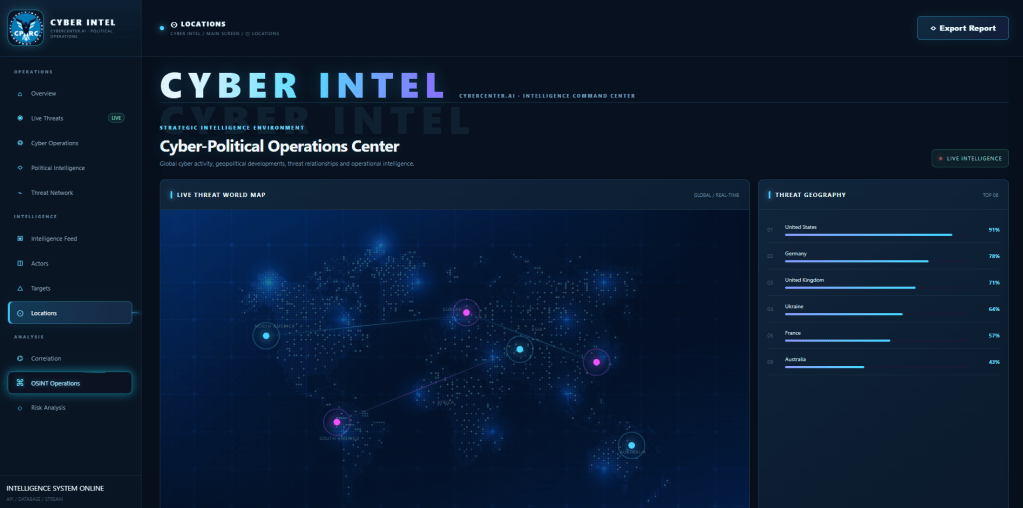
Bring geopolitical intelligence, cyber-threat information, global events, and AI-assisted analysis into a single operational picture.
Instead of treating a cyber incident as an isolated technical event, CYBER INTEL is being designed to examine the environment surrounding it.
A diplomatic confrontation may matter.
A military escalation may matter.
A new sanctions package may matter.
An unusual sequence of government statements may matter.
A cyberattack against critical infrastructure occurring shortly afterward may matter even more.
The platform is intended to help identify and visualize those relationships.
From Monitoring Events to Understanding Context
Traditional dashboards are very good at displaying information.
CYBER INTEL is being built around a more difficult question:
What does the information mean when viewed together?
The platform brings multiple intelligence layers into the same environment, including:
- geopolitical developments and political signals;
- cybersecurity incidents and emerging threats;
- major international confrontations and negotiations;
- state and state-linked cyber activity;
- critical infrastructure developments;
- strategic news and government statements;
- geographic visualization of incidents and events;
- AI-assisted analysis of relationships between political and cyber developments.
The goal is not simply to create another news feed.
It is to build an environment capable of transforming fragmented information into strategic situational awareness.
The Political Layer of Cybersecurity
One of the central ideas behind CYBER INTEL comes directly from my work in cyber diplomacy and international security.
Cybersecurity cannot be understood exclusively through malware, vulnerabilities, indicators of compromise, and network telemetry.
For sophisticated threat environments—particularly those involving states—the political environment matters.
Consider a hypothetical sequence:
Political confrontation → diplomatic escalation → economic pressure → hostile rhetoric → cyber reconnaissance → disruptive cyber activity.
Viewed independently, each event may appear ordinary.
Viewed together, they may represent an emerging strategic pattern.
CYBER INTEL is being developed to make those patterns easier to recognize.
AI as an Intelligence Layer
Artificial intelligence is an important part of this project, but I do not see AI as a replacement for analysts.
Its value is in helping analysts process scale.
An intelligence environment may contain hundreds or thousands of simultaneous signals. No individual can continuously read every government statement, cyber advisory, incident report, geopolitical development, and breaking-news event.
AI can help organize that information, identify relationships, summarize developments, and highlight events that deserve human attention.
That creates a different model:
Data provides the signals.
AI helps connect them.
Human analysis determines their strategic significance.
This is the direction I want CYBER INTEL to pursue.
Built as a Working Project, Not Just a Concept
CYBER INTEL is not simply a research proposal or theoretical framework.
I am actively building the platform.
The current work is focused on developing the intelligence dashboard, integrating relevant open-source information streams, creating geographic and strategic monitoring capabilities, and connecting the system with AI analysis.
The project is evolving iteratively: build a capability, test it, identify what produces useful intelligence, remove what creates noise, and expand what improves situational awareness.
That process matters because intelligence platforms can easily become overloaded with information.
The objective is not to display everything.
The objective is to surface what matters.
From Cyber Dashboard to Strategic Early Warning
The longer-term ambition for CYBER INTEL goes beyond visualization.
I want the system to move progressively toward strategic early warning.
Imagine an intelligence environment that continuously observes political, diplomatic, military, economic, and cyber developments and detects when multiple indicators begin moving in the same direction.
It would not claim to predict the future.
Instead, it could tell an analyst:
Something in the environment has changed. These signals are converging. This deserves attention.
That distinction is important.
Reliable intelligence is rarely about predicting an event with certainty. It is about recognizing changing conditions early enough to improve decisions.
Why I Am Building CYBER INTEL
CyberCenter has increasingly become more than a place where I publish research.
I want it to become a working environment where ideas developed through research in cyber diplomacy, cybersecurity policy, artificial intelligence, and international security can be translated into practical tools.
CYBER INTEL represents that next step.
It connects several areas I have been working on for years:
cybersecurity + geopolitics + cyber diplomacy + artificial intelligence + strategic analysis.
The project asks a simple question:
Can we understand cyber risk earlier by understanding the political environment around it?
I believe the answer is increasingly yes.
As geopolitical competition becomes more tightly connected with digital infrastructure, economic coercion, information operations, AI, and offensive cyber capabilities, separating political intelligence from cybersecurity intelligence becomes increasingly artificial.
The next generation of cyber intelligence systems will need to understand both.
The Direction Ahead
CYBER INTEL remains under active development.
New intelligence sources, analytical capabilities, visualization tools, AI functions, and correlation mechanisms will continue to be tested and integrated as the platform evolves.
But the larger objective will remain the same:
See the signals earlier.
Connect the events.
Understand the context.
Make better strategic decisions.
That is the mission behind CYBER INTEL.
And it is one of the directions in which I believe the broader CyberCenter project can make a meaningful contribution to the future of strategic cybersecurity intelligence.
CYBER INTEL — Intelligence Beyond the Incident.
Developed by Vladimir Tsakanyan as part of the CyberCenter ecosystem and the Center for Cyber Diplomacy and International Security (CCD-IS).

Leave a comment