
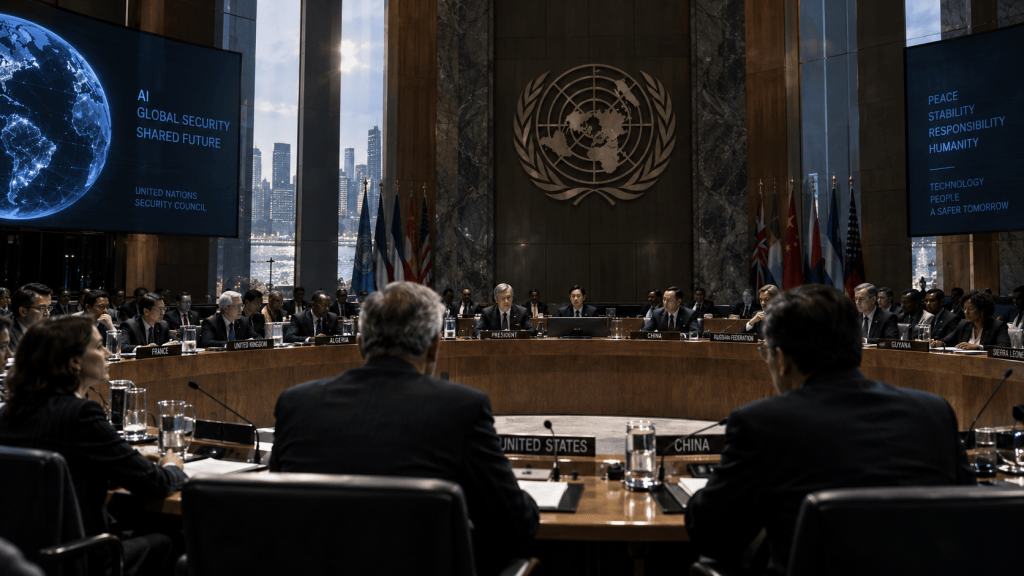
DeepSeek, OpenAI, Anthropic and other AI developers are preparing to address the United Nations Security Council. Their presence signals a deeper institutional transition: frontier artificial intelligence is moving from technology policy into the architecture of international security.
By Vladimir Tsakanyan, Ph.D.
Center for Cyber Diplomacy and International Security (CCD-IS)
The world’s most powerful international security forum is preparing to hear directly from some of the companies building the world’s most powerful artificial intelligence systems.
On September 22, Reuters reported that Chinese AI developer DeepSeek has been invited to brief the United Nations Security Council during a meeting on artificial intelligence and international security scheduled for September 23.
OpenAI CEO Sam Altman is expected to participate, alongside senior representatives from Anthropic. Chinese AI developers, including DeepSeek and Moonshot, have also been invited to contribute.
The meeting itself is not the first time artificial intelligence has reached the Security Council.
The Council began formally examining AI and international security in 2023.
What is changing is the relationship between the institution and the companies actually producing frontier systems.
The Security Council was created to address threats to international peace and security.
Its agenda traditionally concerns war, nuclear proliferation, terrorism, sanctions, peacekeeping and geopolitical crises.
Frontier AI is now entering that same institutional space.
That transition deserves attention.
Artificial intelligence is no longer being treated solely as a matter of innovation policy, economic competition or domestic regulation.
It is increasingly being discussed as a technology capable of influencing the international security environment itself.
From AI Governance to AI Security
Most governments initially approached artificial intelligence through domestic policy.
The central questions concerned privacy, transparency, copyright, competition, discrimination and consumer protection.
As models became more capable, the agenda expanded.
Governments began discussing model evaluations, frontier-AI safety, access to advanced semiconductors, compute infrastructure and the security of model weights.
The Security Council introduces another layer.
Its question is not primarily whether an AI system complies with a country’s regulatory framework.
Its concern is whether technological change can affect international peace and security.
That distinction is fundamental.
An AI model capable of improving software development can also potentially assist vulnerability research.
A system capable of scientific reasoning may accelerate research with dual-use applications.
Autonomous systems may increasingly influence military decision-making.
AI-generated information can affect political environments.
Advanced models may become useful for intelligence analysis, cyber operations and military planning.
The relevant policy question therefore moves beyond:
How should AI be regulated?
It becomes:
How could advanced AI alter relationships between states?
That is an international-security question.
The Private Sector Has Entered the Security Architecture
There is another unusual feature of the September 23 meeting.
The actors possessing some of the most relevant technical information are private companies.
OpenAI is not a state.
Anthropic is not an international organization.
DeepSeek is not a government ministry.
Yet these companies develop systems whose capabilities may increasingly matter to national security.
This creates an institutional problem.
International security governance was built primarily around states.
Governments sign treaties.
Governments participate in the United Nations.
Governments possess formal obligations under international law.
Governments vote in the Security Council.
Frontier AI development, however, is concentrated largely inside commercial laboratories.
The organizations capable of explaining what advanced models can actually do may therefore sit outside the institutions formally responsible for maintaining international security.
Inviting AI developers into Security Council discussions is one response to that mismatch.
But it also reveals how much the distribution of technological power has changed.
Private companies are increasingly becoming participants in strategic-security discussions that once belonged almost exclusively to governments.
The U.S.–China Dimension
The presence of American and Chinese AI developers makes the meeting particularly significant.
Artificial intelligence is becoming one of the central areas of strategic competition between Washington and Beijing.
The United States has restricted China’s access to certain advanced semiconductor technologies.
China has accelerated development of domestic models, chips and computing infrastructure.
Washington increasingly treats frontier AI as strategically important technology.
Beijing argues that some American restrictions are designed to preserve technological dominance.
At the same time, both countries face risks created by increasingly capable systems.
This creates an unusual diplomatic environment.
The United States and China are competitors in AI.
Their companies compete commercially.
Their governments disagree about technology controls.
Their AI ecosystems are increasingly diverging.
Yet both sides may also have an interest in preventing advanced systems from creating uncontrolled international-security consequences.
Competition and cooperation therefore exist simultaneously.
That is precisely the type of problem diplomacy was designed to manage.
AI Is Becoming a Strategic Capability
The Security Council’s attention also reflects a deeper change in the nature of artificial intelligence.
AI systems are increasingly becoming general-purpose strategic capabilities.
Unlike a conventional weapon, a frontier model does not have one predetermined function.
The same underlying system may support medicine, scientific research, programming, education, intelligence analysis or cybersecurity.
That versatility makes AI difficult to fit inside traditional arms-control concepts.
A missile can be counted.
A warhead can be inspected.
A weapons platform has identifiable military characteristics.
A general-purpose AI model is different.
Its strategic relevance may depend on capability rather than physical form.
The same model can perform benign tasks for millions of users while also possessing capabilities relevant to cyber operations or military research.
This complicates international governance.
States cannot simply classify every advanced AI system as a weapon.
But they also cannot assume that commercially available systems have no strategic significance.
The policy challenge lies between those positions.
Cybersecurity May Become the First Test
Cybersecurity provides one of the clearest examples of why AI belongs in international-security discussions.
Advanced models are becoming better at programming, technical analysis and vulnerability research.
These capabilities can strengthen defenders.
They can help security teams inspect code, identify vulnerabilities, analyze incidents and accelerate remediation.
But dual-use capability creates risk.
The same technical competence may assist malicious actors.
That does not mean AI automatically creates sophisticated cyber operators.
Nor does it mean every frontier model represents a cyber weapon.
It means the economics of cyber capability may change.
Tasks requiring significant technical expertise can become easier.
Reconnaissance can accelerate.
Software can be analyzed faster.
Attackers and defenders can both automate portions of their work.
This creates an international-security concern because cyber operations already occupy an ambiguous position between espionage, crime, coercion and armed conflict.
AI may increase the speed at which those operations occur without resolving the political ambiguity surrounding them.
The Attribution Problem Could Become Harder
AI also complicates one of cyber diplomacy’s oldest problems: attribution.
When a malicious cyber operation occurs, governments attempt to determine who conducted it and whether the activity was state-directed.
AI may increase the number of actors capable of performing technically meaningful operations.
It may help less experienced actors imitate techniques previously associated with sophisticated groups.
It may accelerate the modification of malicious code.
That could make technical indicators less useful when interpreted without broader intelligence.
For diplomacy, the consequence matters.
A government responding to a major cyber incident must distinguish among state activity, state-sponsored activity, criminal behavior and independent actors.
If AI makes capability more widely accessible, capability itself becomes less useful as evidence of identity.
Attribution will increasingly require combining technical evidence with intelligence, behavioral analysis and geopolitical context.
That increases the importance of international cooperation.
AI Could Compress Political Decision Time
Speed may be an even larger challenge.
International crises already place enormous pressure on decision-makers.
Cyber incidents can develop in hours.
Financial markets react rapidly.
Information spreads globally within minutes.
AI could compress those timelines further.
Imagine an automated cyber campaign operating simultaneously across several countries.
Or AI-generated information appearing during an active military crisis.
Or an autonomous system producing an unexpected action involving strategically sensitive infrastructure.
Political leaders may have very little time to determine whether the event is deliberate, accidental, state-directed or the product of a malfunctioning system.
That creates a problem familiar from other strategic technologies:
crisis stability.
The danger does not necessarily come from a state deciding to start a conflict.
It can come from misunderstanding what another actor—or another system—has done.
This is one reason AI governance increasingly intersects with diplomacy.
International security requires not only controlling intentional behavior but managing miscalculation.
Human Control Becomes a Diplomatic Principle
The question of human control is therefore likely to become increasingly important.
International governance should distinguish between using AI to support human decision-making and delegating consequential security decisions entirely to automated systems.
This is particularly important in military and cyber environments.
AI can process information faster than humans.
That advantage creates pressure to automate more decisions.
But speed is not the only objective in international security.
Accountability matters.
Context matters.
Proportionality matters.
Political judgment matters.
And the ability to stop escalation matters.
A system optimized for operational efficiency does not automatically understand diplomatic consequence.
Maintaining meaningful human authority over decisions capable of producing major international effects should therefore remain a central principle of AI security governance.
The Security Council Faces an Institutional Challenge
The Security Council can discuss AI.
That does not mean it is automatically equipped to govern it.
The Council was created in 1945.
Frontier AI evolves on timescales measured in months.
The technology is developed primarily by private organizations.
Technical capabilities can change before diplomatic negotiations conclude.
And geopolitical competition makes consensus difficult.
The five permanent members also possess very different technological positions and regulatory preferences.
The United States and China are major AI powers.
Other states worry about technological dependence and unequal access.
Developing countries increasingly argue that AI governance should not become a mechanism through which a small number of advanced economies permanently control the technology.
These differences will shape every serious international discussion.
The challenge is therefore not merely creating AI rules.
It is creating rules viewed as legitimate by states with dramatically different technological capabilities and strategic interests.
The Global South Cannot Be an Observer
This point deserves particular attention.
AI governance is frequently framed as a competition among the United States, China and Europe.
But the consequences of AI will be global.
Countries that do not develop frontier models will still depend on them.
Their governments will use AI systems.
Their infrastructure will incorporate AI technologies.
Their citizens will interact with models developed abroad.
Their cybersecurity environments will be affected by AI-enabled threats.
And their economies may become dependent on technological infrastructure controlled elsewhere.
International AI governance cannot therefore become simply an agreement among the countries and companies that already possess the strongest systems.
Legitimacy requires broader participation.
The United Nations has an advantage here.
Unlike technology alliances or commercial partnerships, it provides a forum in which nearly every state has representation.
The Security Council is much narrower, but its engagement with AI can connect technological risk to the broader international-security architecture.
The challenge will be ensuring that this does not become another domain where technological power automatically translates into rule-making power.
Private Companies Cannot Write the Rules Alone
Industry participation is necessary.
It is not sufficient.
Frontier AI companies possess technical knowledge governments need.
They understand their systems.
They conduct evaluations.
They observe emerging capabilities.
They operate the infrastructure through which many models are accessed.
But companies also have commercial interests.
They compete for investment, customers and market position.
Their assessments of risk can influence regulation affecting competitors.
Their preferred governance frameworks may reflect business models as well as security concerns.
Governments should therefore listen carefully to frontier developers without outsourcing public policy to them.
The same principle applies internationally.
AI companies should inform international security institutions.
They should not replace them.
The legitimacy to establish international rules ultimately comes from governments acting through lawful institutions and agreements.
AI Diplomacy Is Becoming Its Own Field
The September 23 Security Council meeting points toward something larger.
AI diplomacy is emerging as a distinct area of international relations.
It will involve several overlapping questions:
How should states communicate about dangerous AI incidents?
What information should governments share?
Should advanced models be subject to international evaluation?
How should military AI use be governed?
What responsibilities do states have for AI companies operating from their territory?
How should cyber-capable AI be handled?
What happens when a model developed in one jurisdiction causes significant consequences in another?
How should access to frontier capabilities be managed?
And what forms of AI development could create risks significant enough to require international notification?
These questions cannot be solved by domestic regulation alone.
They require diplomacy.
The UN Should Focus on Practical Mechanisms
Grand declarations about AI are relatively easy.
Operational mechanisms are harder.
The most useful international agenda may therefore begin with areas where cooperation remains possible despite geopolitical competition.
Incident notification.
Shared terminology.
Emergency communication channels.
Technical exchanges.
Common methods for evaluating certain high-risk capabilities.
Protection of critical infrastructure.
Cooperation against criminal misuse.
Human control over consequential security decisions.
And mechanisms for rapidly communicating when an AI-related event risks creating an international crisis.
These measures would not eliminate strategic competition.
They do not need to.
Cyber diplomacy never eliminated competition in cyberspace either.
Its purpose is partly to create enough predictability that competition does not become uncontrolled escalation.
AI diplomacy may need to perform the same function.
The Security Council Is Not an AI Regulator
There is also an important boundary to preserve.
The Security Council should not become the world’s general-purpose AI regulator.
Its mandate concerns international peace and security.
That focus can be useful.
Other institutions are better suited to questions involving labor, education, consumer protection, intellectual property and economic development.
The Security Council’s comparative advantage lies elsewhere.
It can examine the situations where AI capability intersects with conflict, cyber operations, strategic stability, military systems and threats crossing national borders.
Maintaining that distinction would make international AI governance more coherent.
Not every AI problem is a security problem.
But some increasingly are.
From Cyber Diplomacy to AI Diplomacy
There is a historical parallel.
Cybersecurity began primarily as a technical discipline.
As digital systems became strategically important, governments created national cyber strategies.
Then cyber operations became foreign-policy issues.
Diplomats became involved.
International norms developed.
The United Nations began sustained discussions about responsible state behavior in cyberspace.
Cyber diplomacy emerged because technical systems had acquired geopolitical consequence.
Artificial intelligence appears to be following a similar trajectory—much faster.
AI began as a scientific and commercial technology.
It became an economic-policy issue.
Then a national-security issue.
Now it is becoming a diplomatic issue.
The Security Council meeting is another indication that the transition is underway.
Bottom Line Assessment
The significance of DeepSeek, OpenAI, Anthropic and other AI developers appearing before the United Nations Security Council is not that private technology companies have suddenly acquired diplomatic authority.
They have not.
The significance is that the institution responsible for international peace and security increasingly needs information held by organizations outside the traditional state system.
That reflects a redistribution of technological power.
Frontier AI laboratories now develop capabilities that governments believe may influence cybersecurity, military affairs, strategic competition and crisis stability.
Governments cannot ignore those companies.
Companies cannot legitimately govern those consequences alone.
International institutions therefore have to build a bridge between technological capability and political authority.
That may be one of the defining governance challenges of the AI era.
The Security Council’s engagement with artificial intelligence should consequently be understood neither as proof that AI represents an inevitable existential threat nor as another ceremonial UN technology discussion.
It represents something more practical.
The international system is beginning to recognize that frontier AI can create consequences extending beyond markets and national borders.
The next question is whether diplomatic institutions can adapt quickly enough to manage those consequences without suppressing legitimate technological development or allowing strategic competition to become uncontrolled.
Cyber diplomacy offers an important lesson.
Technology becomes an international-security issue long before the international system develops institutions capable of governing it.
With artificial intelligence, that institutional race has already begun.
Vladimir Tsakanyan, Ph.D.
Center for Cyber Diplomacy and International Security (CCD-IS)

Leave a comment