At the AI Policy Summit during Ai4 2026, a central question emerged: can the world cooperate on artificial intelligence while the United States, China and Europe compete for technological, economic and geopolitical advantage?
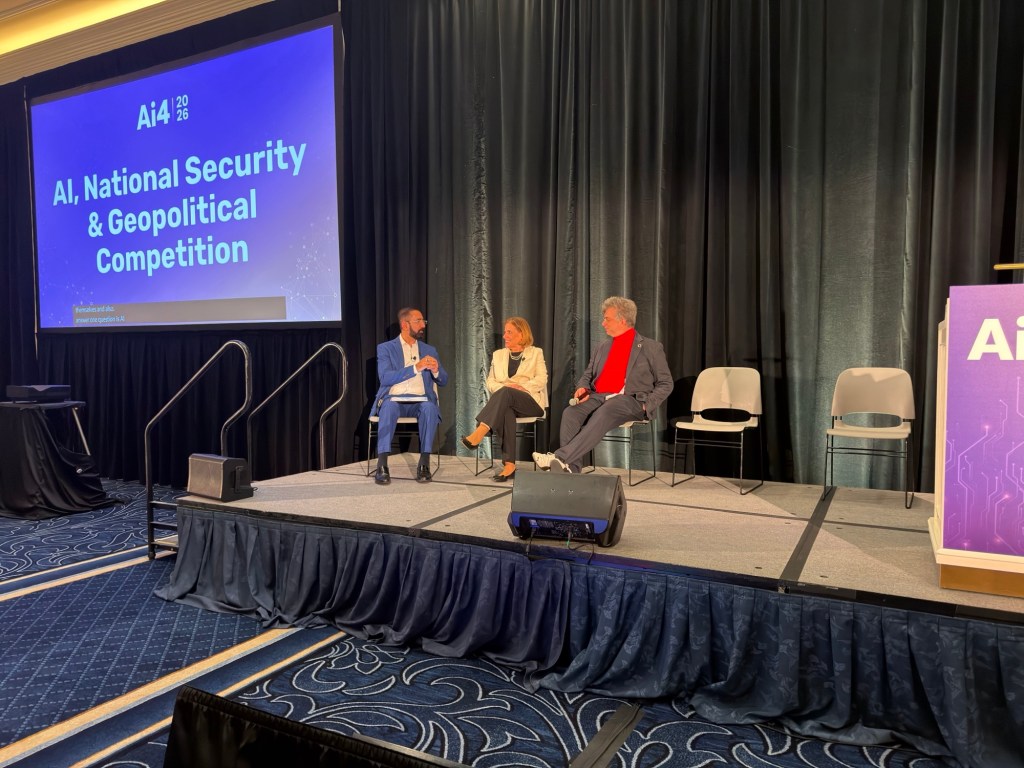
The panel on AI, National Security and Geopolitical Competition brought together Daniel Dobos of the AI for Good Impact Initiative and Lee Tiedrich of Tiedrich Global Strategies. Their discussion focused on a difficult but increasingly urgent challenge: how to create common approaches to AI safety without allowing standards to become tools of political control or technological exclusion.
The answer may lie in separating technical standards from regulation.
Standards Are Not the Same as Regulation
AI standards are sometimes criticized as a source of bureaucracy. However, technical standards and government regulations serve different purposes.
Regulation establishes legal obligations. Standards help define how systems should be measured, tested and evaluated. A standard can remain voluntary in one jurisdiction while becoming mandatory through legislation in another.
This distinction creates room for cooperation across different political systems. Countries that prefer a lighter regulatory approach can use standards as guidance. Countries that favor stronger government oversight can incorporate the same standards into their legal frameworks.
The most important issue is therefore not whether every country adopts identical AI laws. It is whether countries can agree on basic methods for evaluating AI systems.
At present, the global community still lacks consistent answers to fundamental questions:
• How should an AI model’s safety be measured?
• How should bias and reliability be evaluated before deployment?
• What testing should take place after a system enters the real world?
• How can governments compare the risks of different models?
• Which evaluation methods should be accepted across borders?
Developing common answers to these questions could make future regulation more practical and less fragmented.
Trust Is Becoming a Strategic Resource
The discussion also examined the United States’ changing role in global technology governance.
For decades, American influence was reinforced not only by economic and military power, but also by trust in U.S.-led institutions and technical systems. International cooperation in areas such as aviation safety demonstrates how common standards can reduce risk even when countries maintain different political interests.
AI presents a more complicated challenge because it is simultaneously a commercial technology, a national-security capability and a foundation for future military systems.
If international confidence in U.S. leadership declines, the United States may lose some of its ability to shape global AI standards. That does not mean Washington will disappear from the process. The United States remains deeply involved in AI testing, evaluation and standards development. However, relative influence can decline when cooperation is replaced by suspicion.
Trust matters because standards are not purely technical. The country or institution that helps define the standard may also influence:
• Which risks receive priority.
• What types of evidence are considered credible.
• Which companies can comply most easily.
• Which technologies become widely adopted.
• How markets develop around the standard.
A technical framework that is accepted around the world can encourage safety and interoperability. But if it is perceived as favoring one country or group of companies, it can become another front in geopolitical competition.
The AI Standards Race
The competition between the United States and China is increasingly visible in AI governance.
The United States is seeking to strengthen its AI evaluation ecosystem, support domestic innovation and encourage other countries to use American technologies. China, meanwhile, is promoting its own AI industry and participating in international standards organizations while expanding cooperation with countries outside the traditional Western technology sphere.
This creates a risk of competing technological ecosystems.
If countries adopt incompatible standards, businesses may face higher compliance costs and governments may struggle to assess AI systems developed elsewhere. More importantly, early standards can become locked in. Once a technology, testing method or infrastructure becomes dominant, alternative approaches may find it difficult to gain market access.
This is particularly important for developing countries. They may not have the resources to create entirely separate AI ecosystems. Instead, they may adopt whichever standards and models are cheapest, most accessible or most politically attractive.
Standards organizations such as the International Telecommunication Union and the International Organization for Standardization can help reduce this risk by bringing together technical experts, researchers, governments and industry representatives.
Their role is not to eliminate competition. It is to ensure that competition does not prevent cooperation in areas where shared safeguards are necessary.
Open-Weight Models Complicate the Debate
The rise of open-weight AI models adds another layer of complexity.
Open models can support innovation, research and competition. They allow universities, startups and governments to study systems that would otherwise remain controlled by large proprietary companies. Independent researchers can examine model behavior, test for bias and identify security weaknesses.
However, open-weight models may also be easier to modify in ways that remove built-in safeguards. This raises questions about accountability and responsibility. If a model is released openly and later adapted for harmful purposes, who should be held responsible: the original developer, the distributor or the end user?
The panel also touched on the growing use of Chinese AI models by companies in other countries. Some organizations are reportedly running these models on local servers because they can be less expensive than proprietary alternatives.
That trend creates both opportunities and risks. Local deployment may improve affordability and data control, but it can also raise concerns about intellectual property, model security, data provenance and dependence on foreign technology.
The debate over model distillation adds another complication. AI companies increasingly use the outputs of existing systems to train or refine new models. Whether this practice constitutes legitimate innovation or intellectual-property infringement will likely receive greater legal and political attention.
Still, open and proprietary models should not necessarily be viewed as mutually exclusive. The history of software suggests that both approaches can coexist. Proprietary platforms may dominate some markets, while open systems support research, customization and competition in others.
The long-term AI ecosystem will probably include both.
Where Does Europe Fit?
Much of the geopolitical conversation focuses on Washington and Beijing, but Europe is developing a distinct model.
The European approach often places greater emphasis on legal certainty, risk classification and regulatory predictability. This can create compliance burdens, but it may also give businesses clearer expectations about how AI systems can be developed and deployed.
Switzerland offers a different perspective within Europe. As a smaller country with limited resources, it cannot compete with the United States or China simply by matching their spending or scale. Instead, it can focus on targeted investment, specialized research and highly competitive niche industries.
This strategy resembles the role Switzerland has played in other sectors: producing world-class companies and technologies in specialized fields rather than attempting to dominate every part of the market.
The broader European opportunity may be to combine responsible governance with focused innovation. Rather than treating regulation and competitiveness as opposites, European policymakers can seek rules that provide enough certainty for startups and investors while preserving flexibility for emerging technologies.
The challenge is avoiding fragmentation. Different national requirements can make it difficult for companies to operate across borders, particularly when smaller businesses lack the resources to navigate multiple regulatory systems.
Cooperation Is Possible—But It Must Begin With Science
Despite the geopolitical tensions surrounding AI, the panelists identified areas where international cooperation remains possible.
Child protection was one example. Governments may disagree on trade, military strategy and economic policy, but they share an interest in understanding how AI affects children and future generations.
Other potential areas include:
• AI safety testing.
• Model evaluation methods.
• Cybersecurity research.
• Reliability and robustness measurement.
• Protection against harmful or deceptive content.
• Standards for high-risk applications.
Cooperation is more likely when discussions focus on scientific questions rather than political demands.
Researchers from different countries can collaborate on how to measure AI risks without agreeing on every issue of national strategy. They can compare evidence, test systems and identify areas of scientific consensus.
This is why international safety reports and research forums can be valuable. They create space for technical dialogue even when broader diplomatic relationships are strained.
A scientific forum will not resolve disagreements over export controls, military AI or technology competition. But it may help establish a shared vocabulary and common evidence base.
That could be the foundation for future agreements.
Competition and Collaboration Must Coexist
The strategic competition surrounding AI is not going away. The United States, China and Europe will continue to compete for talent, investment, standards influence and market access.
But competition does not eliminate the need for cooperation.
The most realistic path forward is not a single global AI law. It is a layered system in which countries cooperate on technical evaluation and safety standards while maintaining different regulatory and national-security policies.
Such a system would allow:
• Technical experts to work together where shared methods are useful.
• Governments to preserve their own legal and security priorities.
• Businesses to operate with greater predictability.
• Researchers to evaluate systems across borders.
• Smaller countries and companies to participate in the AI economy.
The future of AI governance will depend on whether nations can distinguish between areas where competition is necessary and areas where cooperation is essential.
The central lesson from the Ai4 2026 discussion is clear: common standards do not require common political systems. They require enough trust, transparency and technical discipline to agree on how risks should be measured.
In an era of geopolitical rivalry, that may be the most practical form of AI diplomacy available.
AI, National Security and Geopolitical Competition: Why Standards May Matter More Than Regulation (Ai4 Conference)
Discover more from Center for Cyber Diplomacy and International Security
Subscribe to get the latest posts sent to your email.

Leave a comment