
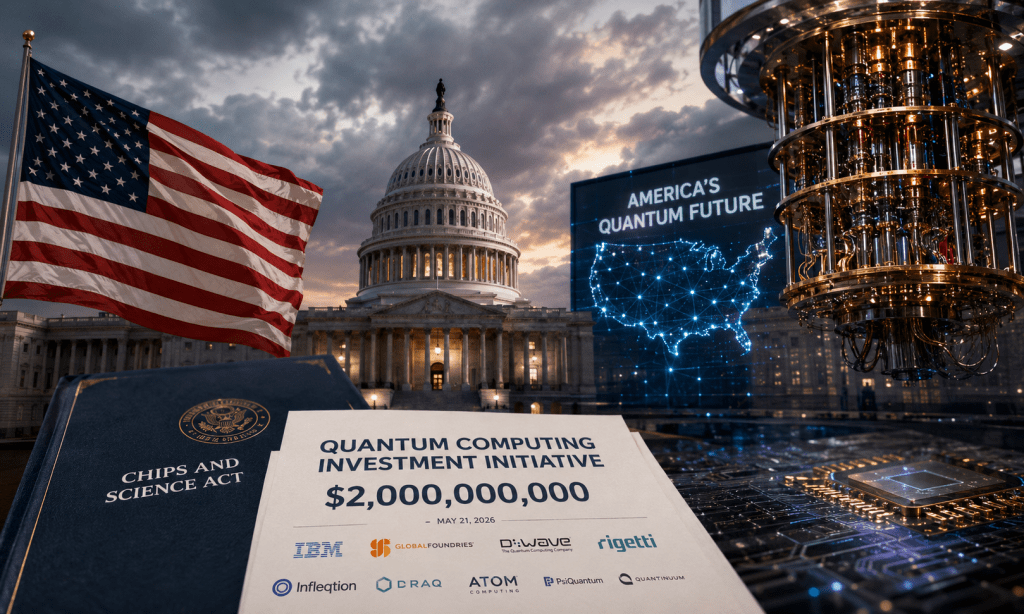
On May 21, 2026, the Trump administration committed $2 billion in federal grants to nine quantum-computing companies, with the U.S. government receiving minority equity stakes in each recipient. The announcement — the largest single federal investment in quantum technology in American history — reflects a governing logic that simultaneously accelerates the development of a technology with transformative national security potential and compresses the timeline within which that technology’s most consequential cybersecurity implications must be managed.
By Vladimir Tsakanyan, PhD · Center for Cyber Diplomacy and International Security · cybercenter.space
The U.S. Department of Commerce’s announcement of $2 billion in CHIPS Act grants to nine quantum-computing companies, structured around government equity stakes in each recipient, represents something more analytically significant than a large technology investment. It represents the application to quantum computing of an industrial policy framework — government as strategic minority shareholder in critical technology development — that the administration has previously deployed in semiconductors and rare earth minerals, and whose extension to quantum computing carries implications for the international governance of a technology whose most consequential application is the eventual obsolescence of the encryption infrastructure on which global digital security currently depends.
The distribution of funding reflects a deliberate supply-chain logic. IBM receives $1 billion — more than every other recipient combined — and commits a matching $1 billion to the construction of a quantum chip foundry called Anderon. GlobalFoundries receives $375 million to manufacture the specialised semiconductors that quantum hardware requires and that most quantum systems cannot currently scale without. D-Wave Quantum, Rigetti Computing, and Infleqtion each receive approximately $100 million, with smaller allocations going to Diraq, Atom Computing, PsiQuantum, and Quantinuum. The four publicly traded companies receiving the largest checks — IBM, GlobalFoundries, D-Wave Quantum, and Rigetti — saw their shares rise between seven and twenty-one percent in premarket trading, a market reaction that captures the investment dimension of the announcement while obscuring its more consequential security dimension entirely.
The Industrial Policy Architecture
The decision to structure federal quantum investment as equity-stake arrangements rather than grants, contracts, or research partnerships is not a technical financial distinction. It is a governing choice whose implications for the long-term relationship between the federal government and the quantum computing industry extend considerably beyond the immediate capitalisation of nine companies.
The Trump administration’s willingness to take ownership stakes in companies marks a decisive change in U.S. industrial policy. The reported investments expand Washington’s strategy of backing domestic supply-chain and strategic technology companies as the U.S. seeks to strengthen its position against China in advanced computing sectors. Among the companies where the government has already taken sizable positions are Intel and MP Materials, a rare earth mining company that plays a role in supplying materials used in electronics, defense systems, and electric vehicles. Quantum computing is the next sector to enter this orbit — and the one whose strategic stakes, for reasons this analysis will address, are the highest of any technology the administration has chosen to adopt this approach for. The Quantum Insider
The funding flows from the 2022 CHIPS and Science Act and still requires final deal completion. Its application to quantum computing — a technology whose commercial applications remain largely theoretical and whose most powerful systems do not yet outperform classical computers in practical tasks — reflects a governing judgment that the competitive window for establishing domestic quantum infrastructure is present now, and that waiting for commercial viability before committing public capital would cede that window to China’s state-directed quantum development program. This judgment may be correct. It is also, applied to a technology whose primary near-term strategic significance is its potential to break encryption, a governing choice that creates obligations and conflicts of interest the administration has not publicly addressed.
Analyst note
The equity-stake model creates an institutional entanglement between the federal government and the quantum computing industry that does not exist in conventional grant or contract relationships. A minority government shareholder in companies developing encryption-breaking technology has financial interests — in the valuation of those companies, in the speed of their technical progress, and in the commercial deployment of their products — that are not straightforwardly aligned with the security interests that would counsel deliberate, disclosed, and internationally coordinated management of quantum capability development. The NSA’s long institutional history of exploiting cryptographic vulnerabilities rather than disclosing them, documented most prominently in the Dual_EC_DRBG affair, is a relevant precedent for how government bodies with access to advanced cryptographic capability have historically managed the tension between offensive advantage and defensive disclosure. The equity-stake structure does not create new versions of that tension, but it adds a financial dimension to it that the grant-and-contract model did not.
The Competitive Logic and Its Security Implications
Secretary of Commerce Howard Lutnick’s framing of the announcement — that the Trump administration is “leading the world into a new era of American innovation” — accurately captures the primary motivating logic of the investment but elides the security architecture question that the investment’s scale and structure make more urgent rather than less.
The investment is, in its competitive dimension, a direct response to China’s state-directed quantum development program, which has operated at significant scale for years and which Washington has assessed as a strategic threat to American technological leadership in a domain whose military and intelligence applications are considered decisive. Anchoring quantum chip manufacturing on American soil through IBM’s Anderon foundry, establishing a domestic supply chain for the specialised semiconductors quantum systems require through GlobalFoundries, and distributing capital across the ecosystem of quantum hardware approaches — superconducting qubits at Rigetti, quantum annealing at D-Wave, neutral atoms at Infleqtion — reflects a supply-chain diversification logic whose strategic coherence is evident.
What this competitive logic does not address is the security implication that follows necessarily from its success. A successful American quantum computing program — one that achieves the cryptographically relevant capability thresholds that the investment is designed to accelerate — is, by definition, a program that has produced a technology capable of breaking the public-key encryption infrastructure that currently protects the communications and data of every government, financial institution, and individual using the global internet. The competitive framing addresses who develops that capability first. It does not address what the existence of that capability means for the security of the systems it was designed to protect.
Industry forecasts from 2026, including reports from Forrester and Google Quantum AI, suggest that “Q-Day” — the point when quantum computers can break mainstream public-key cryptography — is likely to arrive by 2030. Rapid advancements in logical qubit error correction have accelerated this timeline from previous 2035 estimates. An investment of this scale, directed at accelerating precisely the technical progress that those forecasts are based on, should be understood as a policy choice to compress that timeline further. The administration is, in effect, investing in the acceleration of the most consequential cryptographic threat in the history of digital security — while the governance framework for managing that threat’s implications remains, as of this writing, absent at every level from the national to the multilateral. Palo Alto Networks
The Cryptographic Threat Architecture
The cybersecurity implications of quantum computing at cryptographically relevant capability levels are not speculative. They are the subject of a substantial and technically mature body of analysis, and their core mechanism is well understood. Shor’s algorithm, running on a sufficiently large fault-tolerant quantum computer, can solve the integer factorisation and discrete logarithm problems that underpin RSA and elliptic curve cryptography — the two algorithmic foundations of essentially all public-key infrastructure currently in deployment. The practical consequence is the obsolescence of every SSL certificate, every encrypted email channel, every VPN tunnel, and every digital signature scheme built on these foundations. The scope of the affected infrastructure is not a subset of the global digital economy. It is the global digital economy.
Recent studies published in January 2026 reveal that quantum computers capable of breaking widely-used encryption protocols may emerge by 2030, requiring only 10,000 qubits instead of the millions previously estimated. This revision is analytically significant because it is not a marginal refinement of prior estimates. It is a compression of the required quantum resources by multiple orders of magnitude — a change that substantially shortens the distance between the current state of quantum hardware and the capability threshold at which existing encryption becomes operationally compromised. Informed Clearly
The practical security threat, however, does not wait for Q-Day. The harvest-now-decrypt-later attack paradigm — in which adversaries collect encrypted data in the present for decryption once cryptographically relevant quantum capability is achieved — means that the security implications of quantum computing’s eventual capability are present in current operations. Nation-state actors with long intelligence horizons are rationally incentivised to collect and store encrypted communications and data today that they expect to decrypt within the timeframe that revised Q-Day estimates now suggest. The data being collected is being collected now. The policy window for protecting it closed at the moment of collection, not at the moment of decryption.
Analyst note
The harvest-now-decrypt-later dynamic is the most consequential and least-discussed aspect of the quantum cryptographic threat, because it locates the security risk in the present rather than in a projected future capability threshold. Organisations that assess quantum computing as a future risk to be managed on a future timeline are making an error of temporal framing: they are treating a current collection threat as a future decryption threat, and managing it on the timeline of the latter rather than the former. The practical implication is that the window for protecting data against quantum-enabled decryption has already partially closed for any organisation whose encrypted communications have been subject to nation-state collection activity. For organisations in government, critical infrastructure, defence, financial services, and any other sector that represents a high-value collection target, that window may have closed considerably more than partially.
The Post-Quantum Cryptography Transition and Its Governance Gap
The technical response to the quantum cryptographic threat exists and is available for deployment. The National Institute of Standards and Technology finalised its first post-quantum cryptography standards in 2024, providing algorithm specifications — CRYSTALS-Kyber for key encapsulation, CRYSTALS-Dilithium for digital signatures — that are designed to resist attacks from both classical and quantum computers. The transition pathway from current public-key infrastructure to post-quantum cryptography is technically defined. What it is not is operationally complete, or even, for the majority of organisations, operationally initiated.
2026 has been declared the “Year of Quantum Security” by an industry coalition, with launch events in January 2026 featuring senior officials from the FBI, NIST, and CISA. The designation reflects growing coordination across government, industry, and critical infrastructure to accelerate awareness and preparedness. It also reflects, in the vocabulary it requires, the distance between the urgency of the technical community’s assessment and the operational posture of the organisations that assessment is directed at. Nearly half of enterprises in North America and Europe haven’t integrated quantum computing into their cybersecurity strategies. Mid-sized organisations are particularly vulnerable, with 56% admitting they aren’t prepared. ClearanceJobsClearanceJobs
The governance gap this creates is not primarily a gap in technical standards. The standards exist. It is a gap between the availability of a technical solution and the institutional, regulatory, and commercial conditions under which that solution will be adopted at the scale and speed that the threat environment requires. No binding framework at the national level currently mandates post-quantum cryptography migration timelines for critical infrastructure operators. No multilateral framework at the G7, G20, or UN level establishes equivalent obligations across jurisdictions. The European Union’s AI Act, whose risk classification architecture is the most developed regulatory framework for advanced technology in any major jurisdiction, does not address post-quantum cryptography transition as a governance matter. The result is a transition whose technical specifications are complete and whose security urgency is acute, proceeding at the voluntary pace of organisations assessing their own readiness on their own timelines.
The $2 billion investment announced today will accelerate quantum capability development. It will not, in itself, accelerate post-quantum cryptography adoption. These two processes are moving at different speeds, in the same direction, toward the same capability threshold — and the gap between them is the space in which the most consequential cybersecurity risk of the coming decade will materialise.
The Institutional Conflict of Interest
The equity-stake dimension of today’s announcement raises a governance question that neither the administration’s communications nor the financial media’s coverage have engaged: the relationship between government ownership in quantum computing companies and the institutional management of quantum cryptographic vulnerability.
Governments and intelligence agencies with access to advanced cryptographic capabilities have a documented institutional tendency to prioritise the exploitation of those capabilities over the disclosure of the vulnerabilities they enable. This tendency is not unique to any administration or political orientation. It reflects a structural feature of intelligence organisations operating in competitive environments where cryptographic advantage is a strategic asset: the value of the asset is destroyed by its disclosure. The NSA’s influence on the Dual_EC_DRBG pseudorandom number generator — a NIST-approved algorithm later found to contain a backdoor enabling NSA decryption of data encrypted under that standard — is the most documented modern instance of this dynamic, but it is not historically anomalous.
The equity-stake model creates a novel institutional variant of this dynamic. A government that is a minority shareholder in companies developing quantum computing capability has financial interests in those companies’ valuations that are partially aligned with, and partially in tension with, the security interests that would counsel transparent disclosure of quantum cryptographic risks and mandatory timelines for post-quantum migration. A government that benefits financially from the perception that quantum computing represents a sovereign American technological advantage has institutional incentives to manage the public communication of that technology’s security implications in ways that preserve rather than undermine that perception. These incentives do not determine outcomes. They create structural pressures whose existence the governance framework for quantum computing should, at minimum, acknowledge and address.
Bottom Line Assessment
Today’s announcement is, in its competitive dimension, a coherent and arguably necessary expression of American strategic interest in a technology domain where Chinese state investment has been substantial and sustained. The decision to anchor quantum chip manufacturing in the United States, to capitalise the range of quantum hardware approaches that the domestic ecosystem represents, and to take equity stakes that align government financial interest with the success of American quantum development reflects a governing logic whose strategic premises are defensible.
It is also, in its security dimension, an acceleration of the most consequential cryptographic threat to global digital infrastructure that the technology sector has produced. The models whose development this investment is designed to advance are the same models whose cryptographic capability will, on the revised timelines that the most recent technical assessments support, render the encryption architecture of the global internet operationally obsolete within the decade. The investment does not create this threat. It shortens the distance to it.
The governance response to that threat — post-quantum cryptography migration, international coordination on quantum capability thresholds, institutional frameworks for managing the transition from current to quantum-resistant cryptographic infrastructure — remains, as of this writing, entirely voluntary in character, nationally bounded in scope, and operationally nascent in the organisations most directly exposed to the harvest-now-decrypt-later threat that the current transition period represents.
The quantum capability gap between American and Chinese development is the problem that today’s investment is designed to address. The governance gap between quantum capability development and the regulatory architecture designed to manage its security implications is the problem that today’s investment makes more urgent. That second gap received no mention in Secretary Lutnick’s statement. It will receive considerably more attention when the capability threshold the investment is designed to accelerate is reached — at which point the organisations that treated post-quantum cryptography transition as a future problem will discover, as harvest-now-decrypt-later attack campaigns mature into operational decryption, that it was always a present one.
Quantum Computing · Industrial Policy · Post-Quantum Cryptography · Q-Day · CHIPS Act · Trump Administration · IBM · CISA · National Security · Encryption · China Competition · Vladimir Tsakanyan

Leave a comment