
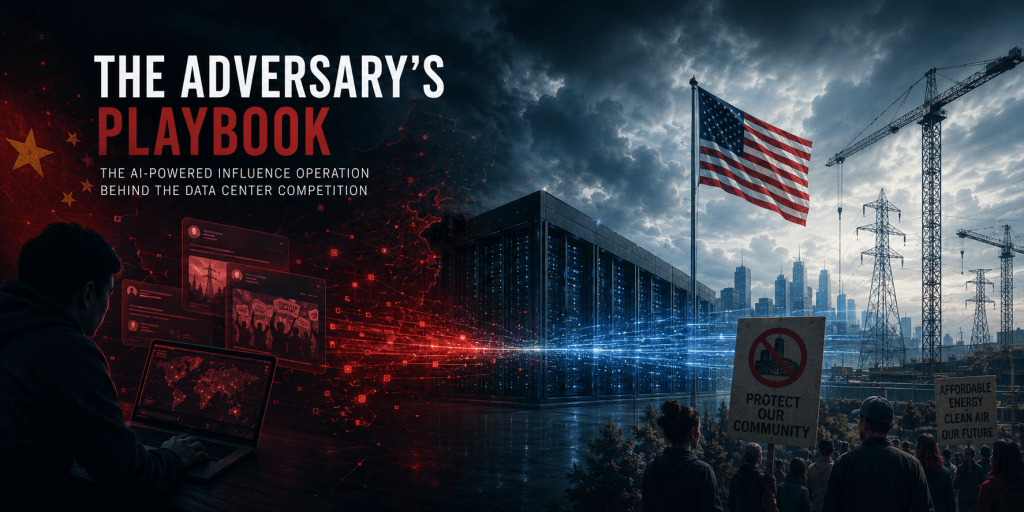
On June 10, 2026, OpenAI published a threat report documenting two China-linked influence operations that used ChatGPT accounts to generate social media content targeting US debates about AI infrastructure and trade policy. The operations failed to gain meaningful traction. Their significance lies not in their operational impact but in their strategic doctrine: China’s AI competition strategy now includes using AI tools to weaponise America’s own domestic political debates against the infrastructure buildout that US AI leadership depends on.
By Vladimir Tsakanyan, PhD · Center for Cyber Diplomacy and International Security · cybercenter.space
The operational irony is precise and deliberate. A cluster of accounts linked to a private Chinese technology company operating under contract with provincial-level government clients used ChatGPT — the AI product of the American company whose country’s AI infrastructure those accounts were attempting to impede — to generate social media content designed to amplify domestic opposition to AI data center construction in the United States.
The campaign, which OpenAI named the “Data Center Bandwagon” in the threat report published on June 10, 2026, generated comments and images on social media platforms alleging that AI data center expansion was driving up electricity costs for ordinary American families and harming local environments. A second cluster, named “Tech and Tariffs,” produced content criticising US trade policy as an instrument of technological dominance. The prompts used in the second campaign, OpenAI noted, specified the exclusion of Chinese President Xi Jinping from the content and the inclusion of President Trump — a targeting specification that reveals, with unusual clarity, the political framing the operation was designed to project.
Neither operation achieved meaningful online traction, in OpenAI’s assessment. The accounts have been banned. The content has been removed. The operation, in its immediate impact, failed.
The doctrine it reveals did not fail. It was tested, refined, and will be applied again — with improvements derived from the performance data of the first iteration.
What the Operations Actually Were
The “Data Center Bandwagon” campaign targeted a political vulnerability that is real, active, and not manufactured: the domestic opposition to data center construction that has been building in the United States as communities, environmental advocates, and local officials grapple with the energy demands, water consumption, land use requirements, and grid pressure that large-scale AI infrastructure development imposes.
This opposition is not a Chinese fabrication. Between May 2024 and June 2025, at least thirty-six data center projects were blocked or delayed by local opposition, regulatory challenges, or infrastructure constraints. Senator Bernie Sanders and Representative Alexandria Ocasio-Cortez have introduced legislation proposing a moratorium on new data centers pending the development of national safeguards. Utility commissions across multiple states have raised concerns about the grid impact of concentrated AI compute demand. Local communities in Virginia, Texas, Iowa, and across the Southeast have organised against planned facilities. The concerns driving this opposition — electricity prices, water use, noise, land consumption — are legitimate and substantively grounded.
The China-linked operation did not create this opposition. It attempted to amplify it. This is the operational architecture of contemporary foreign influence operations, stated plainly in OpenAI’s own analysis: “Foreign influence operations have long sought to latch onto existing local issues and sincerely held beliefs, using them to build credibility, amplify divisions, or exacerbate public distrust.” The operation sought to covertly insert itself into an ongoing American debate while hiding its origin and motivation.
The strategic logic is straightforward. If the primary obstacle to US AI infrastructure buildout is not technical — not a shortage of land, capital, or engineering expertise — but political, then influencing the political environment around data center development is a direct competitive strategy. An operation that delays even a small fraction of planned AI infrastructure development has produced a concrete competitive effect, regardless of whether the amplified concerns are legitimate.
Analyst note
The “Data Center Bandwagon” campaign’s reliance on amplification rather than fabrication is its most analytically significant feature. An influence operation that generates false information can be countered by fact-checking. An influence operation that takes real concerns held by real people and amplifies them through inauthentic accounts is considerably harder to counter, because the underlying concerns are valid and the counter requires distinguishing legitimate grassroots expression from foreign-amplified expression. The distinction matters for platform moderation, for policy responses, and for public discourse — but it is a distinction that, in a high-volume social media environment, is not consistently visible to the individuals whose organic opposition is being amplified alongside synthetic versions of the same position. The operation was designed to be indistinguishable from authentic community activism. That design reflects a sophisticated understanding of how influence operations interact with democratic political discourse.
The Provincial Contractor Model
OpenAI’s attribution of the operation to “a private, unnamed Chinese technology company doing work for Chinese provincial-level government clients” is the element of the threat report that has received the least analytical attention and carries the most strategic significance.
The provincial contractor model — in which influence operations are conducted not by central government agencies but by private companies operating under commercial contracts with regional government entities — is the same organisational architecture documented in other Chinese foreign influence operations and in the broader ecosystem of Chinese state-adjacent commercial activity in the AI and technology sectors. It provides several operational advantages.
First, deniability. A provincial government contract is not a directive from the central government of the People’s Republic of China. The attribution chain from the social media accounts to the provincial government clients to the central government’s strategic intent involves multiple inferential steps, each of which can be contested. OpenAI assessed the accounts as “likely” originating from China — not certainly, not definitively. The operational architecture is designed to produce exactly this level of evidentiary ambiguity.
Second, scalability. A private contractor operating under commercial arrangements with multiple provincial government clients can scale its operations across multiple campaigns, multiple platforms, and multiple target topics without the organisational constraints of a centralised intelligence bureaucracy. The same firm that ran the “Data Center Bandwagon” campaign may be running equivalent campaigns on other topics for other clients simultaneously.
Third, insulation. If the operation is exposed — as this one was — the organisational distance between the contractor and the government clients provides a buffer. No official Chinese government entity need acknowledge the campaign. The contractor can be disavowed. The provincial government clients, whose existence was not publicly named in the report, face no immediate accountability.
The provincial contractor model is not a Chinese innovation. Commercial contractors conducting influence operations have been documented in multiple countries and across multiple political contexts. Its specific application to China’s AI competition strategy — using commercially structured operations to target the domestic political vulnerabilities of US AI infrastructure development — reflects the maturation of influence operation doctrine from the electoral interference model of the 2016-2020 period toward a more specifically economic and strategic target set.
The Infrastructure Competition Dimension
The “Data Center Bandwagon” operation is most accurately understood not as a disinformation campaign in the conventional sense but as a component of China’s strategic competition with the United States for AI infrastructure dominance.
The relationship between AI compute infrastructure and AI capability is direct and well understood. The frontier AI models that determine the competitive position of the leading AI development economies — the models that OpenAI itself has assessed as crossing the threshold of material cybersecurity risk, that triggered the cancelled and subsequently signed AI executive order, and that the Great American Artificial Intelligence Act of 2026 was designed to govern — are trained on compute infrastructure whose scale is a primary determinant of their capability. The United States has a current advantage in AI compute infrastructure by several measures: the concentration of the most advanced GPU manufacturing capacity in allied supply chains, the scale of hyperscaler investment in US-based data centre capacity, and the regulatory and financial environment that has enabled AI infrastructure investment at the pace required to maintain frontier capability.
China’s strategic objective — accelerating its own AI capability development while retarding the US advantage — has multiple instruments: export control circumvention to access restricted semiconductor technology, investment in domestic GPU equivalents through companies and research programmes shielded from export restrictions, and now, as the OpenAI report confirms, influence operations designed to slow the political environment for US AI infrastructure development.
The export control instrument has been widely documented and extensively addressed in US policy, including the advanced semiconductor export controls that have been a central feature of the US-China technology competition for three years. The influence operation instrument — targeting the domestic political opposition to data center development as a mechanism for slowing US AI infrastructure buildout — is a doctrine that the June 10 report has confirmed as operational and that the policy frameworks governing export controls, foreign influence, and AI governance have not yet specifically addressed.
Analyst note
The operational significance of the “Data Center Bandwagon” campaign should be assessed against the backdrop of the actual status of US data center development, not merely against the campaign’s measurable social media impact. At least thirty-six data center projects were blocked or delayed in the twelve months before OpenAI’s disclosure period. The legitimate domestic opposition to data center construction is real, active, and consequential for US AI infrastructure buildout. A foreign influence operation targeting this opposition does not need to create the opposition. It needs only to make it marginally more visible, more resonant, or more politically salient — to push a project decision that was already contested into the “blocked” column rather than the “approved” column. The number of projects in that marginal category, and the degree to which the “Data Center Bandwagon” content contributed to their outcome, is not assessable from the currently available information. What is assessable is that the operation was targeting exactly the political mechanism through which US AI infrastructure development is actually being slowed.
The Platform Detection Question
OpenAI’s detection and disclosure of the “Data Center Bandwagon” and “Tech and Tariffs” campaigns is, in one dimension, a demonstration of effective AI company threat intelligence: the identification of inauthentic coordinated behaviour, the attribution to a likely origin, and the publication of findings in a format that allows public and policy assessment.
In another dimension, it is a disclosure of the limits of the detection architecture. The accounts were identified and banned. The question of how many similar operations using similar techniques on the same platform were not identified — because they were more carefully executed, used different operational security practices, or targeted topics whose amplification profile was less distinctively anomalous — is not answerable from the report’s findings. The disclosed operations are the ones that were caught. The detection rate for this category of operation, across all platforms and all campaigns, is not publicly established.
The specific irony of the platform dimension — that China-linked actors used OpenAI’s own infrastructure to conduct the operation — has attracted commentary that ranges from genuine concern to scepticism about whether a sophisticated operation would use so easily traceable a tool. The sceptical position, articulated publicly by a researcher who questioned whether China would conduct serious influence operations through ChatGPT accounts, reflects a reasonable analytical concern: a sophisticated operation would use infrastructure less directly connected to the companies whose country it is targeting.
The counterargument is that the use of commercially available AI tools for influence operation content generation is not primarily a tradecraft choice. It is an economic one. The cost of generating social media content through commercial AI platforms is orders of magnitude lower than the cost of employing human writers to produce equivalent volume. The operational security risk of using OpenAI’s platform is accepted as a cost of the efficiency gain. And the disclosure in this case — which OpenAI itself made — confirms that the operation was identifiable only because OpenAI conducted active threat intelligence monitoring of its own platform’s use. Not every platform conducts equivalent monitoring. Not every detected operation is publicly disclosed.
The Governance Connection
The “Data Center Bandwagon” operation is analytically connected to two legislative developments that preceded OpenAI’s June 10 report by less than two weeks.
The Great American Artificial Intelligence Act of 2026, introduced as a discussion draft on June 4, includes provisions establishing federal criminal penalties for the use of AI to impersonate government officials and for AI-assisted financial crimes. It does not include specific provisions addressing the use of AI platforms for foreign influence operations targeting US infrastructure policy debates — the specific conduct that the June 10 report documented.
The Trump administration’s executive order on AI innovation and security, signed on June 2, established a voluntary AI cybersecurity clearinghouse and directed agencies toward AI-assisted vulnerability detection. It does not address the use of commercial AI platforms by foreign actors for influence operations targeting domestic policy debates.
The governance gap is specific: the legal and regulatory framework governing the use of AI platforms for foreign influence operations targeting US policy — distinct from election interference, which has established legal and regulatory treatment — has not been developed. The conduct documented in the OpenAI report may not constitute a violation of any current US law, depending on the specific content produced and the specific platforms on which it was distributed. The Foreign Agents Registration Act, the Computer Fraud and Abuse Act, and existing foreign influence statutes were not designed for the operational architecture that the “Data Center Bandwagon” campaign represents.
Bottom Line Assessment
The “Data Center Bandwagon” and “Tech and Tariffs” operations, as documented in OpenAI’s June 10 threat report, are the first publicly confirmed cases of China-linked actors using a major commercial US AI platform to conduct influence operations specifically targeting US AI policy and infrastructure debates. Their operational impact was, by OpenAI’s own assessment, limited. Their strategic significance is not measured by their immediate impact.
The operations confirm that China’s AI competition strategy encompasses influence operations targeting the domestic political environment for US AI infrastructure development — not merely the technical and export control dimensions that have dominated the policy response to date. They confirm that commercially available AI tools are being used for this purpose, with the efficiency advantages that commercial AI provides for content generation at scale. And they confirm that the detection architecture for this category of operation, while functioning in these specific cases, has boundaries that are not publicly established.
The irony that China-linked actors chose OpenAI’s platform as their instrument is not the significant finding. The significant finding is the target: the domestic political opposition to data center construction — real, legitimate, and consequential for US AI infrastructure buildout — as a strategic competition instrument. The operation did not need to manufacture the opposition. It needed only to amplify it. Whether, in the cases of the thirty-six data center projects blocked or delayed in the preceding year, it succeeded in doing so is a question that the currently available information cannot answer.
The infrastructure is the competition. The political environment around the infrastructure is the battleground. And the tools of the battlefield are, as June 10 confirms, the same AI systems whose capabilities both sides are competing to develop.
OpenAI · China Influence Operations · Data Center Competition · AI Infrastructure · Disinformation · Foreign Influence · ChatGPT · Tech and Tariffs · Data Center Bandwagon · AI Governance · Vladimir Tsakanyan

Leave a comment