
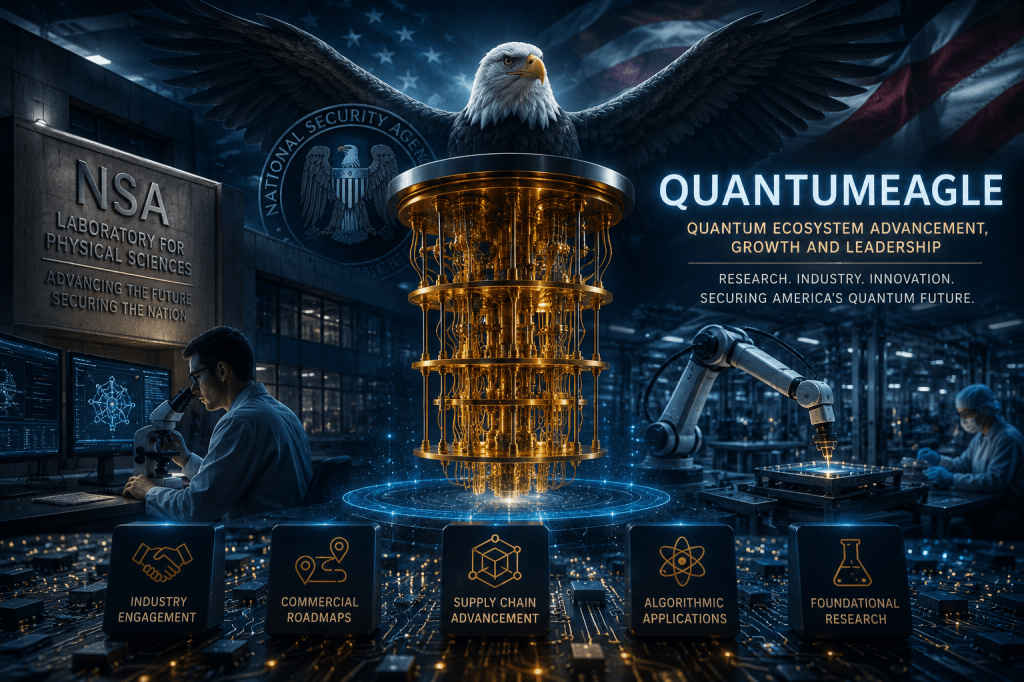
On June 30, 2026 — nine days after the Trump administration signed two quantum executive orders — the National Security Agency’s Laboratory for Physical Sciences and the US Army’s DEVCOM Army Research Office jointly launched QuantumEAGLe: Quantum Ecosystem Advancement, Growth and Leadership. The name is deliberate. For the first time in its history, the NSA has launched a programme whose explicit objectives include commercial roadmap development, supply chain strengthening, and direct industry engagement through flexible contracting. The agency that broke codes is now trying to build an industry.
By Vladimir Tsakanyan, PhD · Center for Cyber Diplomacy and International Security · cybercenter.space
The Laboratory for Physical Sciences is not a household name, even within the national security community that depends on its work. Established at the University of Maryland’s College Park campus under NSA management, LPS has for decades conducted foundational research in quantum information science — qubits, error correction, system characterisation, simulation tools — that feeds directly into the signals intelligence and cryptographic infrastructure that is the NSA’s primary institutional purpose. Its research has been consequential and largely invisible: the kind of classified basic research that produces capability rather than press releases.
<cite index=”13-1″>The QuantumEAGLe initiative, announced June 30, 2026 from Fort Meade, Maryland, represents a significant expansion of NSA’s quantum computing efforts,</cite> in the words of LPS chief Liji Samuel — but expansion understates the character of the change. QuantumEAGLe is not more of what LPS has historically done. It is a different institutional posture entirely: an intelligence agency’s research arm stepping explicitly into the role of ecosystem developer, supply chain builder, and commercial roadmap enabler, using flexible contracting authorities to work directly with US quantum companies in ways that LPS’s prior research model was not designed to accommodate.
The initiative lands nine days after the quantum innovation executive order established the QC-ADDS programme and directed the Department of Energy and the Department of Commerce to develop quantum computer delivery and advance market commitment frameworks. <cite index=”21-1″>QuantumEAGLe enables LPS and ARO to harness their expertise in research, development and technical innovation to develop fault-tolerant quantum computing systems,</cite> addressing challenges in quantum simulation tools, qubit performance, and system characterisation. It is, in the policy architecture this series has documented, the intelligence community’s operational response to the executive order’s direction — and its framing reveals something significant about where the US government believes the primary bottleneck in quantum progress currently lies.
The Five Focus Areas and Their Strategic Logic
QuantumEAGLe’s five focus areas — industry engagement, commercial roadmaps, supply chain advancement, algorithmic applications, and foundational research — are not listed in order of priority, but their ordering in the programme documentation reflects a deliberate sequencing that inverts the traditional government research model.
In the traditional model — the model that has governed LPS’s work for decades — foundational research comes first. Government researchers identify and solve fundamental scientific challenges; the results flow, eventually, into applications; the applications generate commercial interest; industry follows. The timeline from foundational research to commercial product in quantum computing has, under this model, been measured in decades, which is why the NSA’s engagement with quantum information science dates to a period when most commercial quantum companies did not exist.
QuantumEAGLe places industry engagement and commercial roadmaps first, foundational research last. This sequencing encodes a specific diagnostic: that the primary constraint on US quantum computing progress in 2026 is not the absence of scientific knowledge but the absence of a commercially viable industrial base capable of translating existing scientific progress into the hardware, components, and systems that fault-tolerant quantum computing requires. The algorithm improvements and error correction advances that make quantum computing operationally relevant are not, under this diagnostic, primarily limited by what is known. They are limited by whether the components and manufacturing infrastructure required to implement what is known actually exist in sufficient quantity, quality, and domestic availability.
<cite index=”13-1″>The supply chain advancement focus aims to enhance the performance, manufacturing, and commercial availability of specialized components essential for building quantum computers, ensuring a robust US supply chain.</cite> This is the focus area that most directly addresses the vulnerability the June 22 quantum innovation executive order explicitly identified: the risk that the US quantum computing programme, however scientifically advanced, could be dependent on components and materials whose manufacturing is concentrated in jurisdictions that present supply chain risk analogous to the semiconductor supply chain vulnerabilities that crippled American industry in 2020 and 2021.
Analyst note
The decision to place the NSA’s Laboratory for Physical Sciences at the centre of a commercial ecosystem development programme, rather than a purely classified research programme, carries institutional implications that the press release language does not fully surface. LPS has historically operated in the classified research domain, with its outputs flowing into national security applications rather than commercial markets. QuantumEAGLe’s explicit engagement with commercial roadmaps and flexible contracting with US industry creates a new interface between LPS’s classified research capacity and the commercial quantum ecosystem — an interface whose management, in terms of what knowledge flows in which direction across the classification boundary, requires institutional infrastructure and oversight frameworks that the programme’s current documentation does not describe in detail. The intelligence community’s history with dual-use technology transfer includes cases in which the management of that interface has been consequential in both intended and unintended ways.
The LPS-ARO Partnership and Its Institutional Significance
The joint structure of QuantumEAGLe — combining the NSA’s Laboratory for Physical Sciences with the US Army’s DEVCOM Army Research Office — reflects an institutional logic whose significance extends beyond the combination of two research programmes.
LPS and ARO have collaborated on quantum research for years, most visibly through the LPS Qubit Collaboratory launched in 2021, which created a mechanism for external research groups to access advanced qubit facilities and collaborate with LPS scientists on fundamental quantum information science challenges. That collaboration was structured around basic research — academic and national laboratory partnerships accessing classified-adjacent research infrastructure for scientific purposes.
<cite index=”21-1″>Its SSQP programme collaborates with other national laboratories and academic institutions to study theoretical and experimental quantum information science.</cite> QuantumEAGLe extends this collaborative model explicitly into the commercial domain, using ARO’s experience managing research contracts with industry — ARO has extensive experience with the SBIR and BAA contracting mechanisms that allow it to work flexibly with commercial entities — alongside LPS’s scientific depth and national security focus.
ARO Acting Director Dr. Purush Iyer’s statement that <cite index=”14-1″>by combining the strengths of LPS and ARO in fundamental research and technical innovation, QuantumEAGLe will accelerate progress toward fault-tolerant quantum computing</cite> describes the programme’s scientific objective. Its institutional objective — creating a sustainable domestic industrial base for quantum computing hardware and components — is the one whose achievement requires the commercial engagement that ARO’s contracting mechanisms enable and that LPS’s prior model did not.
The SAM.gov posting of the QuantumEAGLe Special Notice through the Army Contracting Command is the most concrete indicator of this commercial orientation. SAM.gov is the platform through which US government contract opportunities are publicly posted and through which commercial companies respond to government solicitations. A programme whose engagement mechanism is a SAM.gov posting is, by design, a programme oriented toward the commercial quantum industry as its primary partner — not toward the national laboratories and academic institutions that LPS’s prior collaborations have centred on.
QuantumEAGLe in the Context of the Quantum Policy Architecture
The launch of QuantumEAGLe on June 30, 2026, must be read in the context of the quantum policy architecture that has been assembled in the preceding six weeks — a compression of quantum-related government action whose pace is without precedent in the programme’s history.
On May 21, the Commerce Department announced $2 billion in equity stakes across nine quantum computing companies, including IBM’s $1 billion share for the Anderon chip foundry. On June 22, the quantum innovation executive order established the QC-ADDS programme targeting a commercially relevant quantum computer by 2028 and directed the Commerce Department to develop advance market commitment mechanisms. On the same day, the post-quantum cryptography executive order set binding federal agency migration deadlines of 2030 and 2031. And on June 30, QuantumEAGLe launched as the intelligence community’s direct operational contribution to the ecosystem development that the executive orders directed.
The architecture these four actions constitute is a vertically integrated quantum industrial policy: equity investment to anchor commercial capacity, executive direction to set capability targets and migration deadlines, and now intelligence community engagement to develop the foundational research-to-commercial pipeline that translates scientific progress into the hardware the 2028 target requires. Each instrument addresses a different constraint in the quantum development pipeline; together, they describe a government that has assessed the quantum competition and concluded that the bottleneck is not the existence of the underlying science but the translation of that science into operational capability at the speed the 2028 target requires.
Analyst note
The intelligence community’s role in QuantumEAGLe carries a dimension that the programme’s commercial framing does not foreground but that is embedded in its institutional structure. The NSA is, institutionally, the United States government’s primary assessor of cryptographic risk — the agency responsible for determining when existing encryption standards are at risk of compromise and for developing and recommending the standards that replace them. LPS’s engagement with quantum computing research is not academically motivated. It is motivated by the NSA’s need to understand, with high confidence and as early as possible, when quantum computing will reach the capability threshold that breaks current public-key encryption. A programme that accelerates the commercial development of fault-tolerant quantum computing simultaneously accelerates the NSA’s own intelligence assessment of when Q-Day will arrive — and therefore accelerates the urgency and specificity with which the post-quantum cryptography migration deadlines that the June 22 executive order set can be enforced. The intelligence and policy functions are not separate in this programme. They are the same function expressed through different institutional channels.
The Supply Chain Dimension and Its Geopolitical Context
The supply chain focus of QuantumEAGLe — the commitment to enhance the performance, manufacturing, and commercial availability of specialised components essential for building quantum computers — addresses a vulnerability in the US quantum programme that has received less public attention than the scientific competition with China but that has potentially more immediate operational significance.
Quantum computing hardware depends on a specific set of specialised components and materials whose manufacturing is currently distributed across a small number of suppliers, some of whom are located in jurisdictions that present supply chain risk. Dilution refrigerators — the ultra-low-temperature cooling systems that superconducting qubits require — are produced by a handful of manufacturers globally, several of them European. Specialised microwave components, superconducting cables, and the exotic materials required for specific qubit architectures each have their own concentrated manufacturing profiles.
The 2020-2021 semiconductor supply chain crisis demonstrated, at national scale, the consequences of manufacturing concentration risk in a critical technology — consequences that included production shutdowns, economic disruption, and strategic vulnerability whose full implications took years to resolve. The quantum computing supply chain is, by most assessments, more concentrated and more fragile than the semiconductor supply chain was at the point when the crisis began. A programme specifically directed at strengthening the domestic availability of quantum computing components — the supply chain advancement pillar of QuantumEAGLe — addresses this vulnerability before it becomes a crisis rather than after.
The counterintelligence dimension of the quantum executive order — directing the FBI and intelligence community to protect quantum research from foreign espionage — connects directly to the supply chain concern. A domestic quantum supply chain that is penetrated by foreign intelligence services, or that depends on components manufactured by entities with foreign intelligence relationships, provides both the capability and the intelligence access that the US quantum programme is designed to develop exclusively within a trusted domestic ecosystem. The supply chain is not merely a production question. It is a security question.
The Fault-Tolerant Target and Its Implications for the 2028 Timeline
Both the quantum innovation executive order and the QuantumEAGLe initiative use the language of fault-tolerant quantum computing as the specific capability target — a precision that distinguishes this policy phase from earlier quantum initiatives that used vaguer formulations about quantum advantage or commercial relevance.
Fault-tolerant quantum computing is a specific technical milestone: a quantum computer capable of executing algorithms with error rates sufficiently low that the results are reliable for the applications the computer is intended to support. Current quantum computers — including the most advanced commercial systems — are characterised as noisy intermediate-scale quantum devices, or NISQ: they operate with error rates that limit the depth and reliability of the circuits they can execute to a degree that prevents their use for the most consequential applications, including the cryptographic algorithms whose execution would constitute a genuine threat to current public-key encryption standards.
The transition from NISQ to fault-tolerant operation requires advances in qubit quality, error correction code implementation, and the physical hardware that supports both — precisely the challenges that QuantumEAGLe’s algorithmic applications and foundational research pillars are directed toward. The 2028 executive order target for a commercially relevant quantum computer is, in this context, a target for fault-tolerant or near-fault-tolerant operation — a target whose achievability is contested in the scientific community but whose pursuit by both government programme direction and commercial investment has been accelerated by the policy architecture assembled in June 2026.
<cite index=”12-1″>Dr. Michael Metcalfe, NSA chief of Quantum Information Science, emphasized that the QuantumEAGLe initiative represents a significant step in strengthening America’s quantum computing capabilities, stating that by working closely with the quantum industry, the aim is to enhance the supply chain, develop cutting-edge algorithms, and overcome fundamental research challenges.</cite> The specific combination of supply chain, algorithms, and fundamental research challenges in a single programme reflects an assessment that fault-tolerant quantum computing is currently limited by all three simultaneously — that no single bottleneck accounts for the gap between current capability and the 2028 target, and that progress requires parallel advancement across all three dimensions simultaneously.
Bottom Line Assessment
QuantumEAGLe is the most significant expansion of the NSA’s direct engagement with the commercial quantum computing industry in the programme’s history. Its launch, nine days after the quantum executive orders that directed this kind of ecosystem development, confirms that the intelligence community has interpreted its mandate under those orders as extending not merely to its traditional classified research domain but to the commercial industrial base whose development the 2028 quantum capability target requires.
The programme’s five pillars — industry engagement, commercial roadmaps, supply chain advancement, algorithmic applications, and foundational research — address the full range of constraints that separate current quantum capability from the fault-tolerant threshold the policy architecture has set as its target. Their combination in a single programme, managed jointly by the NSA’s research laboratory and the Army’s research office through flexible commercial contracting mechanisms, represents a governance innovation whose institutional implications extend beyond the quantum domain to the broader question of how the US national security apparatus engages with commercial technology development in domains where the strategic stakes justify direct intelligence community involvement.
The SAM.gov posting that makes QuantumEAGLe accessible to the commercial quantum industry is the programme’s most consequential practical element. It invites the commercial quantum industry — the nine companies that received $2 billion in Commerce Department equity stakes last month, and the broader ecosystem of suppliers, component manufacturers, and algorithm developers that surround them — into a direct research and development relationship with the NSA and the Army, under contracting mechanisms designed for flexibility and speed.
The quantum race is being run. QuantumEAGLe is the intelligence community’s entry into the field — not as a separate track but as the connector between the classified scientific knowledge that LPS has developed over decades and the commercial industrial base that the 2028 target requires to exist.
QuantumEAGLe · NSA · Laboratory for Physical Sciences · DEVCOM · Army Research Office · Quantum Computing · Fault-Tolerant · Supply Chain · National Security · Post-Quantum Cryptography · Vladimir Tsakanyan

Leave a comment