By Vladimir Tsakanyan | May 16, 2026
The geopolitical chessboard just shifted — and Nvidia may be the biggest winner hiding in plain sight.
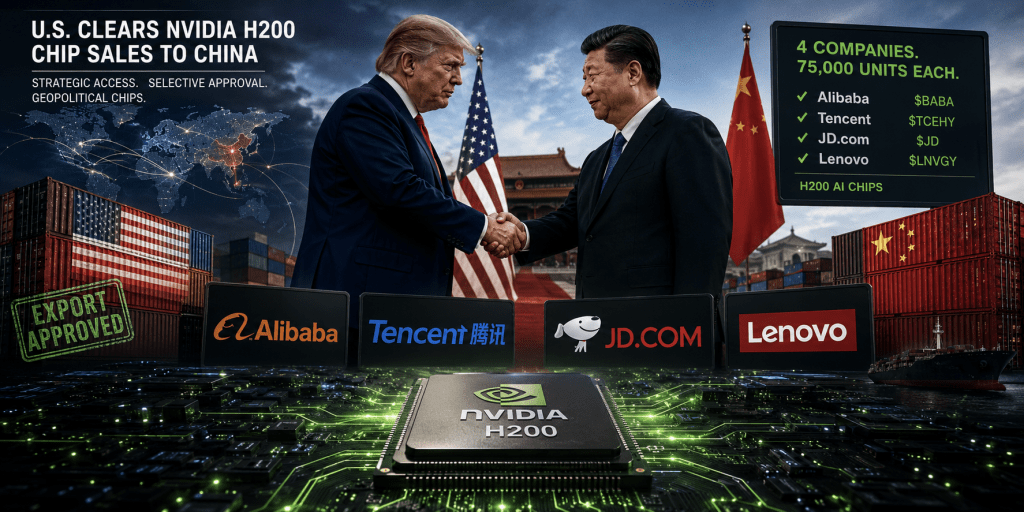
Following President Trump’s high-profile two-day summit with Chinese President Xi Jinping in Beijing this week, Washington quietly cleared sales of Nvidia’s H200 AI chips to a select group of Chinese technology firms. The move, reported by Reuters citing people familiar with the matter, signals a potential thaw in one of the most consequential tech rivalries in modern history.
China once accounted for roughly 13% of Nvidia’s total revenue. Then the export bans hit. Now, that market is back on the table — but access isn’t equal. A short list of US-listed Chinese companies has been green-lit first, and knowing who they are matters if you’re watching the AI chip race.
The 4 Companies First in Line
Alibaba ($BABA) — China’s largest cloud and AI platform. Alibaba Cloud has been racing to build out AI infrastructure and is one of the most compute-hungry entities in the country. Early access to H200 chips would be a massive competitive advantage.
Tencent ($TCEHY) — The conglomerate behind WeChat and one of China’s fastest-growing AI assistants. Tencent has been quietly building frontier AI models and needs serious GPU horsepower to compete globally.
JD.com ($JD) — China’s second-largest e-commerce platform and a major cloud provider. JD has been expanding its cloud and AI services aggressively, making it a natural candidate for high-performance chips.
Lenovo ($LNVGY) — Perhaps the most strategically important name on the list. Lenovo is positioned not just as a buyer, but as an approved distributor for the chips — potentially controlling how H200s flow into the broader Chinese market.
Each company is reportedly capped at 75,000 units per customer under the current clearance framework.
What Actually Happened in Beijing
The story is more complicated than “ban lifted, chips ship.”
Jensen Huang — Nvidia’s CEO — was added to Trump’s delegation at the last minute, boarding Air Force One during a refueling stop in Alaska. His presence raised expectations of a major breakthrough. What actually emerged was murkier.
U.S. Trade Representative Jamieson Greer confirmed that chip export controls were not formally discussed at the bilateral meeting itself. Commerce Secretary Howard Lutnick noted that Beijing had been blocking imports in an effort to steer investment toward domestic chipmakers like Huawei. Some Chinese companies that had already placed purchase orders with Nvidia reportedly backed out under pressure.
Trump, for his part, said “something could happen” — characteristically short on specifics.
The result: Washington has cleared the sales. Beijing hasn’t fully authorized its companies to follow through. The deal is technically approved but practically stalled.
Why This Matters Beyond the Stock Ticker
This isn’t just a trade story — it’s a technology sovereignty story.
China has been accelerating domestic chip alternatives: Huawei’s Ascend line, Biren, Moore Threads. If Chinese tech giants are forced to build on inferior domestic silicon, they fall behind in the global AI race. If they get H200 access, they close the gap — but become dependent on a supply chain controlled by a geopolitical rival.
That tension is exactly why Beijing is hesitating. Xi’s government wants the chips and wants to prove it doesn’t need them.
Meanwhile, for Nvidia, the stakes couldn’t be higher. China was 13% of revenue before the restrictions began. With the H200 now approved but deliveries in legal limbo, Nvidia is sitting on a potentially enormous revenue recovery — or a prolonged standoff.
The Bigger Picture for Tech and Cybersecurity
For anyone tracking the intersection of AI, national security, and supply chain risk, this saga is required reading.
The H200 chip isn’t just a product — it’s compute power, and compute power is geopolitical power in the AI era. Who controls access to frontier AI hardware determines who leads in AI development, military applications, surveillance infrastructure, and economic competitiveness.
The fact that the U.S. government is now curating a specific list of approved Chinese buyers — rather than issuing a blanket clearance — signals that chip access is being treated as a diplomatic instrument, not just a commercial decision.
Expect this story to evolve rapidly. Trump hinted Xi may visit the U.S. for a return summit in September. If that happens, H200 chip sales and AI guardrails will almost certainly be back on the agenda.
Bottom Line
The Nvidia China situation is a live case study in how AI chips have become the new oil — scarce, strategic, and fought over at the highest levels of government. Four companies — Alibaba, Tencent, JD, and Lenovo — are first in line if the deal fully clears. Whether Beijing lets them actually buy is still an open question.
Watch this space.
Sources: CNBC, Reuters, Tom’s Hardware, Built In, France 24, Bloomberg
CyberCenter.Space covers the intersection of technology, cybersecurity, and geopolitics. Follow us for more.

Leave a comment