
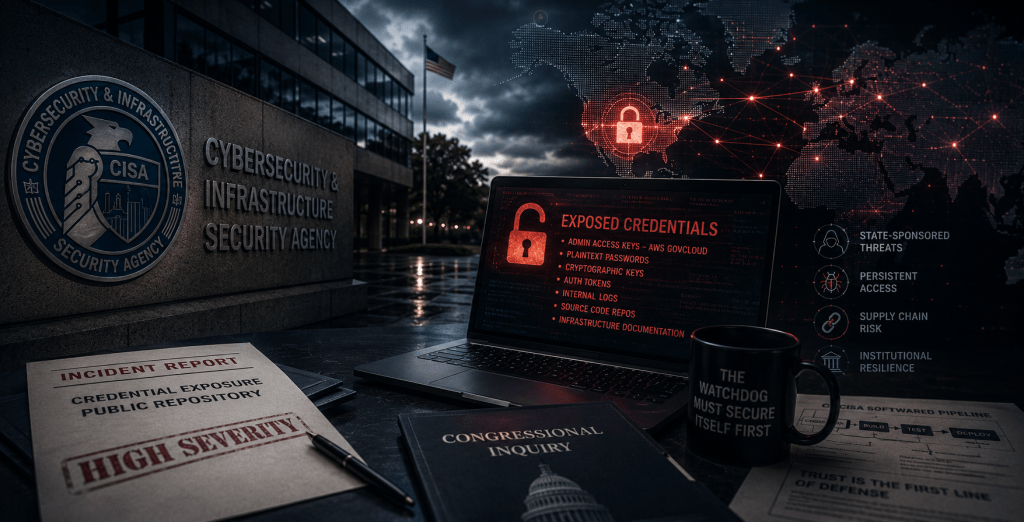
For six months, a public repository on a commercial code hosting platform contained administrative credentials for US government cloud environments, plaintext passwords for internal agency systems, cryptographic keys, and documentation of how America’s primary cybersecurity defence agency builds and deploys its software. The security researcher who discovered it described it as the most serious government credential exposure he had encountered in his career. The question this incident demands is not merely how it happened. It is what the conditions that allowed it to persist reveal about the institutional state of US cybersecurity governance.
By Vladimir Tsakanyan, PhD · Center for Cyber Diplomacy and International Security · cybercenter.space
On November 13, 2025, a contractor associated with the Cybersecurity and Infrastructure Security Agency created a public repository on a commercial code hosting platform. The repository, named “Private-CISA,” accumulated over the following six months approximately 844 megabytes of material that included administrative credentials for government cloud environments, plaintext system passwords, cryptographic keys, digital certificates, authentication tokens, internal log files, and detailed documentation of CISA’s internal software development and deployment architecture. The repository’s secret-scanning protections — features designed to prevent sensitive credentials from being published — were not active during the period of exposure.
The repository was identified on May 14, 2026, by GitGuardian, a private security firm whose automated systems continuously scan public code repositories for exposed credentials. The researcher who escalated the finding described his initial assessment as one of disbelief, given the sensitivity of the material, and subsequently characterised it publicly as the most serious government credential exposure he had encountered in his professional career. CISA was notified and the repository was taken offline. As of May 22, 2026, the process of invalidating and replacing all exposed credentials remained ongoing. Lawmakers in both houses of Congress have formally demanded answers from CISA’s acting director. Multiple independent security researchers have confirmed the authenticity of the exposed material and assessed its potential implications as severe.
CISA stated that there is no indication that any sensitive data was compromised as a result of the incident. The agency has not responded to questions about the full duration of the exposure or the completeness of the remediation effort.
The Scope of the Exposure and Its Implications
A policy assessment of this incident requires a clear-eyed account of what was exposed and what the potential consequences of that exposure are — acknowledging, in each case, the distinction between what the available evidence establishes and what it cannot exclude.
The exposed material included administrative credentials for AWS GovCloud environments. GovCloud is Amazon’s dedicated cloud infrastructure for sensitive US government workloads. Administrative access to these environments represents the highest level of operational control — the capacity to read and modify stored data, alter security configurations, create or remove resources, and establish access mechanisms that would persist beyond any subsequent credential rotation. The security implications of administrative credential exposure are therefore not bounded by the absence of detected data exfiltration. An actor with administrative access can establish persistent mechanisms that do not produce the kind of immediate indicators that standard detection systems are designed to identify.
The exposure of source code repository access credentials has distinct implications that merit separate consideration. CISA develops software tools and standards that are adopted by federal agencies and critical infrastructure operators. The integrity of the software development process — the pipeline through which code is built, tested, and deployed — is the foundation of the security assurance that downstream users of CISA-produced software depend upon. Independent security researchers, speaking on the record following the Krebs on Security disclosures, assessed that the exposed credentials provided a level of access to CISA’s software development infrastructure whose full implications are not captured by any statement about the absence of detected compromise.
CISA’s statement that no sensitive data was compromised reflects the agency’s assessment based on its current monitoring capabilities. It is not, and cannot be, a statement that no access occurred during the six-month exposure window. Sophisticated actors do not always produce detectable evidence of the access they exercise. The absence of detected compromise is not equivalent to the confirmed absence of compromise — a distinction that responsible policy analysis requires acknowledging clearly.
Analyst note
The six-month duration of the exposure is the single most consequential fact about this incident from a national security assessment standpoint. Persistent access to government cloud infrastructure is the operational objective of the most capable state-sponsored threat actors documented in CISA’s own threat intelligence reporting. These actors are characterised by patience, by the capacity to establish access without triggering detection, and by the practice of maintaining persistent footholds for extended periods before activating any operational capability. An exposure window of six months, involving administrative credentials for government cloud environments, is an exposure window whose potential consequences cannot be bounded by what has been detected to date.
The Institutional Context
The CISA credential exposure does not occur in an institutional vacuum. Its full significance is inseparable from the organisational context in which it happened — a context that both contributed to the conditions under which the incident was possible and shapes the assessment of CISA’s capacity to respond to it fully and effectively.
CISA has experienced a significant reduction in its workforce, losing more than a third of its staff following a series of departures across the agency’s divisions over the preceding months. The agency’s proposed budget has been substantially reduced. Most of its senior leadership has been replaced. The agency is currently led by an acting director managing the response to this incident alongside the full scope of CISA’s national cybersecurity responsibilities.
Senator Maggie Hassan, in her formal letter of May 19, 2026, to CISA’s acting director, noted directly that the incident occurred against the backdrop of major disruptions internally at CISA and posed twelve specific questions about the agency’s internal security policies, contractor oversight mechanisms, and incident response procedures. Representative Bennie Thompson and Representative Delia Ramirez, in a joint letter of the same date, expressed concern that the incident reflects a diminished security culture and questioned the agency’s capacity to adequately manage its contract support — noting that the exposed repository provided the information, access, and roadmap that adversaries seek to gain access to and persistence on federal networks.
The questions these legislators have asked are the appropriate questions. The institutional conditions they implicitly identify — reduced oversight capacity, contracted senior leadership, a workforce operating well below its established staffing level — are not conditions that formal responses to congressional inquiries will resolve. They are the product of policy decisions whose reversal is a separate and more fundamental question than any procedural remediation of this specific incident.
Contractor Governance and the Structural Gap
The mechanism through which this incident occurred — a contractor using a personal account on a commercial platform to synchronise agency material between work and home environments — is not a technical failure in the conventional sense. It is a governance failure: the absence of controls that would have prevented agency material from traversing the boundary between managed and unmanaged environments, and the absence of monitoring that would have detected it when it did.
As security professionals commenting on this incident have observed, this category of failure is not fully addressable through technical controls alone. A motivated individual with access to sensitive systems and a personal device can use personal accounts on external platforms in ways that fall entirely outside agency-managed visibility. The technical architecture of the agency’s managed environment may be entirely sound while remaining unable to detect or prevent data movements that occur through personal devices and accounts.
The governance architecture required to address this gap operates at three levels. At the access level, the principle of least privilege — granting contractors access only to the specific systems and data required for their defined work scope, for the duration they require it — limits the material available to be mishandled. At the monitoring level, continuous assessment of data movements associated with privileged accounts, including anomalous access patterns and transfers to external destinations, provides the detection capability that the absence of managed visibility on personal devices cannot replace. At the accountability level, contractor security agreements that clearly define the handling obligations for government material, with enforcement mechanisms that create genuine compliance incentives, provide the deterrence framework that technical controls alone cannot.
None of these governance layers was functioning adequately in this instance. That finding applies not only to the specific contractor involved but to the oversight architecture of the agency responsible for managing contractors with privileged access to sensitive government infrastructure.
Consequences: Near-Term and Long-Term
Near-term operational consequences are centred on the credential rotation effort that remained incomplete as of May 22. The prioritisation of which credentials to rotate first — an assessment that requires mapping the sensitivity and access scope of each exposed credential against the likelihood that it was observed and used during the exposure window — is an exercise that demands experienced security judgment and adequate institutional capacity. Both are resources that CISA is currently managing against a significantly reduced baseline.
Medium-term institutional consequences involve the credibility effects of this incident on CISA’s operational relationships. CISA’s effectiveness as a national cybersecurity authority depends substantially on the quality of its information sharing relationships with federal agencies, critical infrastructure operators, state and local governments, and private sector partners. These relationships are premised, in significant part, on the security of CISA’s own systems and the discretion with which it manages shared information. The public disclosure that CISA’s internal infrastructure — including the architecture of its software development processes — was accessible to any observer for six months is a disclosure that the partners who share sensitive information with CISA cannot ignore in their own risk assessments.
Long-term strategic consequences are the most difficult to assess and the most consequential to consider. The Private-CISA repository, as independent security researchers confirmed, contained documentation of how CISA builds, tests, and deploys its software infrastructure. This information has direct value for any actor seeking to understand CISA’s defensive architecture — the detection tools it employs, the monitoring approaches it uses, and the potential gaps in its own operational security posture. An adversary with this knowledge is an adversary better positioned to design operations that evade CISA’s detection capabilities — a strategic consequence whose operational manifestations may not become visible for months or years.
Domestic Measures: A Policy Framework
A credible domestic policy response to this incident requires addressing the three structural conditions it revealed: the credential architecture that permitted static, long-lived secrets to exist in a form that could be published; the contractor governance framework that permitted agency material to transit unmanaged infrastructure; and the institutional capacity deficit that limited CISA’s ability to monitor, detect, and respond.
Credential architecture reform is the most immediately actionable measure and carries the broadest applicability across the federal government. AWS GovCloud supports dynamic credential mechanisms — temporary, operation-scoped credentials that expire automatically and that cannot be usefully exploited if inadvertently disclosed. A federal mandate requiring the migration of all GovCloud environments from static to dynamic credential architectures, with a defined compliance timeline, would eliminate the category of exposure that this incident represents at the architectural level. CISA’s own guidance to federal agencies and private sector entities recommends precisely this approach. Its application to CISA’s own infrastructure should be a mandatory outcome of this incident’s review, not an aspirational commitment.
Contractor governance standardisation requires a federal-level baseline that applies uniformly across the contractor ecosystem rather than varying according to the oversight capacity of individual agencies. The baseline should include mandatory device management enrollment as a condition of access to sensitive development infrastructure; repository policy compliance verified at the agency level, not delegated to contractor self-management; activity monitoring that captures data movements associated with privileged accounts regardless of the device from which they originate; and security agreement terms that create enforceable compliance obligations with defined consequences for violation.
Institutional capacity restoration is the most politically sensitive domestic measure and the most consequential for the long-term effectiveness of any governance reform. Technical controls and contractor oversight frameworks are only as effective as the institutional capacity available to implement, monitor, and enforce them. An agency operating at significantly reduced staffing and leadership levels cannot exercise the oversight functions that its security responsibilities require. Congressional direction to restore CISA’s operational capacity — in funding, in staffing levels, and in the continuity of senior security leadership — is the prerequisite for the effective implementation of every other domestic measure that the policy response to this incident should produce.
Legislative standardisation of minimum security requirements for government contractors with access to sensitive cloud environments — covering credential management practices, device compliance requirements, external platform usage policies, and mandatory incident notification timelines — would create a compliance baseline that does not depend on the oversight capacity of individual agencies and that applies consistently across the federal contractor ecosystem. The DOJ’s Civil Cyber-Fraud Initiative, which applies the False Claims Act to cybersecurity failures by government contractors, provides an existing enforcement architecture whose effectiveness is enhanced by clearly defined statutory standards against which contractor performance can be assessed.
International Measures: Closing the Cross-Border Gap
The international dimensions of this incident have received no attention in the congressional correspondence or public commentary thus far, despite their direct relevance to the security of allied governments and multilateral technology partnerships whose operational connections to CISA’s infrastructure create potential cross-border exposure.
Allied notification frameworks for government credential exposures with potential cross-border implications represent the most immediately relevant international gap. The Private-CISA repository was publicly accessible for six months to any actor monitoring commercial code hosting platforms — a monitoring capability that both criminal actors and foreign intelligence services are documented to maintain. Allied governments whose networks, systems, or information sharing relationships intersect with CISA’s infrastructure have a direct security interest in understanding the scope of the exposure and its potential implications for their own environments. No formal mechanism currently exists for notifying allied cybersecurity agencies of domestic government security incidents of this character within a defined timeframe and through established channels. Establishing such a mechanism — through the Five Eyes framework, through NATO’s cyber defence architecture, or through bilateral cybersecurity agreements — would provide the cross-border incident coordination that the current framework does not support.
Contractor security standards within multilateral frameworks address a structural gap whose importance extends beyond this specific incident. The allied technology partnerships being constructed under frameworks such as Pax Silica and equivalent multilateral arrangements create information sharing relationships and technology interdependencies that are only as secure as the weakest point in the contractor ecosystem of any member jurisdiction. A harmonised minimum security standard for contractors with access to government cloud infrastructure across allied jurisdictions — jointly developed by member cybersecurity agencies and applied uniformly — would address the cross-border dimension of the contractor governance gap that this incident illustrates. The EU’s NIS2 Directive and the related requirements applicable to managed service providers in European member states provide a reference point for what such a standard might contain.
Software supply chain security coordination is the most consequential international measure for the specific risk profile that the development infrastructure exposure creates. CISA’s software tools, security standards, and technical guidelines are adopted and implemented by allied governments, critical infrastructure operators, and private sector entities across multiple jurisdictions. If the integrity of CISA’s software development infrastructure was potentially affected during the exposure window, the downstream implications extend to every entity that has implemented CISA-developed tools or followed CISA-issued technical guidance. A multilateral mechanism for rapid notification, technical assessment, and coordinated response when a government software development pipeline is subject to potential compromise — modelled on the threat intelligence sharing frameworks that allied cybersecurity agencies already operate — is a governance instrument that does not currently exist and whose absence this incident has made visible.
International standards for government secrets management represent the longest-horizon international measure but potentially the most durable. The credential management practices that produced this incident — static, long-lived credentials stored in plaintext, accessible through personal devices on external platforms — are not unique to this agency or this contractor. They represent a category of practice that is present across government technology environments in multiple jurisdictions. Developing international standards for government cloud credential management, through bodies including ISO, NIST’s international engagement programmes, or the UN Global Mechanism’s capacity development workstream, would extend the domestic architectural reforms discussed above into a multilateral governance framework that addresses the systemic character of the underlying vulnerability.
The Systemic Pattern
The CISA credential exposure is, in its immediate facts, a specific incident involving specific circumstances. In its analytical context, it is an expression of a pattern whose structural dimensions repeat across government cybersecurity institutions: the gap between the security standards agencies publish for others and those they maintain internally; the vulnerability created by institutional contraction at a moment of elevated threat; and the contractor governance gap that allows privileged access to government infrastructure to be exercised through channels outside agency visibility.
Each of these conditions predates this incident and will persist after the congressional inquiry concludes. Addressing them requires a policy response calibrated to their structural character rather than to the specific facts of the incident that made them visible. The domestic and international measures outlined above are not a remediation plan for what has already happened. They are the framework required to reduce the probability of its recurrence — in this agency, in its counterparts in allied jurisdictions, and in the contractor ecosystem that operates across the boundary between government and private sector in every domain where the most sensitive government infrastructure is built and maintained.
Bottom Line Assessment
The Private-CISA repository was publicly accessible for approximately six months. It was identified not by the agency’s own monitoring systems but by a private sector firm’s automated scanning. Its discovery was escalated through a security researcher, not through an official government channel. It remained incompletely remediated four days after public disclosure. Lawmakers in both chambers of Congress have formally demanded answers that the institutional conditions producing the incident will make genuinely difficult to provide.
CISA’s statement that there is no indication of sensitive data compromise is an accurate account of what has been detected. It cannot be an account of what occurred during six months of public credential exposure to a threat environment that includes the intelligence services of every adversary that CISA’s own reporting has identified as targeting US government networks with patience, sophistication, and the specific objective of establishing access that does not produce immediate detection.
The incident is, as described, serious. Its resolution requires measures at the domestic and international levels that address not only the specific technical failures it represents but the institutional conditions that allowed those failures to persist undetected for the period they did.
An agency operating below its established capacity, without its senior leadership, and with a contractor oversight framework that cannot see beyond managed infrastructure boundaries is an agency whose security posture reflects those conditions. Restoring the capacity is the prerequisite for the governance. The governance is the prerequisite for the security. The security is the mission.
That sequence is currently running in reverse.
CISA · AWS GovCloud · Credential Security · Contractor Governance · Supply Chain Security · Congressional Oversight · Allied Cybersecurity · Institutional Resilience · Post-Quantum Migration · Vladimir Tsakanyan

Leave a comment