
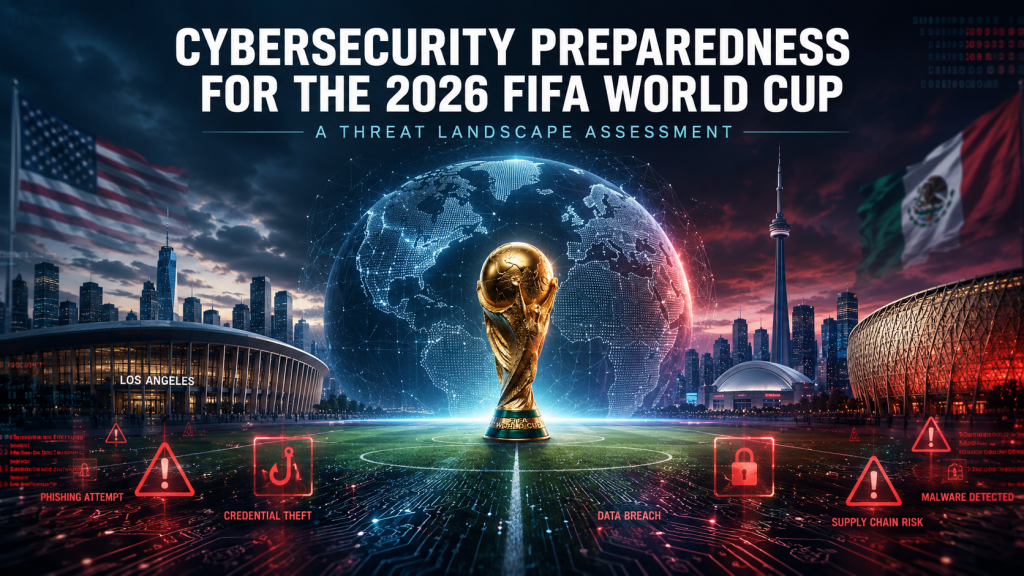
The FIFA World Cup 2026 begins on June 11 across sixteen host cities in the United States, Canada, and Mexico, representing the largest sporting event in history by venue count, participating nation count, and associated digital infrastructure. Pre-tournament threat intelligence indicates that attack infrastructure targeting the event has been operational for several months. This assessment examines the threat landscape across criminal, state-sponsored, and hacktivist categories, and considers the institutional context within which the tournament’s cybersecurity will be managed.
By Vladimir Tsakanyan, PhD · Center for Cyber Diplomacy and International Security · cybercenter.space
The cybersecurity challenge of a major international sporting event is, in structural terms, a problem of simultaneous scale and distribution. Scale because the number of digital interactions — ticket transactions, payment processing, media streaming, communications, venue management, transportation coordination — reaches volumes that create exceptional opportunity for actors seeking to exploit the attention, urgency, and volume that the event generates. Distribution because the assets requiring protection are not concentrated in a single location but dispersed across thousands of organisations — sponsors, broadcasters, hospitality providers, transportation operators, venue managers, local governments, payment processors, and the supply chains that connect them — none of which operates under a unified security governance framework and all of which represent a potential entry point to the broader ecosystem.
The FIFA World Cup 2026 combines both dimensions at a scale that has no North American precedent. One hundred and four matches. Forty-eight nations. Sixteen host cities across three sovereign jurisdictions, each with distinct regulatory frameworks, distinct law enforcement agencies, and distinct cybersecurity postures. A global television audience in the billions. A digital economy surrounding the tournament that will process billions of dollars in transactions across financial services, travel, hospitality, and online betting in the span of thirty-nine days.
The criminal infrastructure targeting the World Cup was not assembled in response to the event’s arrival. It reflects a build cycle prepared well in advance, consistent with the operational practices documented in the criminal ecosystem targeting major global events generally.
The Pre-Tournament Infrastructure Build
The most operationally significant finding from the pre-tournament threat intelligence is that the attack infrastructure targeting the World Cup is not being assembled in response to the event’s arrival. It has been prepared in anticipation of it — a build cycle that reflects the professional sophistication of the criminal ecosystem now targeting major global events and that has materially changed the security posture of all organisations connected to the tournament.
Since April 1, 2026, Insikt Group researchers detected more than 1,100 suspicious domains containing the words “World” and “Cup,” alongside hundreds of additional suspicious registrations of event-linked host city domains that criminal actors could use to impersonate official World Cup sites, commit fraud, conduct phishing, or deploy malware. FortiGuard Labs confirmed that cybercriminal infrastructure linked to the tournament is already operational — ticketing fraud sites mirroring official FIFA design, credential harvesting pages targeting fan accounts, counterfeit merchandise platforms, and fraudulent betting sites positioned to capture the surge in online gambling activity that accompanies the tournament’s peak matches.
The Canadian Centre for Cyber Security’s threat bulletin, published June 3, 2026, and based on intelligence current to that date, assessed that cybercriminals will almost certainly exploit the public engagement of the FIFA World Cup to support financially motivated cyber threat activity against individuals and organisations — the highest confidence assessment the Centre applies. The assessment identifies the common operational pattern: major events serve as topical lures and pretexts for phishing campaigns and social engineering attacks, with criminal actors exploiting the urgency of fans seeking tickets, travel arrangements, and streaming access to induce credential disclosure, payment fraud, and malware installation.
The precedent from the 2022 FIFA World Cup in Qatar is instructive. Phishing attempts against targets in the Middle East and North Africa doubled ahead of the tournament, with criminal actors exploiting ticket scarcity, travel demand, and the emotional engagement of fans in regions with less established cybersecurity awareness infrastructure. The 2026 tournament encompasses three host nations whose combined digital footprint, fan base, and online transaction volume are of a different order of magnitude.
Analyst note
The domain registration intelligence carries a specific operational implication that the summary statistics do not fully convey. A fraudulent domain registered months before a major event has time to age — to accumulate search engine indexing, to avoid the reputation filtering that newly registered domains trigger in email security systems, and to build the appearance of legitimacy that drives victim engagement. The criminal actors who registered World Cup-themed domains in April and May 2026 have given their infrastructure two to three months of preparation time before the tournament’s most commercially active period. The detection lag between domain registration and the identification of malicious use means that a substantial portion of the pre-positioned infrastructure will not be identified until it is in active use against victims.
The Institutional Vulnerability: Email Authentication and the Supplier Gap
The most immediately actionable finding from the pre-tournament security analysis is also the most operationally embarrassing: more than a third of FIFA’s own sponsors and suppliers have no Domain-based Message Authentication, Reporting, and Conformance record on their mail domains.
DMARC is a fundamental email authentication protocol — a technical standard that allows receiving mail servers to verify that an email purporting to come from a specific domain actually originated from a server authorised to send mail for that domain. Its absence means that a criminal actor does not need to employ sophisticated technical methods to send emails that appear to come from a FIFA sponsor or supplier. The impersonation is technically trivial. The victim has no technical indicator that the email is fraudulent. The only defence is the recipient’s own judgment — which, in the context of a high-demand event driving urgency and volume, is a defence whose reliability is consistently overestimated.
The supplier gap compounds the institutional vulnerability. Every service provider, third-party vendor, and digital integration partner connected to the World Cup’s operational infrastructure represents both a potential attack entry point and a potential impersonation vector. The list of organisations in this ecosystem is large, heterogeneous in its security posture, and not subject to any unified security governance framework. A logistics provider with inadequate email authentication enables the impersonation of a FIFA operations contact. A ticketing resale partner with insufficient endpoint protection enables credential theft that propagates through the fan account ecosystem. A broadcaster’s cloud vendor with unpatched infrastructure enables access to rights management systems whose compromise disrupts the media delivery on which the tournament’s global visibility depends.
The Paris 2024 Olympics recorded 140 successful cyber incidents. Its footprint was approximately a quarter of the 2026 World Cup’s scale by venue count. Extrapolating linearly from that precedent is methodologically imprecise — the attack surface does not scale linearly with venue count, and the security investment for 2026 has presumably benefited from the Paris experience. But the precedent establishes the baseline expectation: at this scale of event, with this level of criminal and state actor interest, successful incidents are not a risk to be managed to zero. They are a feature of the threat environment to be managed in terms of their consequence and containment.
The State Actor Dimension
The criminal threat to the FIFA World Cup 2026 is the dimension that has received the most public attention from security vendors and government bulletins. It is not the dimension that carries the most strategic significance.
Major international events have historically provided state-sponsored actors with a specific operational opportunity: the concentration of high-value targets, the information noise generated by a high-volume event that can conceal persistent access operations, and the symbolic significance of disrupting an event with global visibility. The 2018 Winter Olympics in Pyeongchang provided the clearest documented precedent. A sophisticated malware operation compromised the event’s IT infrastructure in the hours before the opening ceremony, causing disruption to the official website, the spectator ticketing systems, and the display boards at the main stadium. The malware was designed to appear to have originated from multiple different threat actors — a deliberate false flag operation whose attribution took security researchers months to resolve. The attack used the visibility and information intensity of the event as both a disruption amplifier and an attribution obscurant.
The 2026 World Cup occurs in a geopolitical environment that is materially more complex than the 2018 context. The Recorded Future threat assessment for the tournament, published fourteen hours ago, explicitly identifies the Iran war as a geopolitical development that could increase the likelihood of hacktivist activity, influence operations, or politically triggered threats linked to the tournament. Iran’s demonstrated willingness, in 2026, to conduct destructive cyberattacks against US commercial infrastructure — the March strikes on medical technology company systems that resulted in the remote wiping of tens of thousands of employee devices — establishes an operational precedent for state-linked destructive action against US-hosted high-profile events.
The geopolitical trigger potential of the World Cup’s host context is specific. The United States is hosting its first World Cup since 1994 — an event with enormous national prestige and global visibility. Disruption of the event’s digital infrastructure, whether through service denial, data exfiltration from connected systems, or compromise of the broadcast infrastructure that delivers the tournament to billions of viewers, carries symbolic and operational consequences that extend well beyond the competitive implications for any individual match.
The information operations dimension adds a further layer. A major international event hosted across three North American nations, in a geopolitical environment characterised by contested narratives about US global leadership, provides extensive material for influence operations that could use the event as a backdrop for disinformation campaigns targeting host country governments, participating nations, or the tournament’s governance institutions. The combination of high public engagement, emotional intensity, and the global media environment that the World Cup generates creates an influence operation environment of unusual richness.
Analyst note
The hacktivist dimension of the World Cup threat is the category most likely to be underestimated in pre-tournament security planning. Hacktivists — actors motivated by political or ideological objectives rather than financial ones — have demonstrated, in the 2026 incident record, an increasing willingness to conduct disruptive operations against high-profile targets as statements of political position rather than in pursuit of operational objectives in the traditional sense. The World Cup’s hosting context — three nations, with distinct relationships to the full range of current geopolitical tensions, hosting teams and fans from forty-eight countries representing the full spectrum of political geography — provides hacktivist actors with a target set of unusual symbolic richness. The assessment that geopolitical developments could increase hacktivist activity is not a prediction of specific incidents. It is a description of the structural conditions that make the tournament an attractive target for politically motivated disruptive action.
The Institutional Context: A Host at Reduced Capacity
The US federal government’s role in coordinating cybersecurity for major national events is a function that has historically resided primarily with the Cybersecurity and Infrastructure Security Agency — the body responsible for critical infrastructure protection, for coordination with sector-specific agencies and information sharing organisations, and for the provision of technical assistance to state and local governments managing event security challenges.
CISA enters the FIFA World Cup 2026 period with its operational capacity at significantly reduced levels following the workforce reductions, budget contractions, and leadership changes of the preceding twelve months. The specific functions most directly relevant to major event cybersecurity — stakeholder engagement, coordination with sector-specific organisations, and the Joint Cyber Defence Collaborative that previously brought together federal agencies and private sector partners for coordinated response — are among those whose capacity has been most directly affected.
The practical consequences of this institutional condition for World Cup cybersecurity are not quantifiable with precision, but their direction is clear. Federal coordination of cybersecurity preparation and response across the sixteen host cities, their associated infrastructure operators, and the thousands of commercial entities in the tournament ecosystem requires an institution with the capacity to manage the coordination challenge at the scale the event demands. The gap between that requirement and the current institutional capacity is a governance condition whose implications will be assessed in the event of any significant incident over the tournament’s thirty-nine-day duration.
The AI executive order signed on June 2, 2026 — whose provisions include the establishment of a voluntary AI cybersecurity clearinghouse — provides relevant institutional infrastructure whose implementation timeline, at thirty days for initial formation, will not produce an operational clearinghouse before the tournament’s most intensive period. The Great American Artificial Intelligence Act, introduced as a discussion draft on June 4, has no enactment timeline. The governance instruments being developed are real and consequential. Their operational maturity and the World Cup’s commencement are not aligned.
The Three-Sector Concentration
Check Point’s analysis of the World Cup threat landscape identifies three sectors that face the most concentrated and highest-consequence cyber risk during the tournament: financial services, transportation and hospitality, and online gambling.
The financial services sector faces elevated fraud risk across every category of transaction associated with the event — ticket purchases, international money transfers, currency exchange, sports betting settlements, and the high-volume payment processing that accompanies the concentration of millions of international visitors in host cities. The specific risk of AI-assisted financial fraud — synthetic identity construction, account takeover at scale, and the manipulation of fraud detection systems through adversarial techniques — is heightened in a high-volume transaction environment where the velocity of legitimate transactions creates detection noise that obscures fraudulent ones.
Transportation and hospitality operators face risks concentrated in their customer-facing digital infrastructure and their operational technology systems. Hotel property management systems, airline check-in platforms, and ride-sharing networks are each high-value targets for credential harvesting and ransomware during the tournament period — high-value because the operational disruption of any of these systems during a period of peak demand has consequences that operators are strongly motivated to pay to resolve. The ransom payment calculus shifts materially in an environment where the operational cost of continued disruption is measured in hours of a major international event.
The online gambling sector presents a specific risk profile that the Canadian Centre and Check Point analyses both identify: the convergence of high transaction volumes, international payment flows, and the regulatory complexity of cross-jurisdictional gambling creates an environment that is attractive both for direct financial fraud and for money laundering operations that exploit the legitimate high-volume transaction environment as cover.
Bottom Line Assessment
The FIFA World Cup 2026 presents the most concentrated and geopolitically complex cybersecurity environment that North American host infrastructure has faced at a major international event. Its scale — in venue count, participating nations, digital transaction volume, and global media exposure — exceeds any comparable precedent. Its threat actor diversity — financially motivated criminal infrastructure built over months, state-sponsored actors with demonstrated destructive capability and potential interest in symbolic disruption, and hacktivist actors motivated by a geopolitical environment of unusual intensity — encompasses every category of cyber threat actor simultaneously. And its institutional context — a federal cyber defence agency at reduced capacity, a governance framework for AI-enabled threats whose implementation timeline does not match the tournament’s — creates a coordination gap whose management will test the capabilities of every security organisation involved.
The Paris 2024 experience established that successful incidents are a feature of this scale of event’s threat environment, not an avoidable outcome. The 2026 World Cup’s scale is four times larger by venue count, in a geopolitical environment considerably more complex, in a host country whose federal cybersecurity coordination infrastructure is operating below its established baseline.
The security community’s preparation has been substantive and is documented in the threat intelligence, government bulletins, and vendor research published in advance of the tournament. Whether that preparation proves commensurate with the threat environment described in this assessment will be determined over the course of the tournament’s thirty-nine-day duration.
FIFA World Cup 2026 · Event Cybersecurity · Critical Infrastructure · Phishing · State Actors · Hacktivism · CISA · Financial Fraud · AI Threats · Supply Chain Security · Vladimir Tsakanyan

Leave a Reply