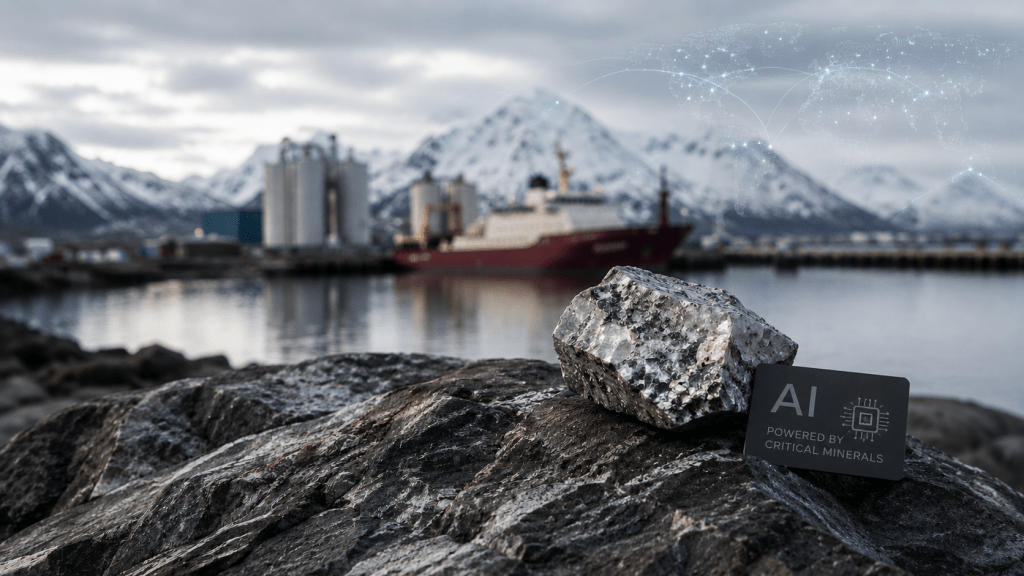
On May 6, 2026, Norway’s ambassador signed a declaration in Washington that most foreign ministries have barely noticed. It may be the most consequential diplomatic act of the year. The world is being reorganised around the materials that make artificial intelligence possible. The question is not whether to join. It is whether joining fast enough still matters.
By Vladimir Tsakanyan, PhD · Center for Cyber Diplomacy and International Security · cybercenter.space
The document signed in Washington on May 6 was four pages long and non-binding. It committed no government to any specific action, imposed no treaty obligations, created no enforcement mechanism, and triggered no parliamentary ratification process in any signatory state. It was, in the formal sense, a declaration of intent.
It was also the fifteenth entry in the membership of an initiative that, in the five months since its launch, has restructured the diplomatic geometry of the global technology supply chain more consequentially than any bilateral trade agreement in recent memory. Norway is now inside Pax Silica. What that means — for Norway, for the initiative, and for the broader contest it represents — requires understanding what Pax Silica actually is, which is not quite what the State Department’s media notes suggest.
Not a Chip Deal. A World Order.
The name was chosen deliberately. Pax — the Latin root that gave the world Pax Romana and Pax Americana — denotes not merely peace but the specific stability that a dominant power imposes on a system it controls. Silica is the compound refined into silicon, the element that makes the transistor possible. The name’s ambition is embedded in its etymology: this is an attempt to establish, under American leadership, a stable order governing the infrastructure of the AI age.
The initiative’s formal description — a framework to secure supply chains for critical minerals, semiconductors, AI infrastructure, energy, and logistics — understates both its scope and its strategic logic. Pax Silica describes itself as a “positive-sum” partnership intended to reduce “coercive dependencies” and improve resilience across the full technology stack, from mineral extraction and processing through chip manufacturing and computing infrastructure. In practice, it is an attempt to do to the AI economy what the post-war order did to the oil economy: to establish a set of allied relationships, investment flows, governance norms, and infrastructure dependencies that make the dominant power’s technological ecosystem the default, and make exit from it progressively more costly.
The initiative spans the “minerals-to-models” supply chain, from critical minerals and manufacturing to data and AI systems, built on the recognition that no country can be entirely self-sufficient in this domain. The genius — and the strategic risk — of this architecture is that it is designed to be interdependent by construction. Each member specialises in a segment of the stack that others cannot easily replicate. Japan and South Korea bring semiconductor manufacturing expertise. Australia houses critical mineral reserves. Israel and the United Kingdom bring specific niches in chip design. India has engineering talent and growing mineral processing capacity. Singapore is a critical connectivity node in the Indo-Pacific. The UAE and Qatar bring energy and abundant sovereign capital.
Norway brings something that none of the existing fourteen members can provide in the same combination: a NATO founding member with significant European mineral reserves, Arctic strategic positioning, established offshore energy infrastructure, and a sovereign wealth fund of extraordinary scale that has, for decades, been the most consequential patient capital vehicle in the world.
Analyst note
The phrase “positive-sum” in Pax Silica’s self-description deserves careful examination. The initiative is positive-sum in the sense that its members are intended to benefit collectively from coordinated supply chain resilience. It is explicitly zero-sum in its relationship to the actors it excludes. Vis-à-vis China, Pax Silica seeks to reduce structural dependencies and dilute Beijing’s leverage across the interconnected layers of the AI technology stack. The framework does not merely build an alternative ecosystem. It is designed to make the alternative ecosystem the trusted one — and to define “trusted” in terms that systematically exclude the actors whose supply chain dominance it is designed to erode. The diplomacy is constructive. The intent is competitive. Both things are true.
Norway’s Specific Geometry
Norway’s accession is not symbolic. It fills a specific gap in Pax Silica’s supply chain architecture that no existing member was well-positioned to fill.
Norway has large mineral resources by European standards — natural resources that the EU has sought authority over through the Critical Raw Materials Act. The country sits on deposits of significance for the defence and technology industries, including materials that appear on NATO’s December 2024 list of twelve defence-critical raw materials essential for advanced defence systems. Norway’s offshore energy infrastructure — the largest in Europe — provides the energy foundation that AI data centres and advanced semiconductor fabrication require at a scale that no other European country on the Pax Silica list can match. And Norway’s geographic position — commanding the North Atlantic approaches, sharing a border with Russia, and controlling Arctic maritime routes whose strategic significance has grown with every year of Russian aggression in Ukraine — makes it a node in the physical infrastructure of the initiative that its coordinates on a map do not fully capture.
The accession also resolves, at least partially, a tension that has complicated Norway’s strategic positioning for the better part of a year. Both minerals and the purchase of defence equipment have been part of ongoing negotiations between Norway and the United States, and the government has confirmed that if Norway transfers authority over Norwegian minerals to the EU through the CRMA, it will not be able to enter into a mineral agreement with the United States. The Pax Silica signature is, among other things, a strategic clarification: Norway has chosen to anchor its mineral diplomacy in the US-led framework rather than cede primary authority over its resources to the European regulatory architecture that the Critical Raw Materials Act represents.
This is a significant decision with consequences that extend well beyond the minerals question. Norway is not an EU member. It participates in the single market through the European Economic Area but is not subject to EU governance in the areas where that status matters most for this calculation. The Pax Silica accession signals that Norway intends to maintain that strategic flexibility — to be a NATO ally first, a US partner in the technology supply chain second, and a participant in European regulatory frameworks where those frameworks align with rather than constrain the first two commitments.
The Cyber Diplomacy Dimension
Pax Silica is described, in almost every public account, as a supply chain initiative. It is also, in its digital infrastructure dimensions, a cyber diplomacy framework — and this is the aspect that has received the least analytical attention.
Among its core commitments, the initiative charges members to protect sensitive technologies and critical infrastructure from undue access or control by countries of concern, and to build trusted technology ecosystems, including ICT systems, fibre-optic cables, data centres, foundational models, and applications. These are not supply chain objectives in the conventional sense. They are digital sovereignty objectives — a framework for determining which states’ technology infrastructure can be trusted to carry the sensitive data, the AI workloads, and the defence-relevant computing that the initiative’s members are coordinating.
In this dimension, Norway’s membership has an operational significance that mineral reserves alone do not explain. Norway hosts significant undersea cable infrastructure connecting Europe to North America. Its energy grid, increasingly powered by renewable sources, makes it one of the few European locations where the power demands of large-scale AI data centre operations can be met without the carbon exposure that constrains comparable operations elsewhere. And its established integration with NATO’s command and communications architecture makes it a natural node in the trusted digital infrastructure that Pax Silica is designed to build across member states.
The cyber security implications of this architecture are not incidental. The initiative is likely to evolve into a project-based coordination mechanism where member states cooperate on specific initiatives such as AI data centres, semiconductor manufacturing capacity, or critical mineral processing, which would deepen their functional interdependence. That deepened interdependence creates shared infrastructure that is, simultaneously, a shared attack surface. The same interconnected supply chain that reduces individual member states’ vulnerability to coercion by external actors creates, across the initiative’s membership, a set of cross-border dependencies whose cyber security must be managed collectively or not at all.
This is the governance challenge that Pax Silica has not yet formally addressed. The initiative has a supply chain coordination function. It has an investment facilitation function. It has a political signalling function. It does not yet have a cyber security architecture — a shared framework for protecting the infrastructure it is building, detecting threats to the supply chains it is coordinating, and responding to state-sponsored operations targeting the initiative’s members precisely because of their membership.
Analyst note
The absence of a cyber security dimension in Pax Silica’s current architecture is not an oversight. It is a sequencing decision — the initiative is building the coalition before building the security framework, on the reasonable calculation that the former must precede the latter. The risk of this sequencing is that the infrastructure being built and the interdependencies being created in the initiative’s early phase will have embedded design decisions that are difficult to retrofit with security architecture after the fact. The history of critical infrastructure security — in maritime, in energy, in telecommunications — is a history of exactly this problem: systems designed for efficiency and connectivity, secured as an afterthought when the attack surface had already been established. Pax Silica has the opportunity to make different choices. The window for those choices is open now, while the framework is still being designed.
Beijing’s Counter-Move
China has watched the construction of Pax Silica with the attentiveness of a state that understands precisely what it is designed to do — and has responded with the instruments most available to it.
Chinese exports of rare earth magnets — essential for electric vehicles, wind turbines, and missiles — surged 8.2% year-on-year in the first two months of 2026, yet shipments to the United States plunged by 22.5% over the same period. China is selling more rare earths to the world. It is selling markedly fewer to the country that leads Pax Silica. The signal is calibrated and unmistakable: the leverage that decades of supply chain dominance have purchased will be applied selectively, in quantities proportionate to the perceived threat that each initiative represents.
China is likely to increase efforts to consolidate parallel technology ecosystems, strengthen ties with countries outside US-led frameworks, and use its current role in supply chains — particularly in rare earths and manufacturing inputs — to extract strategic concessions from states that have not yet joined or are considering leaving. The fifteen Pax Silica signatories have, by signing, made their strategic choice explicit. The much larger number of states that have not signed — including most of continental Europe, most of the Global South, and every major economy that maintains significant economic relationships with China — now face a version of the same calculation that Norway just resolved: which ecosystem to anchor in, and what the cost of that choice will be in the relationships it forecloses.
Norway’s decision, signed quietly in Washington on a Tuesday in May, is one answer to that question. It will not be the last. And the accumulation of those answers — each one a diplomatic note, a declaration signing, a sovereign wealth fund commitment, or a data centre location decision — is, collectively, the process by which the digital world is dividing itself into the architectures that will define the next generation of technological power.
What Norway’s Signature Signals
The Pax Silica initiative, as of May 6, 2026, has fifteen members spanning three continents, covering a significant portion of global semiconductor manufacturing capacity, a meaningful share of Western critical mineral reserves, the primary AI infrastructure investment capital of the Gulf, and now the Arctic strategic positioning and North Atlantic energy infrastructure that Norway uniquely provides.
At its core, Pax Silica is about resilience — reducing reliance on single-country supply chains by strengthening coordination between trusted partners, including everything from the extraction and processing of raw materials to the manufacturing of advanced chips and the deployment of AI systems. Norway adds depth to the mineral and energy layers of this stack in ways that the initiative’s existing membership could not internally provide.
But the deeper significance of Norway’s accession is not technical. It is diplomatic. Norway is a NATO founding member, an Arctic power, a country whose strategic geography has mattered to Western security planning since the first days of the Cold War. Its signature on the Pax Silica declaration is a statement that the minerals-to-models supply chain is, for a country in Norway’s position, a matter of the same strategic seriousness as collective defence. That it belongs in the same category of commitments as Article 5, not in the same category as a trade facilitation agreement.
As US officials have framed it: “If the 20th century ran on oil and steel, the 21st century runs on compute and the minerals that feed it.” Norway spent the 20th century becoming one of the world’s most consequential hydrocarbon powers. It is now making its bet on what the 21st century runs on.
The declaration was four pages. Non-binding. No enforcement mechanism. But the choices encoded in it — about whose supply chains to trust, whose infrastructure to build, whose technology ecosystem to join — are the choices through which the new economic order is being constructed, one signature at a time.
Bottom Line Assessment
Pax Silica is the most consequential technology alliance framework launched since the CHIPS Act, and it is moving faster than any comparable diplomatic initiative in recent memory. In five months, it has grown from eleven founding members to fifteen. It has secured Gulf sovereign capital, Indo-Pacific semiconductor capacity, European mineral reserves, and now Arctic strategic positioning — all under a single non-binding declaration that has nonetheless functioned as a credible commitment mechanism because the alternative to joining is to watch the trusted supply chain being built without you.
Norway’s accession closes a gap in the initiative’s European and Arctic architecture that no other candidate could have filled in the same way. It also signals, to the states still weighing their options, that the window for early entry — with the influence over the framework’s design that early entry provides — is not indefinitely open.
The initiative still lacks a cyber security architecture commensurate with the infrastructure it is building. It still lacks a coherent strategy for engaging the states outside its membership whose supply chain roles cannot be easily replicated within it. And it still faces the fundamental tension between the transactionalism of its current membership approach and the deep integration that genuine supply chain resilience requires.
These are solvable problems. The unsolvable one — the one that Norway’s signature confirms is already past the point of comfortable ambiguity — is the choice between ecosystems that the AI age has made unavoidable. The minerals are in the ground. The code is being written. The alliance is being formed. The question every government that has not yet signed is being asked, with increasing urgency, is the same one Norway just answered.
Whose infrastructure do you trust? And who decides what trust means?
Pax Silica · Critical Minerals · AI Supply Chain · Norway · Cyber Diplomacy · Digital Sovereignty · Technology Alliance · Semiconductors · Vladimir Tsakanyan

Leave a comment