
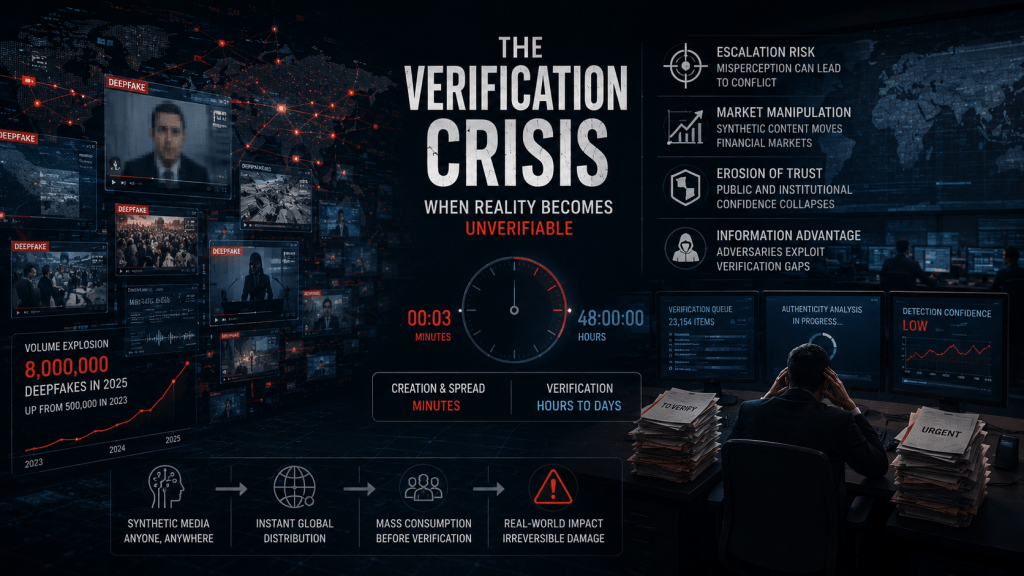
The foundational assumption of international communication — that a statement attributed to an actor represents what that actor said — is no longer reliable. The technology required to fabricate convincing synthetic audio, video, and official communications has become broadly accessible. The infrastructure required to verify authenticity at the speed at which synthetic content circulates does not exist. This gap is the defining governance challenge of the current information environment.
By Vladimir Tsakanyan, PhD · Center for Cyber Diplomacy and International Security · cybercenter.space
Diplomacy, intelligence assessment, and crisis management share a common operational prerequisite: the capacity to assign reasonable confidence to the authenticity of the communications, images, and statements that inform consequential decisions. This capacity has never been absolute. States have always managed the gap between what they observed and what was real, between what adversaries communicated and what they intended. The management of that gap — through established diplomatic channels, intelligence verification processes, and the slow accumulation of corroborated information — has been the foundational practice of international affairs.
The emergence of generative artificial intelligence as a broadly accessible production technology has introduced a qualitative change into this environment. The change is not the existence of fabricated content — disinformation predates the digital era by centuries. The change is the dissolution of the authentication layer: the aggregate of signals, institutional processes, and technical capacities through which states and international actors have historically been able to assess, however imperfectly, whether a communication is genuine. That layer is not merely under pressure in 2026. In specific domains and at specific operational speeds, it has ceased to function as a reliable verification mechanism.
The Scale of the Transformation
The quantitative dimension of synthetic media expansion provides the context for assessing its qualitative strategic implications. In 2023, an estimated 500,000 deepfakes were shared across digital platforms. By 2025, that figure had reached eight million — an increase of approximately 1,500 percent over two years. The growth trajectory was not driven primarily by state-sponsored actors deploying specialised capabilities. It was driven by the broad democratisation of generative AI tools that reduced the technical barrier to producing convincing synthetic media from a capability requiring significant expertise and resources to one accessible through consumer applications requiring minimal technical knowledge.
The World Economic Forum’s 2026 assessment of the information environment identified a specific qualitative threshold that the technology had crossed: synthetic video and audio content had eliminated the earlier tell-tale technical artefacts — inconsistent lighting, unnatural eye movements, audio phase irregularities — that previously allowed detection through visual or auditory inspection. Independent researchers and technical analysts working on information environments in active conflict zones confirmed in early 2026 that specific categories of fabricated content had reached quality levels at which human sensory assessment could no longer serve as a reliable detection mechanism.
The operational consequence of this threshold crossing is precise. Fabrication can be executed in minutes. Distribution across global digital networks occurs in seconds. Verification — the technical analysis required to assess whether a specific piece of content is synthetic — requires time measured in hours or, for sophisticated fabrications, days. The gap between these timescales is the space in which the verification crisis operates, and it is a gap that no detection technology currently available closes within the timeframe that consequential decisions require.
Analyst note
The economics of synthetic media production have inverted the historical relationship between the cost of fabrication and the cost of verification. Throughout the era of analogue and early digital media, producing convincing fabrications required resources that constrained their supply. Verification systems — editorial processes, official response channels, technical assessment capabilities — were designed for an environment in which the volume of fabricated content was bounded by production costs. Those costs have effectively reached zero for a growing range of synthetic content types. The verification architecture designed for constrained supply is now operating against unlimited supply. The mismatch is structural and is not addressable through incremental improvements to existing verification systems.
The Authentication Layer and Its Disruption
The authentication infrastructure of international relations developed over decades as an aggregate of practices and institutions rather than as a designed system. Official communications were authenticated through established diplomatic protocols. Imagery was assessed by trained analysts applying consistent methodological standards. Statements attributed to senior officials were verified through the cross-referencing of official sources, established media organisations, and technical intelligence that could confirm the authenticity of a communication independent of its content.
This infrastructure was imperfect. It was subject to manipulation, to analytical error, and to the inherent limitations of working with incomplete information under time pressure. But it provided a functional baseline — a set of practices that, taken together, allowed decision-makers to assign confidence levels to the information they received and act on something approaching verified knowledge.
What generative AI has disrupted is the evidentiary relationship between a communication and its attributed source. A video of a state official making a statement was previously evidence that the official had made the statement — imperfect evidence, subject to assessment and challenge, but evidence. The same video, produced in 2026 by a generative AI system, may be indistinguishable in quality from authentic footage while bearing no relationship to what the official said or did. The disruption is not merely to specific communications but to the epistemic foundation of the verification process itself: the assumption that the correspondence between a communication and its attributed source can be assessed through the properties of the communication.
Geopolitical risks in this environment are, as the Diplo Foundation’s analysis established, harder to quantify but potentially more destabilising than any individual instance of fabricated content. Synthetic statements attributed to senior officials can spread globally within minutes, shaping narratives, influencing public assessments, and affecting the information environment of decision-makers long before any official correction is issued. Even when identified as fabricated quickly, such content leaves residual impressions that subsequent corrections do not fully dispel.
The Financial Dimension: Synthetic Diplomacy
One of the most operationally immediate and economically consequential dimensions of the verification crisis has emerged at the intersection of synthetic media and automated financial systems — a domain that analysts have described as synthetic diplomacy.
Contemporary financial markets operate through automated trading architectures designed to respond to information signals including statements attributed to government officials, central bank communications, and geopolitical stability indicators. These systems process information inputs at speeds that no human verification process can match. A fabricated statement attributed to a finance minister, a synthetic audio recording attributed to a central bank official, or a deepfake video of a head of government can trigger automated market responses before any analyst, platform moderator, or official spokesperson has assessed its authenticity. By the time the content is identified as fabricated and official corrections are issued, the market movement it triggered has occurred. Real financial consequences have been produced by a synthetic cause.
This mechanism creates a category of financial risk that existing regulatory frameworks were not designed to address. Market regulations governing the dissemination of false information were developed for an environment in which producing convincing fabrications attributed to specific officials required significant resources and left detectable traces. Neither condition holds in 2026. The regulatory architecture for market integrity has not been updated to reflect the production economics of generative AI, and the gap between the speed of synthetic content distribution and the speed of regulatory response is a vulnerability that sophisticated actors are positioned to exploit with limited risk of attribution or consequence.
Crisis Management and the Misperception Risk
The most strategically significant application of the verification crisis is in the domain of crisis management — the practices through which states navigate periods of acute international tension while maintaining the communication reliability that de-escalation requires.
Effective crisis management has historically depended on two communication capacities. The first is the ability of decision-makers to assess, with reasonable confidence, what their adversaries have communicated — what positions they have stated, what orders they have issued, and what signals they have transmitted through official and back-channel diplomatic mechanisms. The second is the ability of both parties to a crisis to communicate credibly with each other and with third-party mediators, maintaining the reliability of their own communications as a prerequisite for any negotiated resolution.
Both capacities are now subject to systematic disruption through synthetic media. Fabricated content attributed to senior officials, circulating at scale during a period of acute tension, can reach decision-makers before verification processes have established its authenticity. The response to fabricated content — if that response is calibrated to the reality the fabrication depicts rather than to what actually occurred — constitutes a misperception event with real operational consequences. The Bulletin of the Atomic Scientists, assessing crisis communication dynamics in high-tension environments, identified the specific mechanism: even a fabricated image or statement, if it generates sufficient circulation before being identified as fabricated, increases the risk that decision-makers will respond to a representation of reality that does not correspond to actual events.
The risk is not merely that individual decision-makers might be deceived. It is that the information environment through which crisis management operates — the shared understanding of what has occurred that allows parties to a dispute to communicate about the same reality — can be deliberately fragmented by actors with both the incentive to prevent de-escalation and the capability to produce synthetic content at the required scale and quality.
Analyst note
The intersection of synthetic media and nuclear crisis management represents the application of this risk to its most consequential domain. The communication infrastructure through which states with nuclear capabilities manage acute confrontations depends on the reliability of the communications they exchange — the authenticity of statements, the integrity of signals, and the credibility of the verification processes that allow each side to assess whether the other’s communications represent genuine positions or deliberate deception. The introduction of broadly accessible synthetic media capabilities into this environment, without any corresponding development of authentication infrastructure specifically designed for crisis communication between nuclear-armed states, represents a structural vulnerability in the stability architecture of the international system. It has received substantially less governance attention than less consequential applications of the same technology.
The Detection Gap and Its Governance Implications
The detection ecosystem for synthetic media has expanded significantly since 2023, with the development of analysis tools that examine micro-expressions, audio phase characteristics, lighting consistency, and metadata patterns to identify synthetic content. These tools represent a genuine technical contribution to the verification challenge. They do not close the verification gap.
Detection technology operates at a structural disadvantage relative to production technology in the current environment. The generative AI systems used to produce synthetic content are continuously improved against the detection signatures that identification tools rely upon — an adversarial dynamic in which each improvement in detection capability is eventually matched by an improvement in production capability designed to evade it. More fundamentally, detection tools require processing time that exceeds, in most cases, the velocity at which synthetic content achieves its maximum impact. Content that is identified as fabricated forty-eight hours after generating millions of views and shaping the public understanding of an event has not been neutralised by its identification. Its consequences have already occurred.
The governance implication of this dynamic is that the verification crisis cannot be resolved through detection technology alone. Technical detection is a necessary component of the response. It is not a sufficient one. The broader response requires the development of authentication infrastructure — mechanisms that allow the authenticity of official communications to be verified at the point of origin, before distribution, rather than through post-hoc analysis after circulation has occurred.
Several technical standards provide a foundation for this approach. Cryptographic content authentication frameworks allow digital signatures to be attached to official communications at the point of creation, enabling recipients to verify authenticity without requiring forensic analysis of the content itself. Content provenance standards, developed through multi-stakeholder technical bodies, provide a framework for embedding verifiable origin information in digital media in ways that are resistant to removal or falsification. Neither framework has been deployed at the scale or across the categories of official communication for which authentication has the highest strategic value.
What the Governance Architecture Requires
A governance response commensurate with the verification crisis requires addressing its dimensions at the technical, institutional, and normative levels simultaneously — and recognising that responses calibrated only to the most visible and politically tractable manifestations of the problem will leave its most strategically significant dimensions ungoverned.
At the technical level, the priority is the development and international adoption of cryptographic authentication standards for official government communications — not as a replacement for existing secure communication protocols but as a layer that allows recipients of official communications to verify their authenticity through a mechanism independent of the content’s properties. The technical components of such a system exist. The governance architecture — the international agreements on key management, the standards for implementation, the mechanisms for revocation and recovery — requires development through multilateral technical bodies including ITU, ISO, and the relevant working groups of NIST and its international equivalents.
At the institutional level, the establishment of a standing rapid authentication capacity for crisis communications represents the most urgent institutional gap. A mechanism capable of providing authoritative and technically grounded assessments of the authenticity of communications attributed to senior officials during periods of acute international tension — housed in a mutually trusted international institution and operating on a timeline commensurate with the speed of synthetic content circulation — would address the most dangerous application of the verification gap. The institutional architecture for such a capacity does not exist. Its development requires both technical investment and the multilateral agreement necessary to establish its authority and credibility.
At the normative level, the extension of existing international frameworks for responsible state behaviour to specifically address state-sponsored synthetic media operations targeting official communications, crisis management channels, and financial systems represents the appropriate multilateral governance pathway. The framework of voluntary norms developed through the UN process on ICT security makes no reference to synthetic media. The UN Global Mechanism, as the successor to that process, provides the institutional vehicle through which norm development on synthetic media could proceed — if the political will to prioritise it exists among the mechanism’s member states. Connecting the synthetic media governance agenda to the existing cyber norms process would allow it to benefit from the procedural architecture already in place while extending that architecture to a domain whose strategic consequences the original framework did not anticipate.
Bottom Line Assessment
The verification crisis is not a technology problem awaiting a technology solution. It is a governance problem whose technical dimensions are instrumentalised by strategic actors whose interests are served by the absence of authentication infrastructure — and whose political dimensions have prevented the development of that infrastructure from receiving the priority its strategic consequences warrant.
The authentication layer of international relations developed over decades as a functional, if imperfect, foundation for the communication reliability that diplomacy, intelligence assessment, and crisis management require. The technology now exists to degrade that layer systematically, at scale, and at a cost that no production constraint limits. The governance architecture that might restore it — through technical authentication standards, institutional verification capacity, and multilateral norms specifically addressing synthetic media in strategic communication contexts — is at an early stage of development relative to the urgency the problem presents.
Eight million synthetic media items circulated in 2025. The figure for 2026 will be higher. The detection infrastructure is improving and remains structurally insufficient. The authentication infrastructure that would address the problem at its source does not yet exist at the international level.
The gap between the technology and its governance is the verification crisis. It is not self-correcting. It is not narrowing. And the consequences of managing strategic international communications in an environment where the authenticity of any communication can be credibly disputed will compound with every crisis in which the authentication infrastructure required to resolve that dispute is absent.
Synthetic Media · Deepfakes · Authentication · Verification Infrastructure · Crisis Management · Financial Security · Cyber Diplomacy · International Governance · Information Integrity · Vladimir Tsakanyan

Leave a Reply